

Culture in the Crosshairs
Mousiké technē: Why Chhayanaut Matters
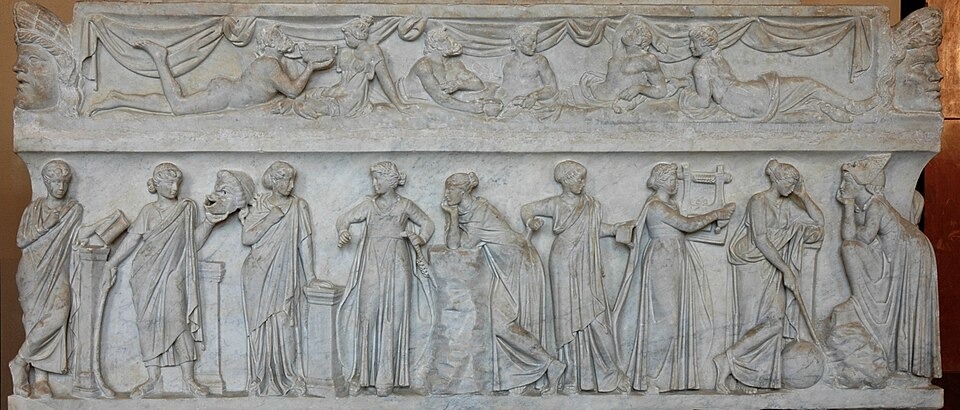
Mousiké technē – this particular idiom in ancient Greek used to convey the art of the Muses. Yes, the Muses were the nine deities of Greek myths who used to rule over the realm of arts and sciences- depicted frequently by Homer and Hesiod. Gradually, it was the Muse Polyhymnia who turned out to be the ‘Muse of music’ in comparison to the other muses. It is from this Greek phrase Mousiké technē that the Latin mūsica or old French musique are supposed to originate. Today’s English word music has its roots in the aforementioned words of different European languages.
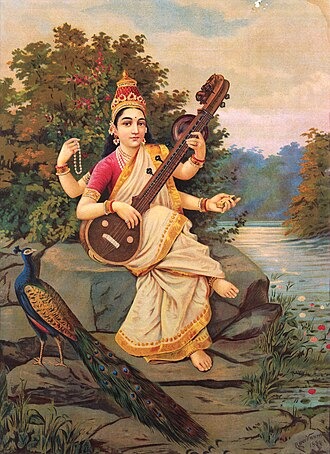
On the other hand, musical treasure trove of ancient India can be well found in the Vedic literature of Hinduism. In Indian myths, Goddess Swaraswati holds a Veena (lute) along with a book in her hands. She is acknowledged and worshipped as the icon Goddess of both knowledge and music in Hinduism. North Indian music, however, has come to interaction and mingling with the musical streams of Persia, Afghanistan and central Asia over the millennium. Indian music has been successfully blended with the music of those regions since the warriors and Sufi missionaries from different parts of the middle-east and central Asia have come to India and gradually settled here.
Our sub-continent is immensely blessed to have great predecessors like Amīr Khusrau or Tansen in the arena of music and their valued teachings of harmony, tolerance and co-existence. Those lessons are still being carried out by thousands of lyricists and musicians of Hindustani classical music. Hindustani classical music stands out to be the ‘pole star’ of human values and communal harmony where a Muslim lyricist or musician easily chants the lyrics in praise of Hindu deities and Hindu musicians or lyricists to easily sings the eulogies for Muslim saints, angels, Prophet Hazrat (SM), Ali or Allah. The classical music of South India or Carnaticmusic, however, has not been that much blended with the Persian, central Asian or middle-eastern musical schools.
In Bengal (comprising of today’s Bangladesh, West Bengal of India and Bengali speaking population of Tripura and Assam of India and Bengali speaking diaspora across the world), we have a very rich heritage of folk songs (Bhatiali, Bhawaiya, pala gan, Baul songs, mangal kavya, murshidi, jari, sari etc.) along with the North Indian classical music as foundation course for every middle-class based music learner, songs of ‘Pancha Kabi’ or Tagore, Kazi Nazrul, Dwijendra Lal, Rajani Kanta and Atul Prasad as well as modern Bengali songs and ‘Jibonmukhi gaan’ or the songs of alternative trend.
Readers, please, don’t be impatient! You may wonder that where is the mention of Chhayanaut here? Yes, now we are coming to the point. The largest musical school of Bangladesh has been passionately serving Bengali culture and tradition since its inception in 1961. The institution commenced its journey to safeguard the musical tradition of Bengal when the dominant Pakistani rulers were trying to curb our cultural spirit in a number of ways. Today it may seem very easy but it was not so easy in 1964 to start celebrating Bengali New Year at the Ramna greens despite the Pak military regime’s red eyes against Bengali tradition and culture. Since 1964, the organization has been observing Bengali New Year till today. It also observes the birth and death anniversaries of Rabindranath Tagore (25th Boishakh and 22nd Srabon) along with the festivals on prominent Bengali seasons like Autumn and Spring festivals or organizes musical soirees on monsoon.
Actually, in the decades of the 1960s, the military regime of Pakistan imposed a ban on broadcasting of Tagore’s songs in the then-East Pakistan radio. In is to defy the ban that the celebrated Rabindra Sangeet singer Kalim Sharafi, with some of his comrades, commenced the journey to establish Chhayanaut, an organization devoted to music, drama, and dance. In spite of Pakistani opposition, branches of Chhayanaut sprouted secretly across district towns like an underground platform. After the centenary celebration of Rabindranath Tagore in 1961, a group of some ardent cultural activists, among them Mokhlesur Rahman (popularly known as Sidhu Bhai), Shamsunnahar Rahman, Sufia Kamal, and Wahidul Haq, endeavored to form a progressive cultural organization. The name "Chhayanaut" (meaning the shade of a tree and also a ‘Raga’ in the North Indian classical music and mentioned in Kazi Nazrul Islam’s forever immortal poem ‘Bidrohi’) was proposed by Saeedul Hasan.
In the blood drenched days of Liberation War
When the Liberation War broke out in 1971, some prominent figures of Chhayanaut, including Wahidul Haque and Sanjida Khatun, were compelled to seek refuge over the frontiers. They established the Mukti Sangrami Shilpi Sangstha (Freedom Fighters' Artists' Association) in Kolkata, West Bengal. The group used to organize cultural programmes on a regular basis in the refugee camps and freedom fighters' bases through channelizing music and art to encourage the spirit of resistance. This historic cultural movement of immense historical value later became the core topic of subject of filmmaker Tareque Masud’s documentary Muktir Gaan.
Independent Bangladesh (1971 - Present)
Since after Bangladesh’s independence, Chhayanaut was permitted to act on the premises of the University Laboratory School and College at the University of Dhaka for around three decades. It was made possible by Dr. Nurun Nahar Faizunnnesa, then principal of the school, with formal approval from Professor Mozzafar Ahmad Chowdhury, the Vice Chancellor at the time.
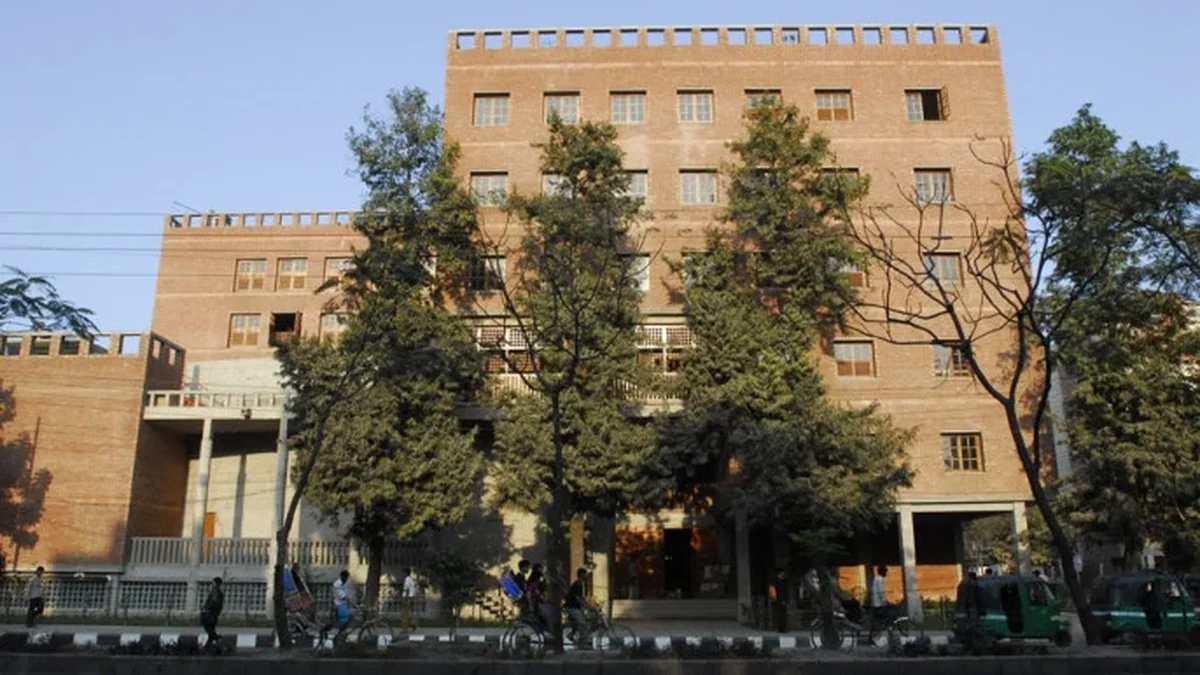
In 1999, the then Government of Bangladesh allocated one bigha (0.33 acre) of land to acknowledge the institution’s remarkable offerings to Bengali cultural development over four decades. The Chhayanaut Sanskriti Bhaban was established on this land, designed by architect Bashirul Haq.
Chhhayanaut, however, underwent lots of attacks and aggression in course of time- like a great banyan tree. On 14 April 2001, during Chhayanaut’s Pohela Boishakh programme at Ramna Batamul, a terrorist attack was targeted at the artists. As the song “E ki Oporup Rupe Ma Tomay Herinu Polli Jononi” was being played, two bombs did burst out at the venue, while the show was being broadcast live on Bangladesh Television (BTV). Seven people instantly died on the spot with around 50 others injured. The Islamic fundamentalist group Harkat-ul-Jihad al-Islami (HuJI) orchestrated the mayhem.
The attack still continues as the largest musical school of Bangladesh was violently attacked by an extremist mob again on 19th December night.
‘We, teachers-students-staffs of Chayyanaut, got out of the institution by 9:00 pm after finishing our day long duties. Only the night guards were there- very few in number. The mobs attacked by 11:00 PM to 11:30 PM. Look at the musical instruments- too many harmoniums, tablas, micro-phones gutted down, destroyed and demolished- also plundered! No less than four crores’ worth musical instruments have been destroyed,’ said two young teachers of the organization on the condition of anonymity.
‘The real damage, however, took place in the archive section. We cannot even fathom the length of losses incurred there. Many invaluable books or musical manuscripts have been burnt to ashes,’ they added.
I talked to them on last Tuesday (i.e., on 23rd December) after the one-hour long protest meeting of the organization through songs of all genres (Tagore’s songs, songs by Kazi Nazrul Islam, folk songs or political songs). The artists of the institution replied too aesthetically against the brute, savage forces of the extremists!
To surround the ‘cities’ by the ‘villages’
For long many years I have heard all the Maoist jargons like ‘Cities need to be surrounded by the villages’ from a handful of ‘Marxists’ in Shahbagh Aziz super market or other dens of the ‘revolutionaries.’ It has been translated into action- but not by them, by their fellow ‘comrades’ in the faith based extremist groups. These same extremists torched the Ustad Allauddin Khan Sangitangan at Brahmanbaria of broader Comilla by mid-January of 2016.
Within a nine-years’ long span of time, the extremists now dare to attack on ‘Chhayanaut’. So definitely the ‘villages’ have been able to surround the ‘cities’ to the extent that Ustad Alauddin Khan’s successor and an artist of Maihar gharana Siraj Ali Khan has recently declared to not come to Bangladesh ever again.