

From 1971 to Rooppur Nuclear Project
Bangladesh-Russia Friendship Survives the ‘Test of Time’!
It is difficult for the historians of Bangladesh to deny the benevolent role of the then Soviet Union (USSR) for executing its veto power in UN Security council during our Liberation War of 1971. Despite overlooking of a ruthless genocide in Bangladesh by super power USA and her allies, Russia extended her support to the war affected people of Bangladesh and successfully countered the US plan to pass a security Council motion against India for ‘commencing the war.’ Russia got prepared even to send her Pacific Fleet to aid India during our Liberation War (1971) as a response of any U.S. attempt to send its Seventh Fleet to our ‘Bay of Bengal.’
The flow of support did not end there. No sooner had Bangladesh become independent, Moscow supported us to have an entry into the UN. Hundreds and thousands of Bangladeshi students have been provided with full scholarship for higher studies in different universities of USSR since 1972 to the last days of USSR.
Apart from offering scholarships to a good number of Bangladeshi students each year, it was Russia who launched and carried out a two-year long demining operation from 1972-74. Around 800 naval officials, mainly from the Pacific Fleet, stayed in Chittagong for these two years. The then Soviet scaffold workers and divers worked relentless, even at the cost of their lives.
The 9-months’ long war of 1971 destructed 12 out of the 18 moorings of the Chittagong port and more than 40 water vessels sank near the port.
‘’Chittagong Port Comes into Life Again,’ a memoir by V.P. Kazurin and V.A. Mochanov depicts the austerities witnessed by Russian sailors in Chittagong. The navigators had to deal with not too comfortable living conditions, storms, high currents, heat and humidity and zero visibility in the silted water of the Bay of Bengal.
The Russian team of seamen, under the direction of Rear Admiral Stanislav Zuenko, successfully completed the utter restoration of the port and they trained up the port people of Chittagong simultaneously. Our port commenced working within three months of the starting of the Russian demining process. Monthly operations of the port surpassed pre-war levels within two years of the Russian demining procedure.
Yes, our Bay of Bengal is the witness of death of Yury Redkin, a navigator of mid-20s. He was the only Russian casualty during the two years’ long demining process in Bangladesh. He was entombed in today’s Bangladesh Naval Academy.
Tales of the Russia-supported Power Plants in Bangladesh: From Ghorasal to Ruppur
Not only offering scholarships to Bangladeshi students or demining the Chittagong ports, one-fourth of the total power output in Bangladesh used to be derived from the Siddhirganj and Ghorasal power plants till 2016, which were constructed by the Soviet Union in the mid-1970s.
The Rooppur Nuclear Power Plant: Tale of a long journey!
The site at Rooppur, by the River Padma, was selected more than 50 years ago for a 10MWe prototype nuclear power plant on utterly political grounds by the then
Pakistani Junta (in 1961). In 1963, the Rooppur village of the Pabna district was chosen for the planned plant and 254 acres (103 ha) of land was undertaken for this purpose. The plan was to establish a 200MW nuclear power plant in the selected site. Discussions were held with the Government of Canada from 1964 to 1966. Discussions with the governments of Sweden and Norway were also being continued on in those years. However, no actual advancement took place. In 1970, the project was thrown away.
After Independence of Bangladesh, the Government of Bangladesh commenced conversation with the Soviet Union in 1974, but no agreement could be made. In 1976–77, the French company Sofratom carried out a feasibility study and established the project at Rooppur workable. In 1980, a 125 MW nuclear power plant project got approval. However, this endeavour could not also be implemented. In the 1987-88 period, another feasibility study was carried out and the decision was undertaken to build a 300 to 500 MW nuclear power plant. In 1998, steps were taken to build a 600 MW power plant. The nuclear action plan was granted approval in 2000.
In 2005, Bangladesh signed a nuclear cooperation accord with China. In 2007, the Bangladesh Atomic Energy Commission (BAEC) offered two 500 MW nuclear reactors for Rooppur by 2015. In 2008, China offered funding for the project. In lieu of it, the Bangladesh government began conversation with the Russian government after a year and on 13 February the two governments scribbled a Memorandum of Understanding (MOU). Rosatom said they would start construction by 2013.
In 2011, International Atomic Energy Agency carried out IAEA Integrated Nuclear Infrastructure Review (INIR) mission in Bangladesh. Then IAEA permitted a technical assistance project for the Rooppur nuclear power plant. In 2013 a group of Bangladeshi scientists and the global diaspora conveyed their grave concern over the security and financial feasibility of the plant. Several distinct issues were put on the table for discussion ranging from the impropriety of the site to the antiquity of the VVER-1000 model offered, contentious economic arrangements and a shortage of agreement with Russia over nuclear waste disposal.
In 2016 ground preparation work started. The $12.65 billion contract was 90% sponsored by a loan from the Russian government. On 4 November 2017, Bangladesh Atomic Energy Commission obtained, from Bangladesh Atomic Energy Regulatory Authority, the design and construction license of Unit 1, leading the way for the nuclear island first concrete pour.
When the COVID-19 pandemic did hit Bangladesh in early 2020, many projects such as the Dhaka Metro Rail were thwarted, but the Rooppur Nuclear Power Plant persisted on track to be finished by 2023. Advancement in this period comprises Rosatom's engineering company Atommash finishing hydraulic tests for Rooppur unit 1.
Safety/Security Measures undertaken in Rooppur:
-VVER-1200/523 is one of the latest Generation III+nuclear reactor. Design feature of the nuclear reactor is layered safety barriers preventing escape of radioactive material. The reactor has five layers:
-Fuel pellets: Radioactive elements are retained within the crystal structure of the fuel pellets.
-Fuel rods: The zircaloy tubes provide a further barrier resistant to heat and high pressure.
-Reactor shell: a massive steel shell encases the whole fuel assembly hermetically.
-Core catcher: A core catcher is a device provided to catch the molten core material (corium) of a nuclear reactor in case of a nuclear meltdown and prevent it from escaping the containment building.
-Reactor building: A concrete containment building is the last line of defence. It prevents escape of radiation. It also protects from external damages.
April 29th of 2026: Bangladesh Entering into atomic energy phase!
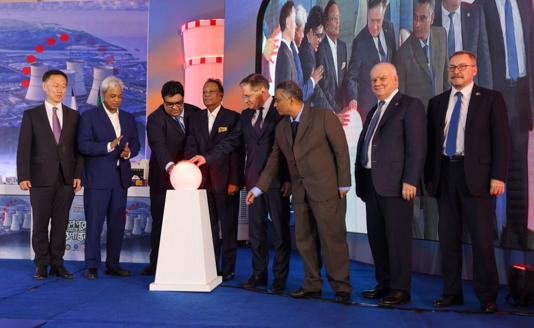
The fuel On April 29th, Bangladesh officially stepped into the peaceful atomic energy epoch with the beginning of nuclear fuel loading at the first unit of the Rooppur Nuclear Power Plant. It enabled us to be member of a little group of nuclear power-producing states in South Asia. With this progress, we have also become the third nation in South Asia, following India and Pakistan, to be able to accelerate nuclear energy for power generation, marking a strategic shift as our state aims to ensure long-tenured, low-carbon electricity for its progressing economy.
The loading event at Rooppur, approximately 160 kilometers from Dhaka, was graced by General Alexey Likhachev, Rosatom Director and Mr. Fakir Mahbub Anam, Bangladesh’s Minister of Science and Technology. Together they allowed symbolic approval to load fresh nuclear fuel into the Unit 1 reactor core.
"Today, Bangladesh has joined the club of countries that use the peaceful atom as a reliable source of sustainable development," Likhachev mentioned as he elaborated, "Rooppur Nuclear Power Plant will definitely become the most important element of the energy system of the country."
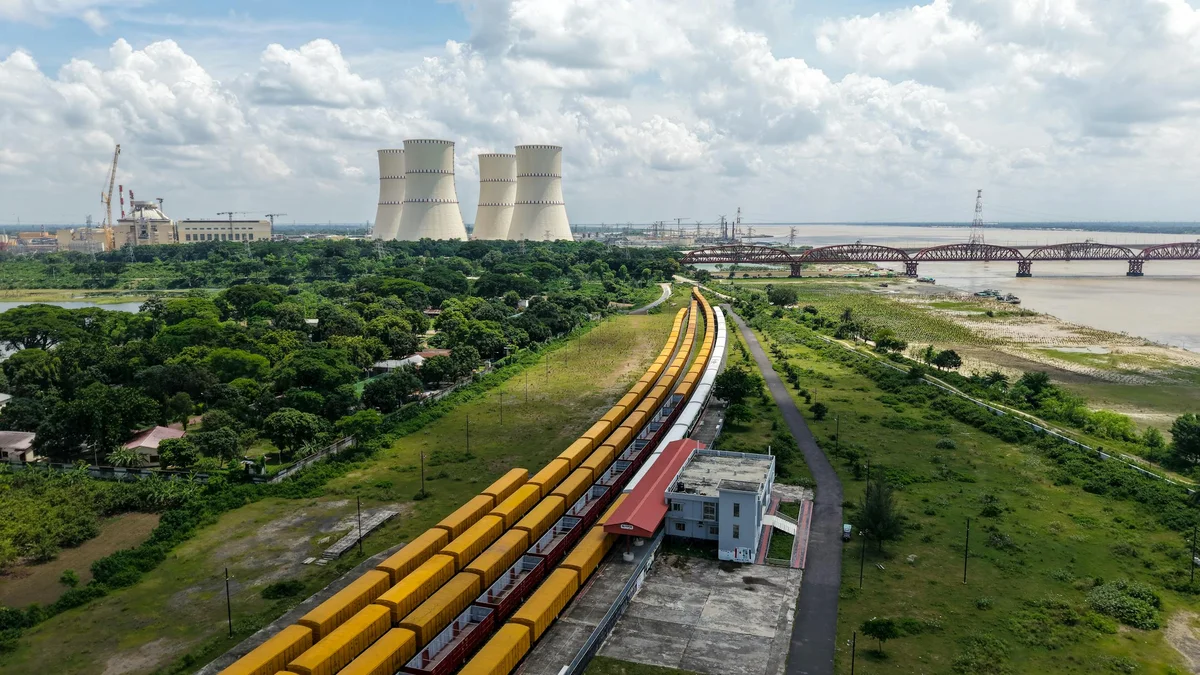
Rooppur is capacitated with two VVER-1200 reactors, each with the power to generate around 1,200 megawatts, providing the plant a combined output of 2,400 megawatts. What is even more suprising but equally logical that Bangladesh's first nuclear reactors are founded on even more advanced technology than the reactors India initially obtained from Russia for the Kudankulam Nuclear Power Plant. While Kudankulam Units 1 and 2 use VVER-1000 older generation reactors, Rooppur has jumped straightly to the newer VVER-1200 Gen III+ design.
"The peaceful utilisation of nuclear energy will play a vital role in ensuring national energy security, accelerating industrialisation and fostering the growth of a technology-driven economy," Bangladesh's Science and Technology Minister Fakir Mahbub Anam observed, "The Rooppur project stands as a symbol of Bangladesh's scientific advancement and demonstrates our readiness and capability to harness advanced technologies responsibly and effectively."
For Bangladesh, where power consumption demand is on rise for its rapid industrial growth and fast paced urbanisation, nuclear energy presents a steady, baseload alternative to fossil fuels. Once totally operational, Rooppur is supposed to furnish a vital share of the country's total electricity, endorsing energy security while also playing the role of catalyst to carbon emissions.
Rosatom, the Russian agency acting as both the general contractor and general designer of the Rooppur plant, narrates the project as part of its wider strategy of extending peaceful nuclear cooperation with partner states. VVER-1200 reactors are already acting in Russia and Belarus, with similar plants under construction in Egypt, Turkey, Hungary and China.
"For Rosatom, this project is another important step in developing peaceful nuclear power and in strengthening friendly relations with our foreign partners," Likhachev noted, saying that the company expects long-term partnership for mutual aid and cooperation with Bangladesh.
The Rooppur project is being implemented under a general contract signed on December 25, 2015, and presents one of the largest infrastructure investments in Bangladesh's history. Apart from power generation, the fuel loading milestone signifies wider metaphorical weight for Bangladesh.
As Bangladesh takes preparation for grid-connected nuclear electricity in the coming months, Rooppur will not serve us as merely a power plant, but as the indicator of our entry into a new epoch of technological maturity, joining India and Pakistan as South Asia's peaceful nuclear power generators.
India too played a behind-the-curtain but pivotal role in preparing Bangladesh's human resources for safe nuclear operations at Rooppur by offering trainings to Bangladeshi engineers and scientists under a trilateral cooperation framework (i.e., between India, Bangladesh and Russia).
What the critics say?
Yes, none can deny that Chernobyl nuclear disaster happened in Ukraine, U.S.S.R. by the middle of the eighties. On Friday 11 March 2011 the Great East Japan Earthquake, which measured 9.0 on the Richter scale, caused a 15-metre tsunami that disabled the power supply and prompted three reactor meltdowns at the Fukushima Daiichi plant. Official figures suggest that more than 1,000 deaths occurred as a result of an evacuation process that displaced more than 100,000 people. Subsequent investigations have suggested that the infrastructure and risk forecasting were inadequate for such a devastating natural disaster. It was only the second accident in history to receive the most severe Level 7 rating.
But time has progressed and technologies are far more advanced now. And nuclear power is such a ‘necessary evil’ which every modern state wishes to have to earn dignity and respect in the global community. And Bangladesh has achieved it with the strong, friendly support from Russia. Bangladesh feels really too grateful to Russian President Vladimir Putin and the people of Russia!
Besides ‘Rosatam’, other major Russian companies also have a presence in Bangladesh. Gazprom is helping develop 10 gas fields of the Petro-Bangla Corporation.
Acknowledgements: