Bangladesh in the blood-drenched March: Counting Women’s Condition!
Thus Spoke Zarathustra- Thus Spoke Sheikh Mujib
‘Write my residential address of Dhamondi-32 on your envelopes as your parental abode,’ thus spoke Zarathrustra- sorry- thus spoke Bangabandhu to the hundreds and thousands of ravished women of 1971 whom our traditional, patriarchal society instantly rejected after a blood drenched war of nine long months.
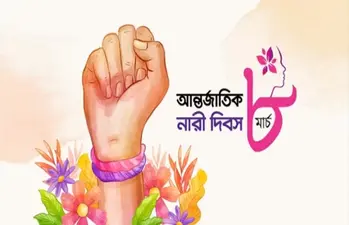
If April is ‘the cruelest month,’ as depicted by T.S. Eliot, March is a month of immense courage and resilience for the people of Bangladesh- full of fire and blood that reminds one of the vibrant Krishnachura petals. Be it the day of 7th March of call for our Liberation War by Bangbandhu Sheikh Mujibur Rahman, 8th March or the ‘International Women’s Day,’ 17th March or the birthday of our Father of the Nation, 25th March or the day when a terrifying genocide suddenly commenced against the Bengalis and finally the 26th March- this month contains series of bloodshed and massacre, heroic call for the right to independence and armed resistance, gender equality and what not? It is on 26th March of 1971 that we started replying to the invader Pak army’s brutal and lethal killing against the Bengalis and again on the 17th March of 1972 that the Indian army was withdrawn from Bangladesh to comply with Bangabandhu’s request to the then Indian Prime Minister Mrs. Indira Gandhi.
Even the celebrated races like Germans, Japanese or East Europeans too had to forbear with the US or the then USSR army bases within their territories in silence. Only Bangladesh could make such a political and diplomatic move with the ‘friendly army in Liberation War’ through sheer courage of Bangabandhu.
The story of women of Bangladesh, however, is a profoundly saddening tale of rape and survival, social stigma and mass abortions. Yes, our predecessor women had to rise again like a phoenix from the ashes and army bunkers of the 1971. And how far we have progressed? And how many times we fell down? What is the condition of Bangladeshi women in different aspect of development and progress indicators since the ‘much acclaimed July Uprising of 2024?’ Let us have a quick reality check:
Violence Against Women and Girls:
This year the ‘International Women’s Day’ started in Bangladesh with the horrific rape incident of Ira, a minor child from Sitakunda, Chittaong whom a neighboring man (a cadre of fundamentalist Jamat and recently released from prison of July 2024; he was earlier put into jail on charge of another child rape) took to the nearby Sitakunda eco-park with consent from her parents, raped her and tried to slaughter her. The ill-fated child still tried to save her life and began running towards her home with her half-slaughtered neck. However, some construction workers within the park, noting the blood- soaked child, immediately sent her to the nearby hospital but she expired after two surgeries.
According to the monthly report on ‘Violence Against Women and Girls’ by Bangladesh Mahila Parisad (BMP), around 32 women and girls were killed in the month of February alone. Of them, nine were girls under 18.
The BMP report, in addition, states that a total number of 183 women and girls underwent multiple forms of violence in February. Of them 73 are girls and 110 are women. Number of total rape victims was 32 of whom four minor children were killed after rape.
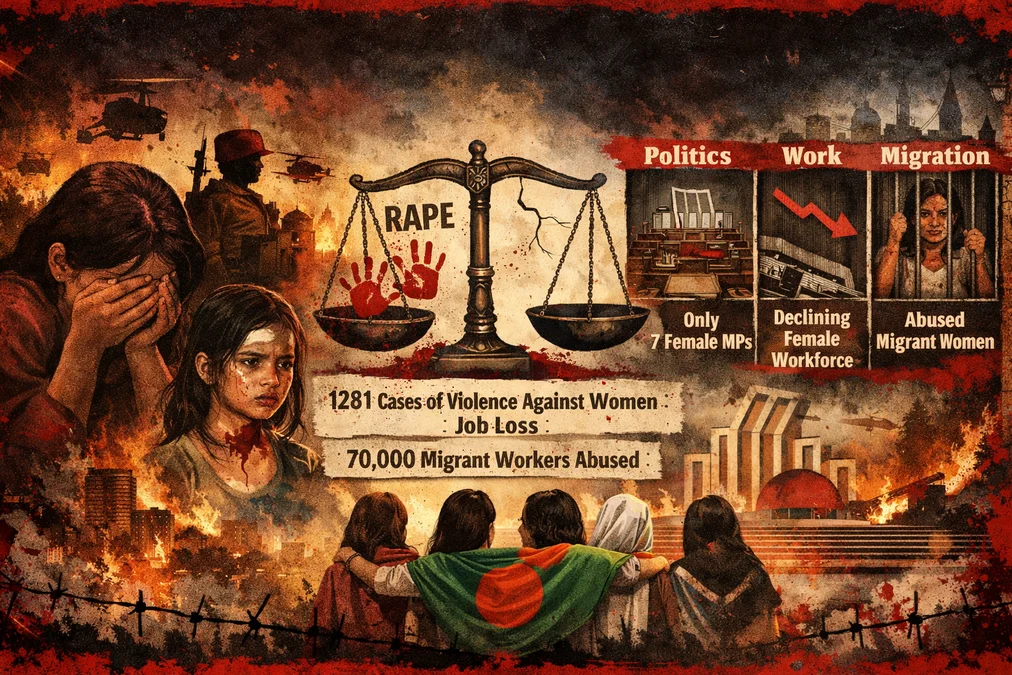
According to police, around 1281 cases of ‘Violence Against Women and Children’ were filed in January while the number 1248 in last December (source: 8th March, Bangla Tribune).
Meantime, while Ira was fighting for her last breath in the hospital, some vested quarters tried to spread misinformation and communal hatred on social media. Such groups tried their best to propagate a rumor that Ira was being taken to a temple within the eco-park for slaughtering before the deity.
The tragic death of Ira took place at a time when the entire world is gradually being engaged in a war in Iran, involving the sustainability question of Khomeni regime who caused death of Mahsa Amini and subsequent 531 protest-deaths in that land around three years ago.
Women’s Participation in the Labour Market
Bangladesh's labour force shrank by 17 lakh in just one year, with women accounting for most of the decline, according to the final report of the BBS's Labour Force Survey 2024.
The report shows that the total labour force stood at 7.17 crore in 2024, down from 7.34 crore the previous year. Male participation remained largely unchanged at 4.8 crore, compared with 4.81 crore in 2023. Female participation, however, fell sharply from 2.53 crore to 2.37 crore over the same period. This marks the first contraction in the country's labour force since 2010. Between 2010 and 2023, the labour force expanded by more than 1.6 crore, driven largely by rising female participation, which grew from 1.72 crore in 2010 to 2.53 crore in 2023 (https://www.business-humanrights.org/en/latest-news/bangladesh-womens-labour-force-participation-declines-sharply-experts-cite-jobless-growth-structural-barriers-and-shrinking-opportunities-in-manufacturing/).
Women’s participation in the parliament (1973-2026)
According to a report of ‘Bangladesh Feminist Archives,’ Women’s direct representation in Bangladesh’s parliament has fallen to one of its lowest levels in recent history. In the 13th parliamentary election, only seven women were elected out of 297 seats, despite women constituting nearly half of the electorate. A total of 1,981 candidates contested the election, but only 81 were women, just 4.08 percent of all candidates.’
This marks a steep decline from previous elections. In 2018, 22 women were directly elected; in 2024, that number fell to 19. Earlier parliaments also saw higher participation, with 18 women elected in 2014 and 19 in 2008. The current result reflects a long-term downward trend in women’s electoral success through direct voting, the report further added.
Women’s Representation in the Banking sector
At the end of June 2025, the number of women employees in Bangladesh's banking sector decreased by 4.96% to 35,782, down from 37,649 in December 2024. Their share of the sector's workforce also declined slightly to 16.78% from 17.57%. Meanwhile, only 10.25% of women bankers hold top positions, highlighting the persistent gender disparity in leadership roles (https://www.tbsnews.net/infograph/numbers/female-workforce-banking-drops-1678-1377916).
Condition of Women Migrant Workers:
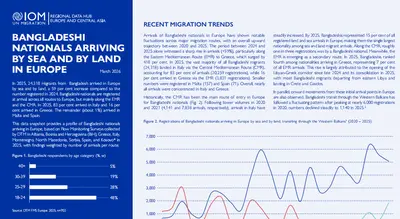
Around 70,000 female migrant workers returned back home in last seven years after going through severe forms of torture from abroad, according to a report of the Daily Samakal on March 8th.
Another report of the Ministry of Home suggest that more than 6000 women have been subject to trafficking during 2012-2025.
It is now clear like broad day light that a so called ‘rightist uprising’ took place in July 2024 through unholy marriage between various extremist groups and a section of ultra-leftist circles who basically serve the purpose of the far rights. Derogatory shift in the lives of women and various ethno-religious minority as well as third gender groups of people uphold this basic fact.
Bangladesh passes through a turbulent and bleak epoch of her history! Only time can determine about our women’s resilience to overcome it.