


When Death Has No Name: 643 Unidentified Bodies Found in Dhaka in a Year
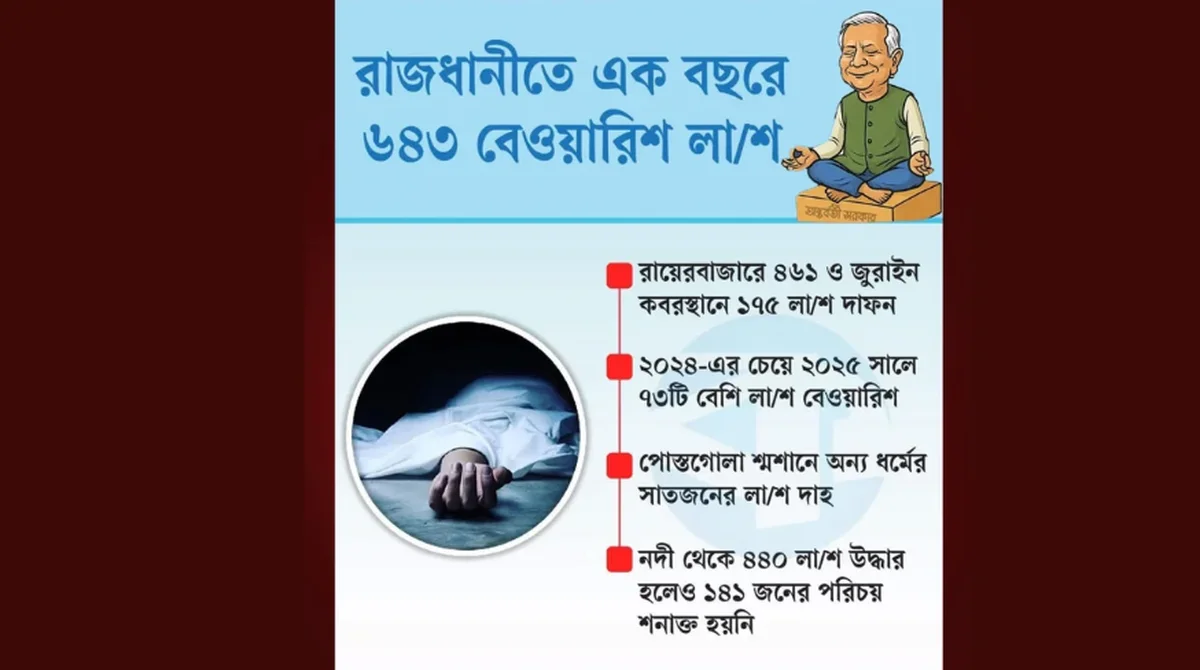
A grim picture of unidentified deaths has emerged in the capital, Dhaka. In 2025 alone, 643 unclaimed bodies were recovered from the capital and buried or cremated. On average, nearly two people are dying every day without identification whose names, addresses, or causes of death remain unknown in most cases.
According to data from Anjuman Mufidul Islam, among these bodies, 461 were buried at Rayerbazar Cemetery and 175 at Jurain Cemetery. The bodies of seven people from other religions were cremated at the Postagola crematorium. The figures show that, on average, the last rites of 54 unidentified individuals were completed every month. In the previous year, 2024, the number stood at 570—an increase of 73 bodies in one year.
These statistics have emerged at a time when allegations of rising violence and crime across the country are intensifying. Data from Police Headquarters show that between September 2024 and December 2025—a period of 16 months—4,732 murder cases were recorded nationwide. On average, nearly 2,500 unnatural death cases are being filed every month.
According to experts, political conflict and violence have increased ahead of the elections, which is impacting the number of unidentified bodies being recovered. The human rights cultural organization (MSF) alleges that in most cases, law enforcement agencies consider their responsibility complete immediately after recovering the bodies. There remains a severe failure in identifying victims, conducting proper investigations, and ensuring justice for the killings.
The situation is even more alarming in Narayanganj. Although 440 bodies were recovered from rivers last year, the identities of 141 individuals have yet to be determined. River police say that due to the lack of evidence and identification, investigations into most murder cases come to a standstill.
The media wing of the Dhaka Metropolitan Police said that when a body cannot be identified, it is handed over to Anjuman Mufidul Islam after completion of legal procedures. However, human rights organizations question whether “legal procedures” merely mean quick burial.
The Police Bureau of Investigation (PBI) and crime experts say that the absence of a central database, delays by families in reporting missing persons, and the lack of modern forensic capabilities are contributing to the rise in unidentified deaths. Many rivers have seemingly turned into “dumping grounds” for criminals.
According to analysts, these statistics are not merely numbers of deaths—they represent a horrifying reflection of the state’s investigative capacity, human rights protection, and the culture of impunity.