
Drop in English, Math Teachers Despite Rise in Educational Institutions

The number of English and mathematics teachers at secondary-level educational institutions in Bangladesh has declined over the past 13 years, despite students’ consistently poor performance in these two core subjects in public examinations.
Between 2011 and 2024, the number of English teachers at junior secondary schools, secondary schools, and the school sections of secondary schools and colleges decreased by 14,673, while the number of mathematics teachers fell by 1,607.
During the same period, the number of such educational institutions increased from 19,070 to 20,631, and the number of students in these institutions rose from 7,510,218 to 8,979,009.
The number of teachers with subject specialisation in English and mathematics has also remained low.
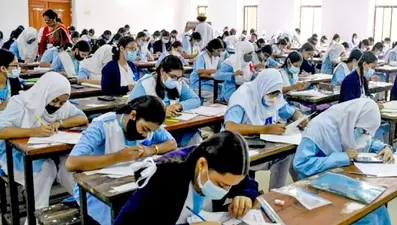
According to education experts, the shortage of English and mathematics teachers is a major reason behind students' weak performance in these two subjects in Secondary School Certificate (SSC) and Higher Secondary Certificate (HSC) examinations.
They attributed the teacher shortage to neglect of the education sector, bureaucratic delays in teacher recruitment, and low salaries and benefits. As a result, many graduates in English and mathematics, who are in high demand in the job market, are reluctant to enter the teaching profession.
This year’s public examination results again revealed students’ poor grasp of these subjects, the experts said, adding that weakness in English and math affects not only academic performance but also students' future employability.
Officials at education boards confirmed that most of the unsuccessful SSC and HSC candidates failed in English and mathematics.
In Bangladesh, English is a compulsory subject from pre-primary to higher secondary level, and mathematics is mandatory from pre-primary to Class X.
According to the Bangladesh Education Statistics 2024, published by the Bangladesh Bureau of Educational Information and Statistics (BANBEIS), a total of 59,791 teachers were teaching English across 20,631 junior secondary and secondary-level institutions in 2024, averaging 2.90 English teachers per institution.
In contrast, in 2011, there were 74,464 English teachers at 19,070 institutions, with an average of 3.9 teachers per institution.
For mathematics, in 2024, there were 61,707 teachers with an average of 3.14 per institution, compared to 63,314 teachers in 2011 with an average of 3.3 per institution.
Professor Md Fazlur Rahman, a faculty member at the Institute of Education and Research, University of Dhaka, said that education remains the most neglected sector in Bangladesh.
“Even under the current interim government, no reform commission has been formed for the sector,” he said, noting that bureaucratic red tape has left many teaching posts vacant.
Professor Fazlur added that graduates in English and math are less inclined to work as schoolteachers due to low pay and benefits. Instead, they pursue higher-paying jobs, leaving the teaching profession mostly to graduates in other subjects who often lack the expertise and training to teach English and mathematics effectively.
He further noted that insufficient in-service training also hampers teaching quality in these core subjects.
This year, the combined pass rate of 68.45% in the SSC and equivalent exams was the lowest in 15 years, following the 67.41% rate in 2009. Most failed students in these exams had failed in mathematics.
In the HSC and equivalent exams in 2024, the combined pass rate dropped to 58.83% from 77.78% in the previous year — a decline of nearly 20 percentage points.
The 57.12% pass rate in the general HSC boards was the lowest since 2005, when the rate was 59.16%.
Education board officials reported that most unsuccessful HSC candidates under the Dhaka board failed in English. In Rajshahi board alone, 32,000 candidates failed in one subject, and 22,000 of them failed in English.
Professor Khandaker Ehsanul Kabir, chairman of the Bangladesh Inter-Education Board Coordination Committee and head of the Dhaka Education Board, stated that English remains the subject with the highest failure rates in SSC and HSC exams every year.
He also noted that many students are weak in Bangla as well and develop a fear of English, viewing it as a foreign language.
Professor Fazlur Rahman emphasized that teachers’ salaries need to be raised.
He added that the COVID-19 pandemic in 2020 and the uprising in 2024 disrupted both teachers and students, while the abrupt shift from the 2021 curriculum to the 2012 curriculum in mid-2024 further affected students' academic performance.
According to BANBEIS 2024, only 16.99% (10,153) of English teachers had studied English as a core subject. Among them, 7.32% (4,374) had a BA (Honours) in English and 9.67% (5,779) held a Master’s in English.
In 2011, just 8.67% (6,459) of English teachers had core academic training in English — with 3.32% (2,472) holding a BA (Honours) and 5.35% (3,987) a Master’s degree.
For mathematics, in 2024, only 14.66% (9,046) of the teachers had studied it as a core subject. Among them, 7.08% (4,370) had a BSc (Honours) in maths, and 7.58% (4,676) had a Master’s in the subject.
In 2011, 8.75% (9,046) of maths teachers had academic training in the subject — 3.74% (2,365) with a BSc (Honours) and 5.01% (3,169) with a Master’s degree.