Bangladesh Drops Three Spots in 2026 Press Freedom Rankings
Bangladesh has dropped three places in the Media Freedom Index this year.
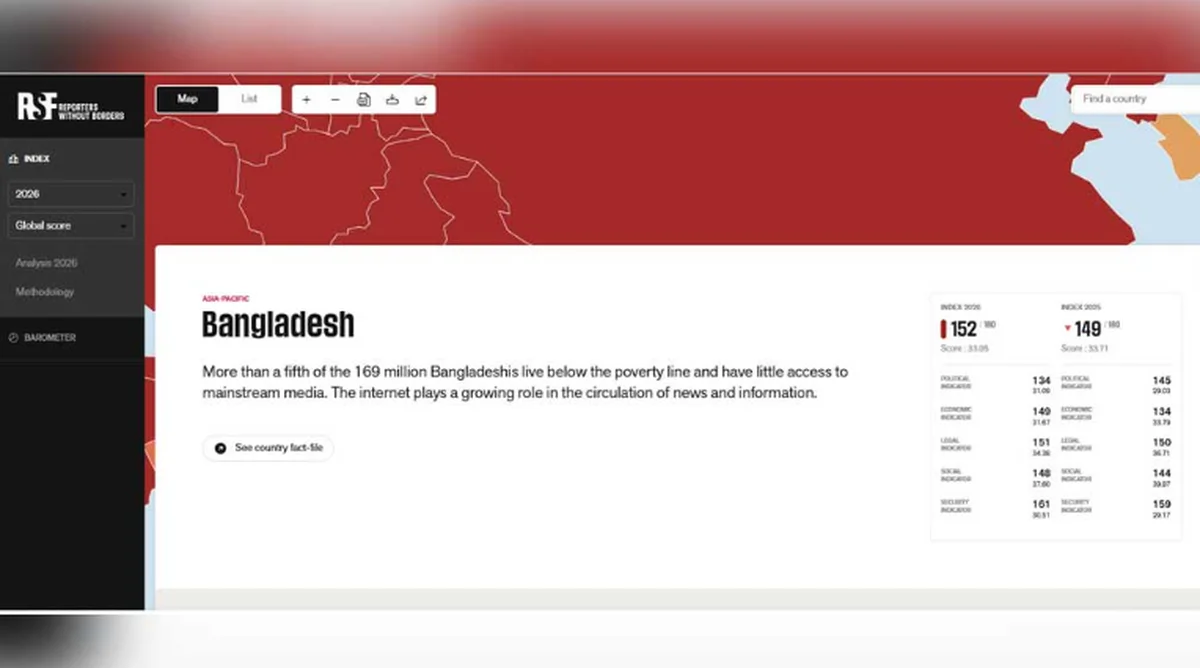
Out of 180 countries, Bangladesh now ranks 152nd, down from 149th last year.
Ahead of World Press Freedom Day (May 3), the non-profit organization Reporters Without Borders (RSF), which works for journalists’ safety, freedom of information, and press freedom, has once again published the “World Press Freedom Index.”
The report states that press freedom worldwide has fallen to its lowest level in the past 25 years. For the first time in the history of the index, more than half of the countries are classified as being in a “difficult” or “very serious” situation. The average score of the 180 countries and territories included in the index has never been this low in the past 25 years.
The ranking is determined based on scores across five indicators: political, economic, legal, social, and safety.
In the political indicator, Bangladesh ranks 134th this year with a score of 31.9, improving from 145th last year with a score of 29.3 an advancement of 10 places.
However, Bangladesh has dropped 15 places in the economic indicator. This year it ranks 149th with a score of 31.67, compared to 134th last year with a score of 33.80.
In the legal indicator, Bangladesh ranks 151st this year with a score of 34.38, down from 150th last year with a score of 36.71.
In the social indicator, Bangladesh is ranked 148th with a score of 37.60, compared to 144th last year with a score of 39.87, falling four places.
In the safety indicator, Bangladesh ranks 161st this year with a score of 30.51, down from 159th last year with a score of 29.17.
Overall, Bangladesh’s total score this year is 33.05, compared to 33.71 last year.
According to the report, more than 20 percent of Bangladesh’s population of at least 169 million lives below the poverty line. A significant portion of these people does not have access to mainstream media, and the internet plays a major role in news and information exchange.
Regarding the media environment in Bangladesh, the report states that BTV, Bangladesh Betar, and the national news agency BSS primarily function as government mouthpieces, lacking clear editorial independence. In addition, Bangladesh has around 3,000 print publications, 30 radio stations, 30 television channels, and several hundred news portals.
The report mentions three private television channels, noting that while they were previously aligned with former Prime Minister Sheikh Hasina, they have refrained from criticizing the interim government. However, Prothom Alo and The Daily Star are said to attempt to maintain editorial independence.
On the political structure of the media, the report states that since gaining independence in 1971, every government in Bangladesh has used the media as a “tool of propaganda.” The government led by Sheikh Hasina from 2009 to 2024 was no exception. During that period, journalism faced significant obstacles due to censorship, cyber harassment, pressure from military intelligence agencies, judicial harassment, repressive laws, and police violence.
As for legal barriers, the report refers to the controversial Digital Security Act enacted during the previous Awami League government and its replacement, the Cyber Security Act, introduced during the interim government. RSF notes that this law allows for arrests without warrants and violations of privacy against journalists.
On the financial aspect, the report states that most major private media outlets are owned by a small group of large business figures who view media as a tool for influence and profit. As a result, maintaining good relations with the government often takes precedence over editorial independence.
The report also highlights that many journalists have been killed in attacks by Islamist groups over the past decade. Currently, such groups are said to harass and threaten “secular” journalists on social media.
It also claims that journalism in Bangladesh remains a male-dominated profession.
According to RSF, female journalists in Bangladesh face workplace harassment and online hate campaigns.
Commenting on the overall index, RSF Editorial Director Anne Bocandé said: “Through a 25-year review, RSF is not only looking backward but also directly toward the future with a simple question: how long will we tolerate the silencing of journalism, the systematic obstruction of reporters, and the continuous erosion of press freedom?”
Independent media is essential to combat misinformation: MFC
The Media Freedom Coalition (MFC) has emphasized the importance of a supportive legal framework, sustainable financial foundations, and a working environment free from undue influence for ensuring media independence.
In a statement issued on Thursday ahead of World Press Freedom Day, the coalition of foreign diplomatic missions made this observation.
The MFC stated: “The Media Freedom Coalition’s diplomatic network in Bangladesh welcomes the government’s commitment to strengthening press freedom. At the same time, it recognizes the essential role of independent media in addressing the challenges of misinformation and disinformation in the digital age.”
“Media operates effectively when supported by a complementary legal framework, financial sustainability, and freedom from undue interference, along with other enabling conditions.”
The statement further said that on World Press Freedom Day, the MFC reaffirms its commitment to advancing press freedom globally.
The MFC Bangladesh also pledged to continue working with the government, public and private institutions, and international partners to promote the rights, safety, and independence of journalists and media workers.
The Media Freedom Coalition is a 51-country alliance working globally on press freedom. It was established in Canada in 2019, and its current co-chairs are the United Kingdom and Finland.
The countries that signed this year’s statement are Australia, Canada, Denmark, France, Germany, Italy, Japan, Kosovo, the Netherlands, Norway, Sweden, Switzerland, and the United Kingdom.