

Attacks on the Media Reflect a Serious Failure of Law Enforcement Agencies
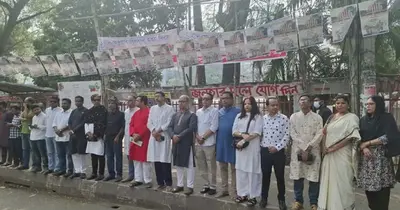
Experts believe that the increasing violence against media outlets and journalists reflects a serious failure of the country’s law enforcement agencies. They say that recent attacks on various media organizations show that law enforcement agencies have failed to take effective action, which is having a negative impact on independent journalism and the free flow of information.
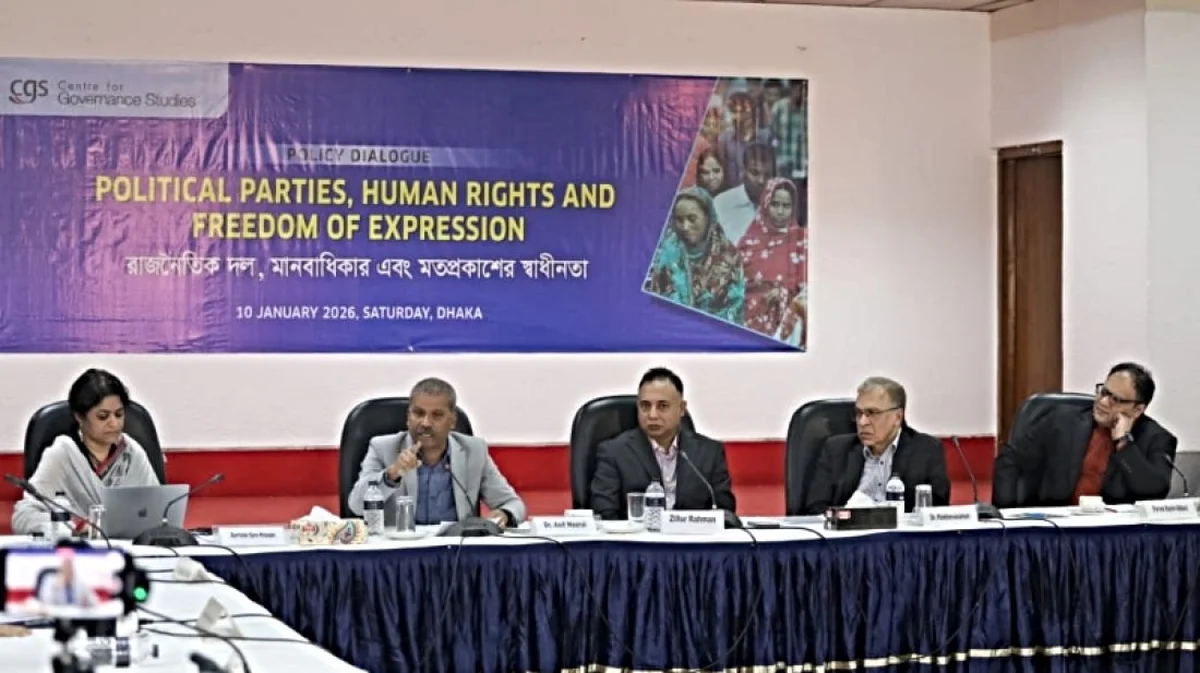
The speakers made these remarks on Saturday (January 10) at a policy dialogue titled “Political Parties, Human Rights, and Freedom of Expression” organized by the Center for Governance Studies (CGS) at the CIRDAP Auditorium in Dhaka.
Political leaders, representatives of civil society, academics, lawyers, journalists, and human rights activists participated in the dialogue to assess the current state of human rights and freedom of expression in the political sphere ahead of the upcoming election.
Law, Justice and Parliamentary Affairs Adviser Dr. Asif Nazrul said at the dialogue that the scope of legal aid services has increased significantly during the interim government period. He said that currently nearly ten times more people are receiving state legal aid compared to before.
Dr. Asif Nazrul said that several important reforms have already been implemented under the interim government. These include transferring key judicial matters to the higher courts, enacting one of the strongest human rights laws in South Asia, and expanding legal aid services. He reiterated that ten times more people are now receiving legal assistance than before.
Regarding the Digital Security Act, he said that nearly 90 percent improvements have been made to the law and more than 20,000 cases have been resolved. Referring to the widespread cyberbullying he faced after the July uprising, he said that meaningful reforms require time. He called on political parties and the media to engage in self-criticism. He also commented that honesty, conscience, tolerance, and accountability are essential to move the country forward over the next five to ten years.
At the beginning of the dialogue, CGS Chairperson Zillur Rahman said that as elections draw closer, the space for human rights and freedom of expression continues to shrink. He said the law is often used as a political weapon, while violence, threats, and harassment spiral out of control.
Raising the question of whether the rule of law actually exists in Bangladesh, he referred to prolonged court proceedings and fragile media freedom. Mentioning attacks on media outlets such as Prothom Alo and The Daily Star, he said these incidents reflect serious failures of law enforcement agencies.
Zillur Rahman said that during the Awami League government, fear of enforced disappearances suppressed dissent, while currently there is a visible rise of mob culture. He also criticized the lack of a healthy electoral culture over the past 54 years, journalist dismissals, changes in media ownership, and the misuse of intelligence agencies.
Transparency International Bangladesh Executive Director Dr. Iftekharuzzaman said that human rights are universal, not relative. He said political parties in Bangladesh still depend on money, power, and religion, while the state is allowing the rise of mob power.
Calling for self-criticism by political parties, he demanded that indigenous peoples’ rights be included in election manifestos. He also called for the enactment and implementation of anti-discrimination laws after the election. Additionally, he demanded clear positions from political parties on which issues require referendums.
Barrister Sara Hossain, Executive Director of Bangladesh Legal Aid and Services Trust (BLAST), said that although Section 54 of the Code of Criminal Procedure has been amended, its implementation remains flawed. Rejecting claims that courts previously granted bail arbitrarily, she questioned why journalists are now afraid to report on enforced disappearances and killings.
Barrister Sara Hossain called for open debate on colonial-era laws such as blasphemy, anti-terrorism, and defamation laws. She also emphasized the need for inclusive policies and public awareness.
Nasrin Sultana Milli, Joint Secretary General of the AB Party, said that smaller parties are divided through inducements ahead of elections. As a result, “supreme leaders” emerge who eventually become cult figures and promote authoritarianism. She alleged that the Election Commission is often seen leaning toward the likely winning party.
Advocate Md. Golam Mostafa said that ordinary people suffer the most during periods of political change. Those in power protect their own interests, while the public pays the price. He emphasized decentralization of power and the protection of human rights.
Senior journalist Abu Sayeed Khan said that mob violence has now become more powerful than court verdicts. Highlighting the government’s weakness in dealing with the law and order situation, he said that no nation can progress without a culture of tolerance for criticism. He also commented that the government has failed to create a credible environment for elections.
Jahangirnagar University Professor Dr. Abdul Latif Masum said that democracy and human rights are inseparably linked. He criticized those in power for using law enforcement agencies, the administration, and the judiciary to serve partisan interests.
Journalist Md. Muktadir Rashid Romeo questioned whether freedom of expression now belongs to citizens or to mobs. He said Bangladesh is becoming increasingly divided; the absence of effective commissions and the tendency to label dissenters as “foreign agents” are suppressing genuine debate.
Others who spoke at the gathering included Didar Bhuiyan, Ragib Ahsan Munna, Parvez Karim Abbasi, Faruk Hasan, Pallab Chakma, Barrister Shihab Uddin Khan, and Sheikh Fazlul Karim Maruf, among others. They expressed concern over the shrinking civic space, lack of internal democracy within political parties, communal violence, and the use of mob power as a political tool.