

Sri Lanka Guardian Analysis: A Silent Persecution of Minorities in Bangladesh
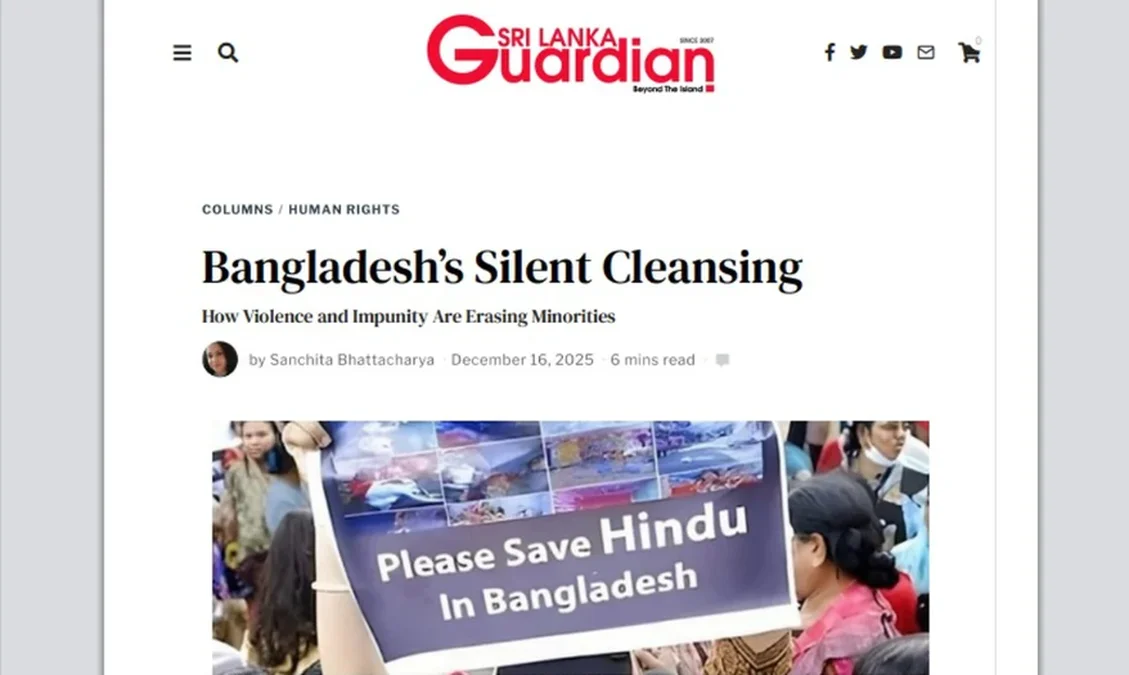
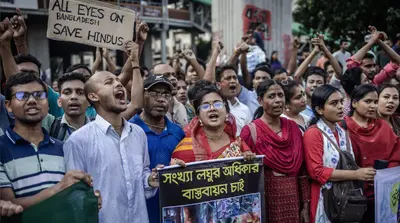
Following political instability, violence against minority communities in Bangladesh has taken on a new dimension. According to a report published in Sri Lanka Guardian, members of the Hindu, Christian, Buddhist, and Ahmadiyya communities have faced a series of attacks, killings, arson, and persecution over the past year.
On 7 December 2025, police recovered the bodies of freedom fighter Jogesh Chandra Roy (75) and his wife Subarna Roy (60) in Taraganj, Rangpur. Both were found with injuries to their heads. Earlier, on 5 December, fish trader Uttam Sarkar was killed in Faridpur. On 2 December, businessman Prantosh Karmakar was shot dead in Narayanganj. In August, journalist Bibhuranjan Sarkar was killed in Munshiganj. Such successive killings have further intensified the sense of insecurity among minority communities.
The report states that attacks on religious sites belonging to minorities have increased. In November and October, two churches in Dhaka were targeted in cocktail bomb attacks. Incidents of vandalism were reported at a Sufi shrine in Rajshahi, a robbery at a Buddhist temple in Chattogram, and an attack on an Ahmadiyya Jamaat prayer center in Rajbari. These attacks threaten not only religious freedom but also social harmony.
According to data from the Bangladesh Hindu Buddhist Christian Unity Council, at least 258 incidents of attacks against minorities occurred in the first six months of 2025. These include 27 killings, 20 cases of violence against women, 59 attacks on religious sites, 27 incidents of arson and looting of homes and business establishments, 12 cases of land grabbing, and 16 attacks on religious rituals and ceremonies. From August to December 2024, a total of 2,184 attacks were documented. This indicates that violence has increased further following political change.
The report also notes that not only people but cultural heritage has come under attack. In July 2025, the ancestral home of Satyajit Ray in Mymensingh was demolished. In June, Rabindranath Tagore’s Kachharibari in Sirajganj was vandalized. These incidents strike at the heart of Bangladesh’s cultural pluralism.
Hefazat-e-Islam, Jamaat-e-Islami, and other extremist groups have been making public statements against minority communities. Demands have been raised to declare Ahmadis as non-Muslims. Protests have also taken place over the inclusion of images of Hindu and Buddhist structures on newly issued banknotes. At the same time, militant organizations such as Jama’atul Mujahideen Bangladesh (JMB), Ansarullah Bangla Team (ABT), and Hizb ut-Tahrir have resumed training camps, further endangering the security of minority communities.
Writer Sanchita Bhattacharya argues that violence against minorities is not merely a consequence of political instability but has intensified due to state impunity and weak law enforcement. She warns that if this trend continues, the very existence of minority communities in Bangladesh will be under serious threat.