Human Rights Betrayed: 40 Killed Without Trial Under Yunus’s Interim Regime

In the 14 months since the ouster of the Awami League through the July violence and the formation of the interim government led by Nobel Peace laureate Professor Muhammad Yunus, Bangladesh has witnessed alarming incidents of extrajudicial killings, reckless security operations, border killings, and widespread human rights violations.
According to the latest quarterly report by the human rights organization Odhikar, at least 40 extrajudicial killings occurred in the country between August 9, 2024, and September 2025. The most worrying data shows that 11 killings took place in just the last three months—an average of about three per month.
What is raising widespread concern is that the very groups and individuals who were once the loudest critics of extrajudicial killings under previous governments are now presiding over a similar pattern of abuses while in power.
Odhikar’s statistics show that, during this period, 19 people were shot dead, 14 died under torture, and seven were beaten to death in custody. Between July and September alone, out of the 11 reported cases, joint security forces were allegedly involved in seven, police in three, and one case involved a military personnel.
The report notes that, during the same July–September period, joint forces were responsible for seven of the killings, the police for three, and the army for one.
Ironically, the same groups who led movements against human rights violations and extrajudicial killings under the Awami League government are now failing to prevent similar incidents after taking office.
Beyond extrajudicial killings, Odhikar reports that in the 14 months of the interim government, 88 people have died in custody, and at least 35 Bangladeshis were killed by the Indian Border Security Force (BSF). Between May and September 2025, about 2,333 Bangladeshis were pushed back across the border.
In the past, such incidents were used to put the Awami League government in the dock internationally. Yet, the current administration has failed to take any meaningful measures to prevent them.
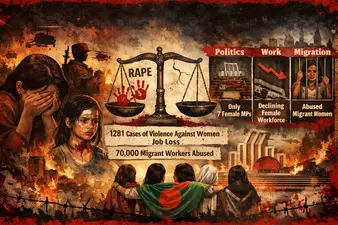
The situation is further aggravated by rising political violence—with 281 people killed during the interim government’s tenure—and a sharp surge in violence against women, with 687 women raped in 14 months, including 188 cases in just the last three months.
Human rights activists say the government, which came to power under the banner of “restoring human rights,” has completely failed to ensure public safety and justice.
Another striking point is that, despite previously blaming the Rapid Action Battalion (RAB) for rights violations and international criticism against it, the interim government has taken no structural reforms of the force. Analysts say that, despite UN recommendations, the lack of accountability mechanisms has further weakened the security situation.
Professor Asif Mohammad Shahan of Dhaka University commented:
“Those who came to power in the name of protecting human rights have failed to stop extrajudicial killings, border deaths, and violence against women. This is blatant hypocrisy.”
The interim government assumed office pledging to establish human rights, justice, and accountability. But after more than a year, the report concludes, the situation regarding security, women’s safety, custodial deaths, and border incidents has become even more alarming.
Now, the public is left asking: Did the movement that overthrew the Awami League truly give birth to a new Bangladesh—or has only the name of the government changed, not the system itself?