


Through the signing of the accord, the hill people had hoped to reclaim their rights from the state
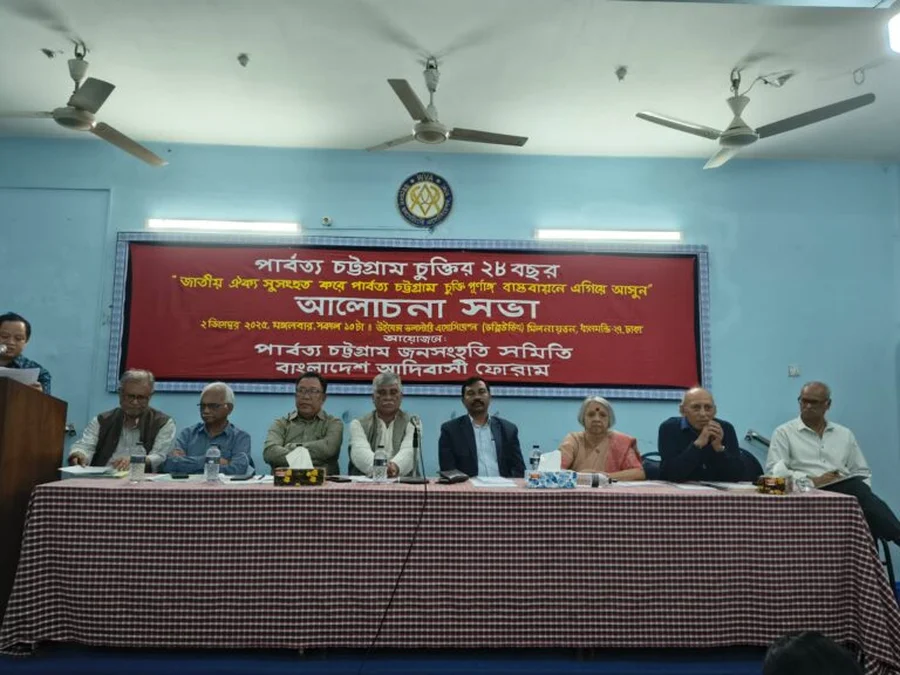
A discussion meeting was held at the Women’s Voluntary Association auditorium in Dhanmondi to mark the 28th anniversary of the Chittagong Hill Tracts (CHT) Peace Accord, under the slogan: “Strengthen national unity and move forward toward full implementation of the CHT Accord.”
The event was chaired by Dr. Gajendranath Mahato, Joint General Secretary of the Bangladesh Adivasi Forum, with Hiron Mitra Chakma, Information and Publicity Secretary, moderating. Among those present were human rights activist and Nijera Kori coordinator Khushi Kabir, ALRD Executive Director Shamsul Huda, KS Mong Marma, Central Committee Member of the Parbatya Chattogram Jana Samhati Samiti (PCJSS), CPB President Sajjad Zahir Chandan, JASAD Standing Committee Member Dr. Mushtaq Hossain, BASAD Joint General Secretary Rajekuzzaman Ratan, CHT Accord Implementation Movement Joint Coordinator Zakir Hossain, along with leaders from various Indigenous student and youth organizations.
Zakir Hossain, Joint Coordinator of the CHT Accord Implementation Movement, said that many people in Bangladesh still lack a clear understanding of the CHT issue, which gives rise to confusion. He noted that some groups are now labeling the accord as “an agreement of the former government” and calling for its cancellation—an idea he described as misleading. The accord, he emphasized, was not made with a political party but between the Bangladesh state and the Indigenous peoples of the CHT.
He alleged that even after the signing of the accord, incidents of arson in Indigenous villages, land grabbing, and violence have persisted, amounting to clear human rights violations. Despite repeated letters from the movement to the interim government, he said, no concrete initiatives have been taken; instead, military presence in the region continues to increase.
CPB President Sajjad Zahir Chandan said that although 28 years have passed since the accord, the hill communities continue to face exploitation, discrimination, and injustice. He added that ethnic attacks, land dispossession, and state oppression have continued even after independence. If the implementation process remains slow, he warned, the region could slip back to its pre-accord situation. Sustainable peace is achievable only if the government demonstrates political will, he said.
BASAD leader Rajekuzzaman Ratan said that the hill people had hoped to regain their rights through the signing of the accord, but the state had betrayed them by failing to implement it. He pointed out that during the drafting of the constitution, the hill communities were labeled as “Bangali,” revealing a narrow nationalist mindset. The duty of the state, he said, is to protect the culture, land, and existence of all ethnic groups. However, cases of land grabbing and rights violations in the hills continue. He urged immediate implementation of the accord and an end to land dispossession to ensure lasting peace.
PCJSS Central Committee member KS Mong stated that the CHT issue is not merely regional but a national and political one. From the era of the Ershad government to later administrations, dialogue repeatedly paved the way for the accord. Yet, the commitment to secure lasting peace and protect the rights of the small ethnic communities remains unfulfilled. He cited Santu Larma’s statement at the signing ceremony—that implementing the accord would be more difficult than signing it—saying that today, attacks on Indigenous languages, culture, and land persist. He argued that fear and intimidation still prevail in the hills, and the only alternative is full implementation of the accord. He declared readiness to build a broader movement if necessary.
ALRD Executive Director Shamsul Huda described the CHT Accord as a historic document safeguarding the rights of the state and Indigenous peoples. Failure to implement it, he warned, will only worsen the situation. Many expectations raised after the July 24 People’s Uprising remain unaddressed. Although numerous reform commissions were formed over the years, he said none incorporated Indigenous perspectives. He also noted that people are now often labeled “anti-state” simply for discussing the accord. Yet more than a hundred countries around the world recognize Indigenous peoples, and protecting their rights is a core principle of democratic governance.
Human rights defender Khushi Kabir said that in 1947, over 90 percent of the population in the CHT were Indigenous. Due to oppression, discrimination, and land dispossession, they were forced into armed resistance. Although the accord was a major achievement, many of its core provisions remain unimplemented. She said that even an international commission formed to investigate the lack of implementation faced obstruction. Human rights investigators were also attacked by settler groups in the region. She stated that from the British era to present-day Bangladesh, successive governments have deliberately altered the region’s demographic balance. Implementation of the accord is essential to protect Indigenous land, culture, and identity, she emphasized, calling for collective action.
At the start of the program, Amar Shanti Chakma, Vice-President of the Bangladesh Adivasi Youth Forum, presented the keynote paper outlining the overall situation. He said that although the government claims to possess political will for implementation, field-level reality remains slow.
According to data from the Jana Samhati Samiti, out of 72 provisions of the accord, only 25 have been fully implemented, 18 partially implemented, and 29 remain completely unaddressed. He added that key components—such as empowering the Regional and District Councils, resolving land disputes, preparing a permanent voter list, ensuring priority recruitment of hill people in CHT government jobs, and building security and social trust among Jumma communities—remain unrealized.