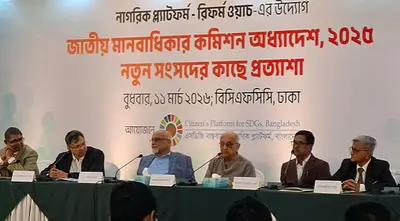

NHRC Remains Inactive for Seven Months, Victims Deprived of Justice
It has now been seven months since the National Human Rights Commission (NHRC) became inactive, depriving victims of human rights violations of its services.
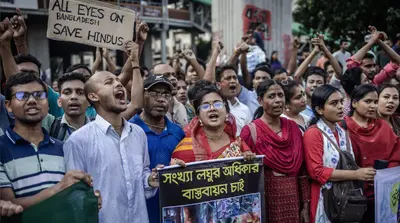
Human rights activists say violations have become widespread across the country. At such a time, when rights issues need to be raised strongly, the NHRC has remained nonfunctional.
The commission, formed during the Awami League government after the student-mass uprising on 5 August last year, functioned until November. On 7 November, some officials from a government intelligence agency visited the NHRC office in Karwan Bazar and spent the entire day there. By the evening, then chairman Kamal Uddin Ahmed, full-time member Md Selim Reza, and four honorary members — Biswajit Chanda, Professor Tania Haque, Aminul Islam, and Kangjuri Chowdhury — resigned. Earlier, another member, Kawsar Ahmed, had also stepped down.
Since then, the commission has remained inactive — now for seven consecutive months — and no new chairman or members have been appointed yet.
Human rights activist Sayeed Ahmed, a member of the Bangladesh Bureau of South Asians for Human Rights (SAHR), expressed disappointment over the prolonged inactivity. “This delay gives the impression that the current interim government does not consider the commission important,” he said.
However, Law Adviser Professor Asif Nazrul stated that an initiative has been taken to reconstitute the NHRC. “We want to make the appointment after amending the commission’s law. The Judiciary Reform Commission has given some recommendations. We plan to scrutinize them carefully and make proper appointments. Hopefully, it can be done within a month,” he said.
According to the National Human Rights Commission Act-2009, the NHRC consists of a chairman, a full-time member, and five honorary members. The body does not have the authority to deliver punishment; it can only investigate, raise its voice, and make recommendations. Even so, the previous commission was criticized by rights activists for being largely silent on grave issues like extrajudicial killings and enforced disappearances.
This time, the restructuring process has faced legal and procedural obstacles. A selection committee chaired by the Speaker of Parliament is supposed to recommend appointments. But with no functioning parliament and the speaker having resigned, this became impossible. As a result, on 20 November, the NHRC Act was amended to allow the selection committee to proceed even in the absence of a speaker.
Services halted
Victims of rights violations are not receiving any assistance from the NHRC.
One such victim, Romena Khatun, a teacher at Kazipur Secondary School in Jashore Sadar upazila, previously won reinstatement through NHRC intervention after being dismissed illegally in 2010. She has again approached the commission over unpaid salary issues — but now, there is no one to hear her case.
Muzaffar Hossain, Assistant Director (Complaints and Investigation) at NHRC, said, “We are just recording complaints now. Nothing else can be done as long as the commission remains vacant.”
The NHRC typically handles complaints through three benches — chaired by the chairman, full-time member, and another member, respectively. With all these positions vacant, no bench is currently functional.
Grave rights violations continue
Meanwhile, reports of harassment, violence against women, and mob justice have surged.
According to the Manabadhikar Shongskriti Foundation (MSF), at least 121 people were killed in mob beatings between August last year and January this year. Rights group Ain O Salish Kendra noted that 2024 saw the highest number of lynching deaths in the past five years. Extrajudicial killings also continue — MSF reported three deaths in “encounters” with law enforcers in February alone.
Despite such grave human rights violations, the NHRC has not issued any statements or interventions. Several rights activists, speaking on condition of anonymity, alleged that the delay in restructuring the NHRC is politically motivated and serves to condone ongoing violations.
Human rights activist Abu Ahmed Faizul Kabir said, “It is alarming that the Human Rights Commission has been ineffective for so long. Many rights violations are taking place, yet the commission cannot play any role. This is deeply unfortunate.”