International Rights Groups Condemn Surge in Violence Against Indigenous Peoples in CHT
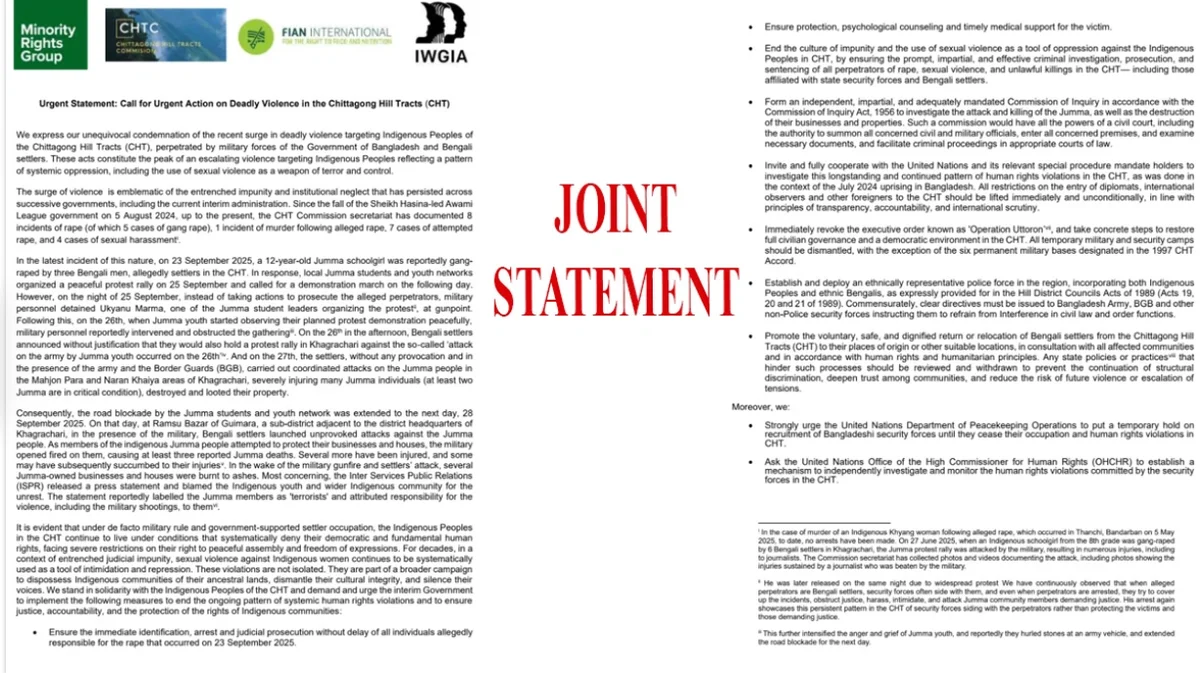
Three leading human rights organizations—FIAN International, the International Chittagong Hill Tracts Commission (CHT Commission), the International Work Group for Indigenous Affairs (IWGIA), and Minority Rights Group International (MRG)—have issued a forceful condemnation of recent lethal attacks targeting the Indigenous peoples of the the Chittagong Hill Tracts (CHT). According to their joint press release, the violence, perpetrated by state security forces and Bengali settlers, represents a continuing pattern of systemic oppression, including the use of sexual violence as an instrument of terror and control.
The rights bodies assert that these events expose entrenched impunity and institutional neglect spanning successive governments, including the current interim administration. Since the fall of the Sheikh Hasina–led Awami League government on 5 August 2024, the CHT Commission secretariat has recorded eight incidents of rape (five of them gang rapes), one rape-related killing, seven attempted rapes, and four cases of sexual harassment.
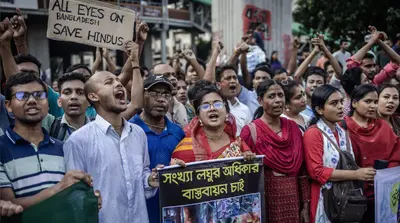
In the most recent incident, on 23 September 2025, a 12‑year‑old Jumma girl was reportedly gang‑raped by three Bengali men, allegedly settlers in the region. In response, local Jumma student and youth groups held a peaceful protest rally on 25 September and organized a demonstration march the next day. That night, instead of prosecuting the suspected perpetrators, military personnel reportedly detained one of the student organizers—Ukyanu Marma—at gunpoint.
On 26 September, when Jumma youth attempted to carry out their planned protest, security forces allegedly intervened to block their gathering. That afternoon, Bengali settlers declared, without substantiation, that they would hold a counter rally in Khagrachari, accusing Jumma youth of attacking the army. On the following day, settlers—backed by the army and Border Guard Bangladesh (BGB)—carried out coordinated attacks in Mahajon Para and Naran Khaiya of Khagrachari, injuring multiple Jumma community members (at least two in critical condition), and looting and destroying their property.
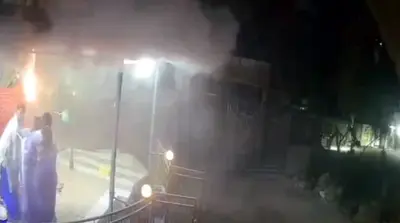
The Jumma-led road blockade extended into 28 September. In Ramsu Bazar, Guimara—a subdistrict adjacent to Khagrachari headquarters—the attack escalated. Settlers launched unprovoked assaults on Jumma residents, and security forces reportedly opened fire as Indigenous people tried to defend their homes and businesses. At least three Jumma civilians were killed, with many others wounded; some may have later died from their injuries.
Amid the violence, multiple Jumma-owned homes and businesses were set ablaze. Shockingly, the Inter Services Public Relations (ISPR) released a statement ostensibly blaming the Indigenous community for the unrest, labeling Jumma members as “terrorists” and attributing responsibility for the violence—including the military shootings—to them.
The rights groups emphasize that under a de facto militarized regime, with state-supported settler encroachment, Indigenous peoples in the CHT are systematically denied basic democratic freedoms—particularly freedom of assembly and expression. Over decades, they maintain, sexual violence against Indigenous women has been used strategically to intimidate communities. These are not isolated tensions but a larger campaign aimed at displacing Indigenous communities, dismantling their cultural integrity, and silencing dissent.
In their joint appeal, FIAN, CHT Commission, IWGIA, and MRG demand the interim government take the following actions:
Immediately identify, arrest, and prosecute all those responsible for the 23 September rape, without delay.
Provide protection, prompt medical care, and psychological support to the victim.
End impunity: ensure impartial criminal investigations, prosecutions, and convictions for rape, sexual violence, extrajudicial killings, whether by state forces or settlers.
Establish an independent Commission of Inquiry (per the Commission of Inquiry Act, 1956) with full powers to summon military and civil officials, inspect premises, examine documents, and facilitate criminal proceedings.
Fully cooperate with the United Nations, including requesting UN special procedure mandates to investigate patterns of abuse in the CHT, and lift all restrictions on international observers, diplomats, and foreign entry to the region.
Revoke the executive order “Operation Uttoron,” restore civilian governance in the CHT, and dismantle temporary security camps (outside the six permanent bases under the 1997 CHT Accord).
Deploy a representative police force (incorporating Indigenous and Bengali personnel) in line with the 1989 Hill District Councils Acts, and instruct military and border forces to refrain from civil policing.
Initiate and support peaceful, voluntary relocation of Bengali settlers from the CHT to their places of origin or other areas, in consultation with affected communities and consistent with human rights.
- Urge the UN Department of Peacekeeping to suspend recruitment of Bangladeshi security forces until abuses in the CHT cease, and petition the United Nations Office of the High Commissioner for Human Rights (OHCHR) to create an independent investigative and monitoring mechanism.
In closing, the rights organizations declare their solidarity with the Indigenous communities of the CHT, emphasizing that systemic violence, when unchecked, threatens not only lives and property but also the very cultural and civil existence of the region’s Indigenous peoples.
Source: Hill Voice