


Human Chain Calls for Protection of Minority, Indigenous and Women Voters Ahead of Election
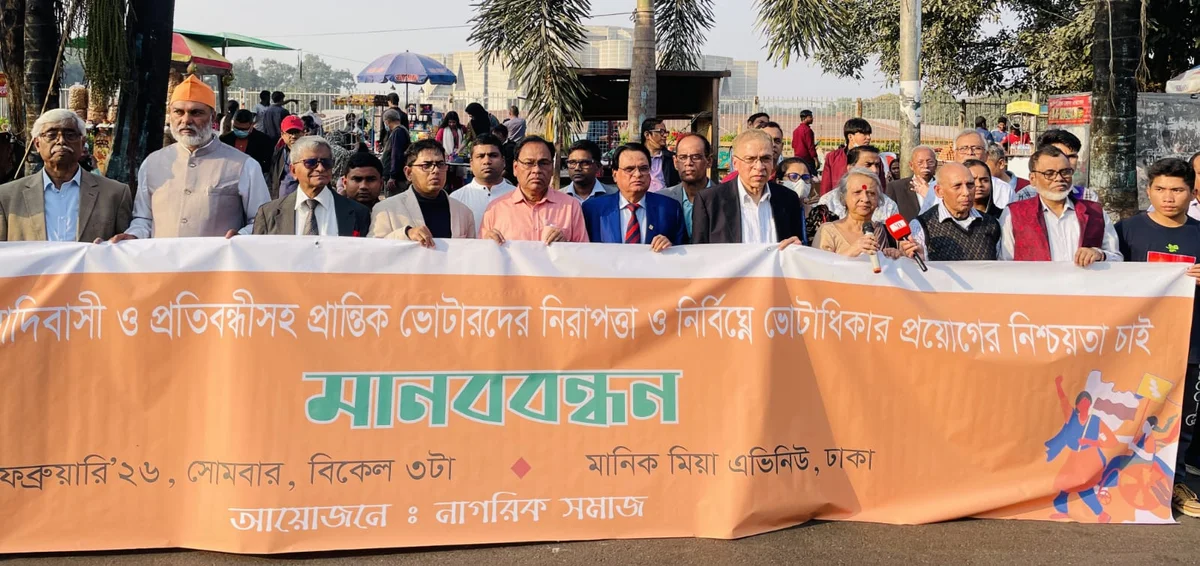
With only three days remaining before the 13th National Parliamentary Election, civil society organisations have expressed serious concern over the safety and voting rights of minority, indigenous and women voters across the country.
Amid heightened election campaigning and growing political tension, reports have emerged from different regions indicating threats, intimidation and fear targeting religious and ethnic minorities, indigenous communities and women voters. Such incidents and fears are reportedly more prevalent in remote and rural districts.
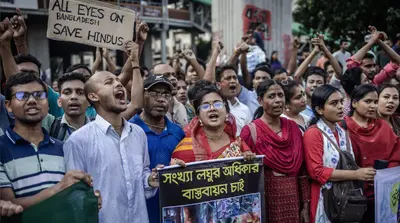
Against this backdrop, several civil society organisations, indigenous groups and women’s rights organisations formed a human chain in front of the National Parliament Building in Dhaka on 9 February 2026, under the banner of civil society. The demonstration called for urgent measures to ensure the safety and unhindered voting rights of minority, indigenous and women voters before, during and after the election.
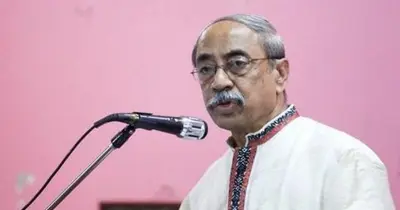
The keynote address at the human chain was delivered by Shamsul Huda, Executive Director of the Association for Land Reform and Development (ALRD). Speakers at the event included Khushi Kabir, Coordinator of Nijera Kori; Zakir Hossain, Chief Executive of Nagorik Uddyog; prominent economist Dr Debapriya Bhattacharya, Distinguished Fellow of the Centre for Policy Dialogue (CPD); Nirmal Rosario, President of the Bangladesh Christian Association; Manindra Kumar Nath, Acting President of the Bangladesh Hindu Buddhist Christian Unity Council; senior lawyer Subrata Chowdhury of the Supreme Court; Advocate Saidur Rahman, Chief Executive of the Human Rights Cultural Foundation; Dr Iftekharuzzaman, Executive Director of Transparency International Bangladesh (TIB); human rights and indigenous rights activist Dipayan Khisa; Dhaka University professor Robayet Ferdous; Kajal Debnath, former president of Bangladesh Puja Udjapan Parishad; and Rasheda K Chowdhury, Executive Director of Campaign for Popular Education, among others.
All speakers unanimously demanded that the government and the Election Commission take immediate and effective steps to ensure maximum security for minority, indigenous and women voters during the pre-election, election-day and post-election periods.
Dr Debapriya Bhattacharya said that the prevailing sense of insecurity surrounding the election is not limited to minorities, indigenous people or women alone, but also affects candidates. He criticised both the government and the Election Commission for showing indifference towards creating an inclusive and secure electoral environment.
Rasheda K Chowdhury stated that there should have been no need for such a human chain if women, minorities and marginalised communities could participate in elections without fear. She emphasised that the right to vote freely is a constitutional right, and called upon the government, the Election Commission and law enforcement agencies to act proactively to ensure this right.
Khushi Kabir noted that it is not the government’s role to campaign for or against any political outcome. Rather, the responsibility of the government and the Election Commission is to ensure the security of minorities, women and marginalised groups before, during and after the election.
On behalf of civil society, Shamsul Huda presented a set of demands and recommendations aimed at removing fear among voters, particularly minority women, indigenous people, persons with disabilities and other marginalised groups. These included activating the Election Commission’s crisis management cell to address voter security concerns, establishing similar monitoring cells at the district level, and ensuring regular monitoring of the security situation by administrative and law enforcement officials.
The recommendations also called for immediate action against any administrative or law enforcement personnel found engaging in partisan activities, and for comprehensive measures to ensure that voters of all ages, genders, religions, ethnicities and social classes can cast their votes safely and without obstruction.
Speakers further stressed that voting is a fundamental civic right and that no citizen should be deprived of this right. They also demanded firm guarantees to prevent post-election violence against minorities, indigenous peoples, Dalits and vulnerable women, including attacks on homes and property.
The human chain concluded with a call to political parties, especially major democratic forces, to play a responsible role in creating an environment of trust that enables marginalised communities to exercise their voting rights freely, ensuring a peaceful, transparent and participatory election.