

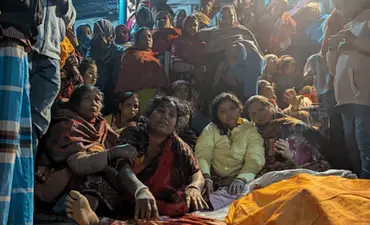


Communal Violence: Authorities Routinely Point to Conspiracies
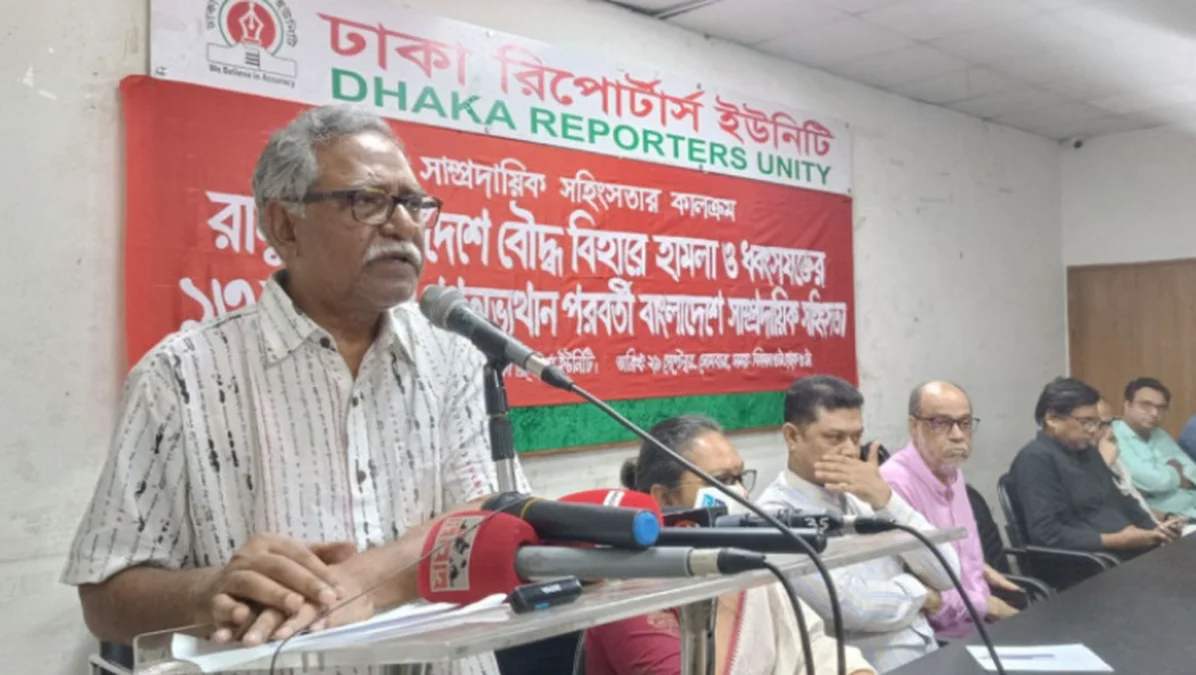
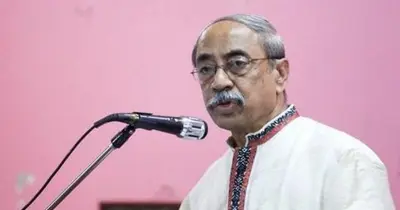
Professor Anu Muhammad yesterday criticized successive governments for blaming "local or foreign conspiracies" for communal violence instead of holding the actual perpetrators accountable.
He said, "When the Ramu incident occurred, the then Home Minister labeled it a Jamaat-BNP conspiracy aimed at sabotaging war crimes trials. Now, as Khagrachhari experiences violence, the current Home Adviser claims it was 'made in India.' The pattern of denial remains the same: investigations are rarely conducted, often because local leaders themselves are involved."
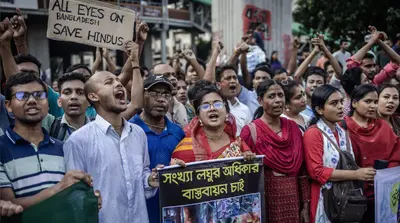
These comments were made during a discussion titled "Timeline of Communal Violence: 13 Years Since the Ramu Buddhist Temple Attacks and Communal Violence in Post-Uprising Bangladesh," organized by the Ganatantra Odhikar Committee at the Dhaka Reporters Unity.
Anu Muhammad argued that communal violence is deliberately orchestrated for political, economic, and institutional gain. He pointed to the 2012 Ramu attacks, where Buddhist monasteries were set on fire following a fabricated Facebook post, and to the post-election violence of 2001 targeting minorities.
"Following the 2001 elections, numerous criminal cases were filed related to attacks, arson, and rape against minorities. However, only a small number of these cases resulted in justice. This cycle has been ongoing since the 1980s and 1990s. Instead of learning from history, we seem to be regressing," he added.
According to him, mobs are not motivated by genuine religious outrage but are mobilized by powerful organizers who manipulate religious sentiments to benefit the elite.
"Those who carry out attacks under the banner of Bangalee or Muslim interests do not represent the real majority—the working poor, farmers, and laborers. They serve a small elite group," he said.
He also called for transparency regarding land ownership in the Chittagong Hill Tracts, stating, "If the government truly desires peace in the hills, it should publish a list of those to whom the land has been leased. Then it will become clear whose interests are being protected by maintaining instability in the region."
Barrister Jyotirmoy Barua, a member of the Ganatantra Odhikar Committee, also spoke at the event. He noted that 13 years after the Ramu Buddhist monastery attacks in Cox’s Bazar, justice has yet to be served in most of the filed cases.
He stated that 19 cases were filed, but most remain unresolved.
Recalling the events of September 29 and 30, 2012, he noted that at least 13 temples were attacked in Ramu, four in Ukhiya, and two in Patiya, with over 50 homes destroyed. Locals had submitted video evidence at the time.
"Some videos clearly show army personnel or Border Guard Bangladesh (BGB) members standing near the temples while attackers set fires without any tear gas being used," he said.
He explained how a manipulated Facebook post acted as a catalyst in Ramu. "A tailor named Uttam Barua didn’t even own a smartphone. Yet, a fake Facebook post bearing his name was circulated in the market. Loudspeaker announcements were then made to gather people. This pattern has since been repeated in Cumilla, Rangpur, Satkhira, and in lynching cases based on alleged insults to religion."
Jyotirmoy also recounted an incident in Rangpur where a Muslim man, unable to repay a loan to a Hindu family, spread a false rumor online accusing them of insulting religion. This led to the burning of an entire village.
"In almost every attack I’ve investigated, leaders or activists from mainstream parties—whether Awami League, BNP, Jamaat, or Jatiya Party—were involved," he added.
He warned that the impact of communal attacks goes beyond physical damage to cause deep psychological trauma. "Legal justice cannot heal the mental wounds. When someone is targeted for their identity, they lose faith in society. This pain remains unspoken in Bangladesh."
Jyotirmoy urged the state to acknowledge its responsibility, saying, "If the state wants to rebuild harmony, it must first admit its failures and address these wounds."
Dhaka University Professor Samina Luthfa highlighted that in recent years, hate speech disguised as freedom of expression has grown more brazen, creating a dangerous environment of cultural and identity conflict.
Abdullah Al Kafi Ratan, President of the Communist Party of Bangladesh, remarked that despite 54 years of independence, no government has truly governed democratically, and called for a "second mass uprising" to fulfill the promises made in 2024.
Singer and writer Arup Rahee observed that communal attacks from Ramu to Khagrachhari reflect a troubling fusion of state and right-wing ideologies, which he described as a new form of fascism in Bangladesh.
The event was moderated by Dhaka University Chhatra Union President Meghmallar Basu. Economist Sujit Chowdhury also spoke, among others.