
Global Human Rights Organizations Call for Immediate Removal of Ban on Awami League
Six international human rights organizations have jointly issued an open letter to Chief Adviser Dr. Muhammad Yunus calling for the adoption of 12 recommendations, including the lifting of the ban on the Awami League. They also praised interim government measures such as the restoration of fundamental freedoms, initiation of legal reforms, and important steps like investigations into enforced disappearances and other human rights violations.
The open letter was published on Human Rights Watch’s official website. The twelve recommendations presented to the government are: ensuring accountability and justice; security-sector reform; defining the crime of enforced disappearance and strengthening the investigative commission; reforming the National Human Rights Commission; law reform to protect personal liberty; protecting personal data and limiting surveillance; withdrawal of politically motivated cases; lifting the ban on the Awami League; protecting the independence of civil society and NGOs; protection for Rohingya refugees; and cooperation with the International Criminal Court (ICC).
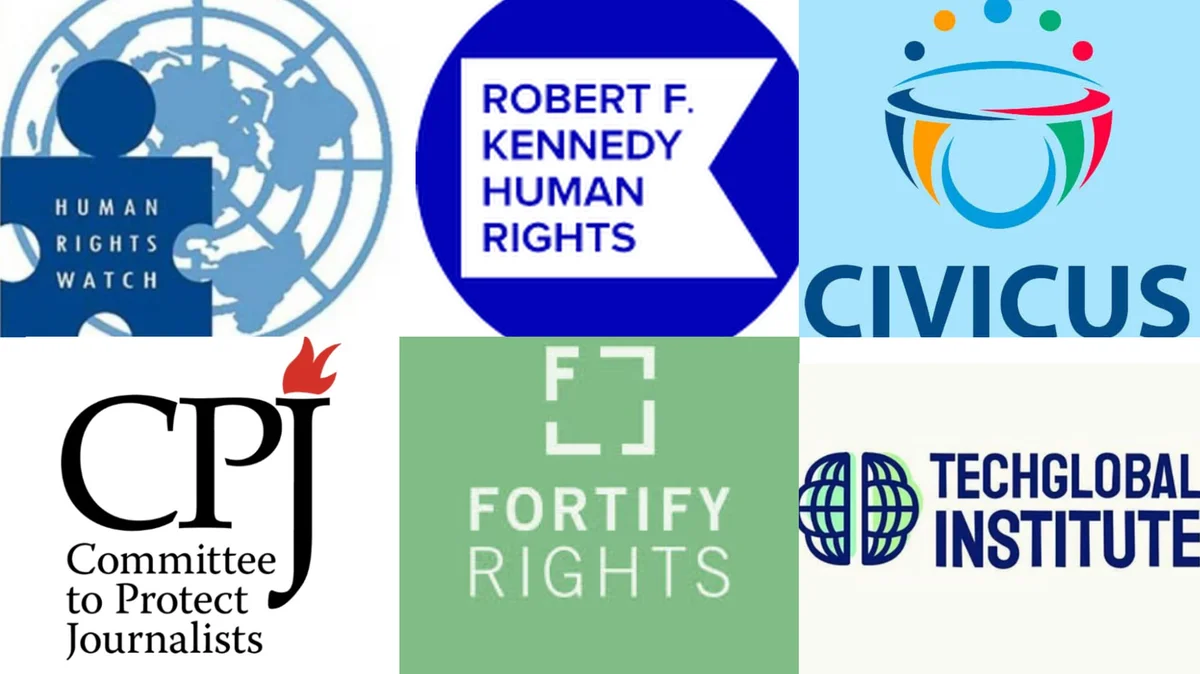
The organizations that signed the letter are: CIVICUS, Committee to Protect Journalists, Fortify Rights, Human Rights Watch, Robert F. Kennedy Human Rights, and Tech Global Institute.
At the start of the letter the signatories praised the government and said, “During the UN General Assembly session, we are deeply grateful to you for meeting with our delegation of international human rights organizations to discuss Bangladesh’s human rights situation.”
They called on the interim government, during the short period before the 2026 elections, to expand protections for human rights and to build strong institutions that will ensure free and fair elections and guard against future risks of authoritarian rule. They added that they were concerned that structural reform in the security sector has not yet occurred and that many members of law enforcement are still not fully cooperating with accountability and reform processes.
The letter urges prosecution of serious human rights violations committed under previous governments. At the same time, it calls for an immediate halt to ongoing arbitrary arrests and detentions, particularly those politically motivated cases against Awami League affiliates that lack credible evidence.
The letter also notes that at the UN high-level meeting on the Rohingya issue you (the Chief Adviser) said the only solution to the Rohingya crisis is repatriation and that as an “immediate step” new arrivals should be “allowed to return.” Rohingya have long expressed the desire to return home. But since the end of 2023 there is no safe, dignified, and durable environment in Myanmar for anyone, including the roughly 150,000 Rohingya who have arrived since late 2023, to return to.
Against this backdrop, the letter makes twelve recommendations to protect the rights and freedoms of all people residing in Bangladesh. They are:
Ensure accountability and justice: Individuals responsible for serious human rights violations during the July uprising and over the past fifteen years — such as enforced disappearances, extrajudicial killings, and torture — must be brought to justice. Bangladesh’s International Crimes Tribunal (ICT) has taken an important step by filing charges and issuing arrest warrants against military and intelligence officers for enforced disappearances and torture as crimes against humanity. The military must fully cooperate with these proceedings and respect the ICT’s jurisdiction as a civilian court. The interim government must ensure the ICT’s legal framework, resources, and independence are sufficiently robust to provide justice consistent with international standards, irrespective of political or institutional identity. At the same time, a temporary moratorium on the death penalty should be declared.
Security-sector reform: The Rapid Action Battalion (RAB) should be disbanded and the powers of the Directorate of General Forces Intelligence (DGFI) limited so that human-rights-compliant security institutions can be built free from past patterns of repression. RAB’s history of unchecked torture, killings, and enforced disappearances places it beyond reform. All military personnel should be withdrawn from civilian law enforcement roles. DGFI’s role should be clearly confined to military intelligence functions, with legal frameworks and oversight.
Define enforced disappearance and strengthen the investigative commission: Enforced disappearance should be criminalized in line with international standards and the “Enforced Disappearances Prevention and Remedies Ordinance” should be passed immediately, excluding the death penalty and in conformity with international human rights treaties. The commission investigating disappearances must be given sufficient time and resources, and law enforcement should grant full access to detention facilities and records.
Reform the National Human Rights Commission (NHRC): The NHRC must be made independent, effective, and free from political influence in accordance with the Paris Principles. The commission should be empowered to investigate complaints against security forces and other state agencies.
Law reform to protect personal liberty: Repressive laws — including the 2025 “Cyber Security Ordinance” and other laws such as anti-terrorism statutes, the Special Powers Act, the Official Secrets Act, and criminal defamation provisions — should be repealed or amended to comply with international human rights standards. Although the 2023 Cyber Security Act was repealed, the new ordinance contains vague and broad provisions that risk abuse of state power.
Protect personal data and limit surveillance: Drafts of the “Personal Data Protection Ordinance” and the “National Data Management Ordinance” must be revised to meet international standards so that citizens’ privacy and data security are protected without creating excessive powers for state authorities.
Freedom of expression and protection for journalists: Journalists must be protected from harassment, arrest, or attack justified by alleged political bias. Recommendations for media reform should be implemented to ensure media independence consistent with international norms.
Withdrawal of politically motivated cases: The interim government should review and withdraw all politically motivated cases filed before and after August 2024, particularly those lacking credible evidence.
Lift the ban on the Awami League: The comprehensive restrictions imposed on Awami League activities under the anti-terrorism law should be immediately lifted. These measures obstruct democratic freedoms and multi-party politics. The UN fact-finding report of February 2025 recommended refraining from banning political parties in the interest of democratic restoration.
Independence of civil society and NGOs: The NGO Affairs Bureau should be reformed so it is not used to harass civic groups or as a tool to restrict foreign funding for voluntary activity. The law regulating foreign grants and voluntary operations must be reconsidered.
Protection of Rohingya refugees: Forced returns of Rohingya refugees to Myanmar must stop. Restrictions on movement, livelihoods, and education in camps should be eased. Given declining assistance, these measures will help protect Rohingya dignity and increase self-reliance.
- Cooperation with the International Criminal Court (ICC): Bangladesh should fully cooperate with the ICC’s ongoing investigations related to the Bangladesh–Myanmar situation and, if persons indicted by the court are present in Bangladesh, surrender them in accordance with ICC warrants.