

Tracking Myanmar’s Nuclear Drive: Latest Developments Under the Junta
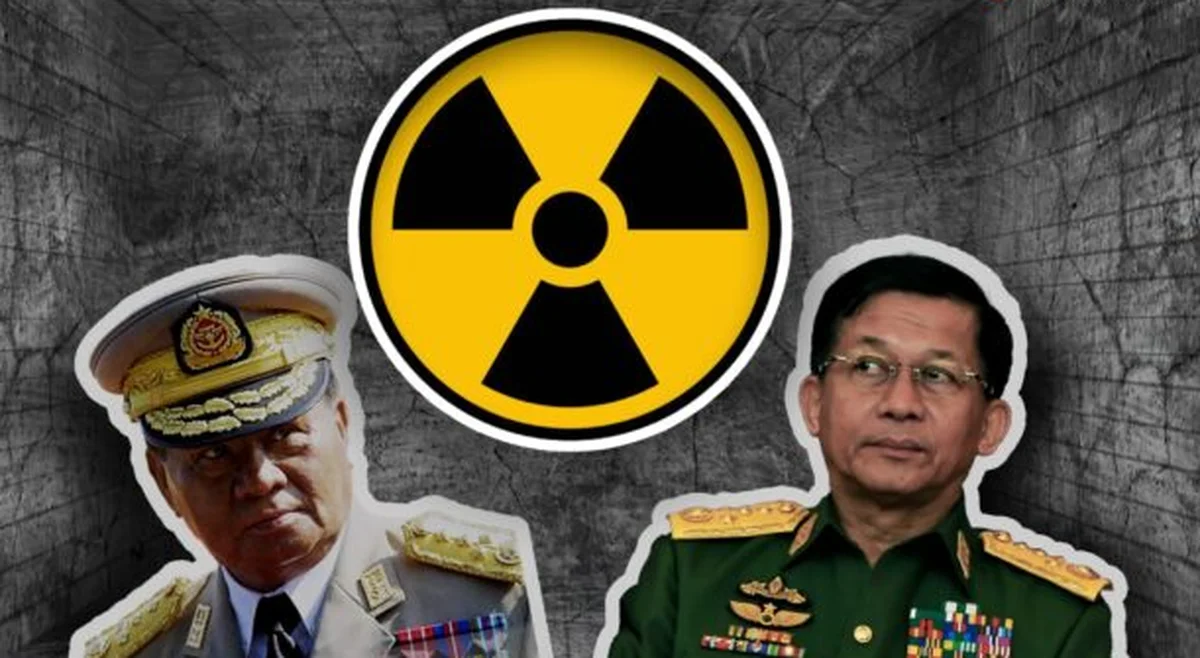
The junta’s recent announcement to construct a small-scale nuclear power plant in the coming years marks the culmination of Myanmar’s decades-long pursuit of nuclear technology, which began in the early 2000s.
The Southeast Asian country’s two-decade-long journey to nuclear capability was made possible by Russia after a series of engagements that accelerated under the current junta and its military predecessor.
Though the current regime insists nuclear energy would be used for peaceful purposes in Myanmar, which has been hit by chronic electricity shortages, many believe this is the first step in a plan to utilize nuclear energy for military purposes including production of nuclear weapons.
The timeline on Myanmar’s long road to nuclear technology:
January 2002
The Myanmar military regime confirms plans to build a nuclear research reactor “for peaceful purposes.”
May 2002
Russia’s Atomic Energy Ministry, Minatom, agrees to help Myanmar build a nuclear studies center comprising a 10-megawatt nuclear reactor and two laboratories, in Magwe Division, central Myanmar. The agreement includes the construction of facilities for disposing of nuclear waste and Russian training for Myanmar technicians.
July 2002
Russia and Myanmar sign an agreement in Moscow on construction of the proposed nuclear research center in Myanmar.
April 9, 2004
Keith Luse, an aide to US Senator Richard Lugar, asks whether North Korea is providing nuclear technology to Burma, during a Washington seminar organized by the Heritage Foundation, a conservative think-tank.
February 13, 2004
The military regime declares that it has “no desire” to develop nuclear weapons, but “has the right to develop nuclear facilities for peaceful purposes.”
September 14, 2004
About 400 young military officers from Myanmar leave for Russia amid reports that some of them will study nuclear engineering.
August 3, 2006
Myanmar’s deputy ambassador to the UN Nyunt Swe tells the UN Conference on Disarmament in Geneva that Burma is opposed to nuclear weapons.
May 15, 2007
Russia’s federal atomic energy agency Rosatom announces it will help Myanmar build the proposed nuclear facility. The agency says the 10-megawatt nuclear reactor, fueled by less than 20 percent uranium-235, will contribute to Myanmar’s “research in nuclear physics, biotechnology, material science as well as…produce a large variety of medicines.” The first round of talks on project details begin.
May 16, 2007
The US condemns the project, while Thailand says it has no worries because the facility will be closely supervised by the International Atomic Energy Agency.
November 2008
A 17-member high-level Myanmar military delegation led by then junta No 3 Thura Shwe Mann makes a secret seven-day visit to Pyongyang via Beijing, during which the two sides sign agreements to deepen military cooperation.
Shwe Mann and his delegation also visit Myohyang in North Korea, where secret tunnels have been built into the mountains to store and shield jet aircraft, missiles, tanks, missiles, and nuclear and chemical weapons. The visit arouses concerns about the Myanmar military’s nuclear ambitions.
In 2012, while serving as Speaker of the Lower House under U Thein Sein’s quasi-civilian government, Shwe Mann claims the delegation to North Korea observed the air defense system and signed a memorandum of understanding for cooperation between two armies, while nuclear weapons were not on the agenda.
2010
Major Sai Thein Win, an engineer in the Myanmar military’s Science and Technology Workshop (known locally as the “nuclear unit”) with a doctorate in atomic energy from Russia, publicly reveals information, including photos, showing that the military regime is studying the possession of nuclear weapons with technological help from North Korea.
July 2013
Lt-Gen Thein Htay, who heads the Directorate of Defense Industries is placed on a US Treasury sanctions list for illicit trade in North Korean arms to Myanmar. He was part of Shwe Mann’s delegation to North Korea in 2008. Today, he serves as a weapon production advisor for the current regime.
2016
Myanmar signs the Comprehensive Nuclear Test Ban Treaty under the democratically elected government led by Daw Aung San Suu Kyi’s National League for Democracy. Daw Aung San Suu Kyi hands over the ratification instrument to United Nations Under-Secretary-General Miguel de Serpa Soares.
2018
Myanmar’s bicameral parliament approves President U Win Myint’s proposal for Myanmar to ratify the Treaty on the Prohibition of Nuclear Weapons. Union Minister for International Cooperation U Kyaw Tin signs the treaty during the UN General Assembly in September.
September 2022
The Myanmar junta and Russia’s state-owned nuclear corporation Rosatom sign a roadmap for further atomic energy cooperation, including possible implementation of a modular reactor project in Myanmar.
The agreement is signed on the sidelines of the Eastern Economic Forum (EEF-2022) in Vladivostok, Russia, which is attended by regime chief Min Aung Hlaing.
September 20, 2022
Junta spokesman Maj-Gen Zaw Min Tun briefs press, confirming the regime’s plan to implement a small nuclear power plant project in the next few years.
He does not specify the project’s location but says the Atomic Energy Department of the junta’s Ministry of Science and Technology will establish a “nuclear information technology center” in Yangon, which will gauge and influence public opinion on nuclear energy.
February 6, 2023
Myanmar’s first nuclear information center opens in Yangon. Min Aung Hlaing attends the opening ceremony and oversees the signing of a roadmap for further atomic energy cooperation between Russia’s Rosatom and his regime.
March 4, 2025
Min Aung Hlaing visits Moscow to pay his first goodwill visit since the coup at the invitation of Russian President Vladimir Putin. During the visit, Science and Technology Minister Myo Thein Kyaw, Myanmar Ambassador to Russia Thit Lin Ohn, and Russian officials sign an agreement on principles of cooperation for the construction of a small modular reactor in Myanmar.
The agreement regulates the conditions for the 110 MW SMR project, with an option for further expansion up to 330 MW.
The two sides also sign a memorandum on cooperation in nuclear and radiation safety.
The head of Rosatom, Alexei Likhachev, tells Russian television that Myanmar is interested in building a modular station with two reactors close to the capital Naypyitaw.
Sept. 24, 2025
Min Aung Hlaing travels to Russia for the fourth time in seven months to attend the World Atomic Week forum at the invitation of Russian President Vladimir Putin.
The Sept. 25-28 forum is described by Russian media as one of the world’s largest gatherings for the nuclear industry. It brings together heads of state, nuclear experts and executives from major companies.
Speaking at a plenary forum in Moscow on Sept. 25, Min Aung Hlaing praises Russia’s role in Myanmar’s nuclear sector and appeals for further cooperation.
Junta media reports he has “earnestly requested” Russia to continue assisting his regime in developing nuclear technology, saying the country has already made “significant progress” with Moscow’s support.
Accompanying Min Aung Hlaing are senior officials including junta secretary General Ye Win Oo, Foreign Minister Than Swe, Electricity Minister Nyan Tun, Energy Minister Ko Ko Lwin, Science and Technology Minister Dr. Myo Thein Kyaw, and Mandalay Region Chief Minister Myo Aung.
Unlike earlier delegations, which included a variety of key economic and military figures, this group is dominated by ministers directly involved in nuclear cooperation with Russia.
Source: The Irrawaddy