

The Arctic as India’s Third Energy Vector, Enabled by Russia
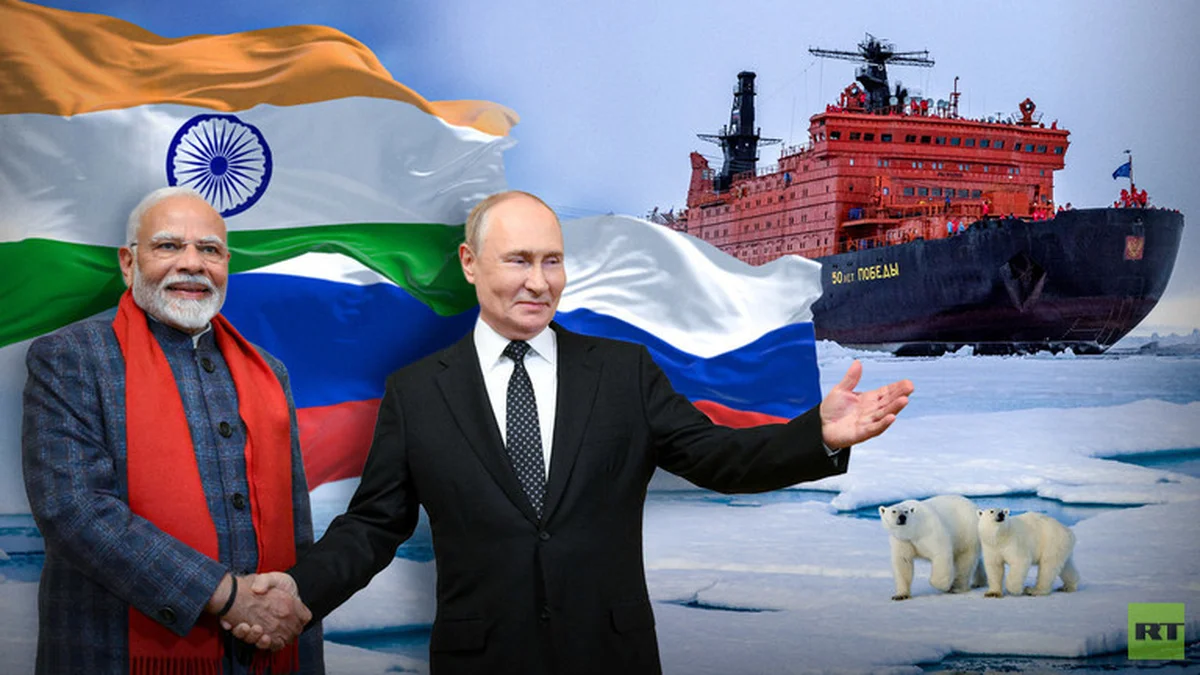
India’s relationship with the Arctic is undergoing a quiet but consequential transformation. For much of the past two decades, New Delhi’s engagement with the polar region was framed largely through the lens of science—focused on climate research, cryosphere dynamics, and polar expeditions. This approach aligned with India’s role as an observer in Arctic governance and reinforced its image as a responsible stakeholder concerned primarily with environmental change. The recent summit between Prime Minister Narendra Modi and Russian President Vladimir Putin, however, makes clear that this phase is giving way to something more strategic.
The language of the Joint Statement may appear restrained, but its implications are significant. India is signaling that it now wants the Arctic to form part of its broader economic and energy architecture. Commitments to cooperate on the Northern Sea Route (NSR), expand trade and investment in Russia’s Arctic and Far East regions, and institutionalize regular consultations on Arctic governance suggest that New Delhi is no longer content with remaining on the margins of polar decision-making. Instead, it seeks to become a participant in shaping the rules and norms of a rapidly emerging Arctic economy.
This shift is closely tied to India’s evolving energy and industrial priorities. As the world’s third-largest energy consumer, India faces mounting pressure to secure reliable supplies while accelerating its transition toward cleaner energy sources. Ambitious national targets—such as achieving 500 GW of non-fossil electricity capacity by 2030—have placed critical minerals, advanced manufacturing inputs, and resilient supply chains at the center of India’s strategic planning. In this context, the Arctic is increasingly viewed not as a remote frontier but as a potential enabler of long-term energy security.
For India’s energy transition, the Arctic offers a valuable strategic hedge. Global demand for critical minerals such as lithium, cobalt, and nickel is rising sharply, driven by the expansion of electric vehicles, battery storage, and renewable energy infrastructure. India remains heavily dependent on imports for these materials, while many existing supply routes pass through congested and geopolitically sensitive maritime chokepoints. Northern connectivity through the Arctic, particularly via the NSR, provides an additional layer of diversification—one that can reduce exposure to disruptions in traditional sea lanes and enhance supply-chain resilience.
Importantly, India’s Arctic engagement is not limited to the movement of resources alone. The focus on developing Arctic-related human capital marks a deeper, more durable form of involvement. Cooperation on training specialists for work in polar waters, Arctic shipping, and cold-climate operations positions India to play a meaningful role in sustaining Arctic logistics as activity in the region grows. As one of the world’s largest suppliers of maritime labor, India is well placed to fill emerging skill gaps in ice navigation, polar engineering, and Arctic port operations.
This emphasis on people carries strategic implications. States that supply specialized expertise essential to the functioning of critical corridors often gain informal influence over how those corridors are managed. Indian professionals embedded in Arctic shipping and logistics networks can help shape operational practices related to safety, environmental monitoring, and transparency. In doing so, India can align day-to-day Arctic operations with its broader emphasis on sustainable and equitable development.
Governance represents another key dimension of India’s Arctic turn. The commitment to regular bilateral consultations on Arctic issues with Russia creates a structured channel for dialogue at a time when multilateral Arctic institutions face constraints due to geopolitical tensions. For observer states like India, whose influence within traditional Arctic forums has been limited, bilateral engagement with Russia—the Arctic’s largest coastal state—offers an alternative pathway to participate in norm-setting.
Through this route, India can introduce Global South perspectives into discussions on Arctic shipping regulations, search and rescue frameworks, environmental safeguards, and the governance of new mining and infrastructure projects. This approach is consistent with India’s 2022 Arctic Policy, which explicitly links polar engagement to climate science, environmental protection, and the well-being of local and Indigenous communities. By integrating these principles into its growing economic presence, India positions itself as an advocate for a more inclusive and balanced model of Arctic development.
Taken together, these developments suggest that the Arctic is becoming an integral component of India’s long-term strategic thinking. While the Indo-Pacific will continue to anchor maritime security and conventional energy flows, and Eurasian corridors such as the International North-South Transport Corridor will shape overland connectivity, the Arctic represents a complementary vector—one oriented toward the future of clean energy, critical minerals, and specialized services.
If pursued with consistency and strategic discipline, India’s Arctic turn could reinforce its decarbonization pathway, strengthen its resilience against supply-chain shocks, and enhance its strategic autonomy in an increasingly fragmented global order. What was once primarily a domain of scientific curiosity is now emerging as a subtle but significant arena of geopolitical and geoeconomic opportunity for New Delhi.
Source: RT