



People’s daily living expenses have started to increase
Daily living costs in the country have started to rise again. From edible oil, vegetables, and cooking gas to transportation expenses are increasing in almost every sector, creating new pressure. Due to global instability, uncertainty in fuel supply, and rising transportation costs, price pressure on essential commodities is gradually increasing. As a result, even though incomes remain unchanged, rising expenses are making life more difficult for ordinary people.
This impact is being felt most by low- and middle-income families. Rising prices of daily necessities, increased LPG gas prices, and higher transportation costs are rapidly changing monthly household budgets. Economists say that if instability in the energy sector continues, this cost pressure may increase further.
New pressure in the edible oil market
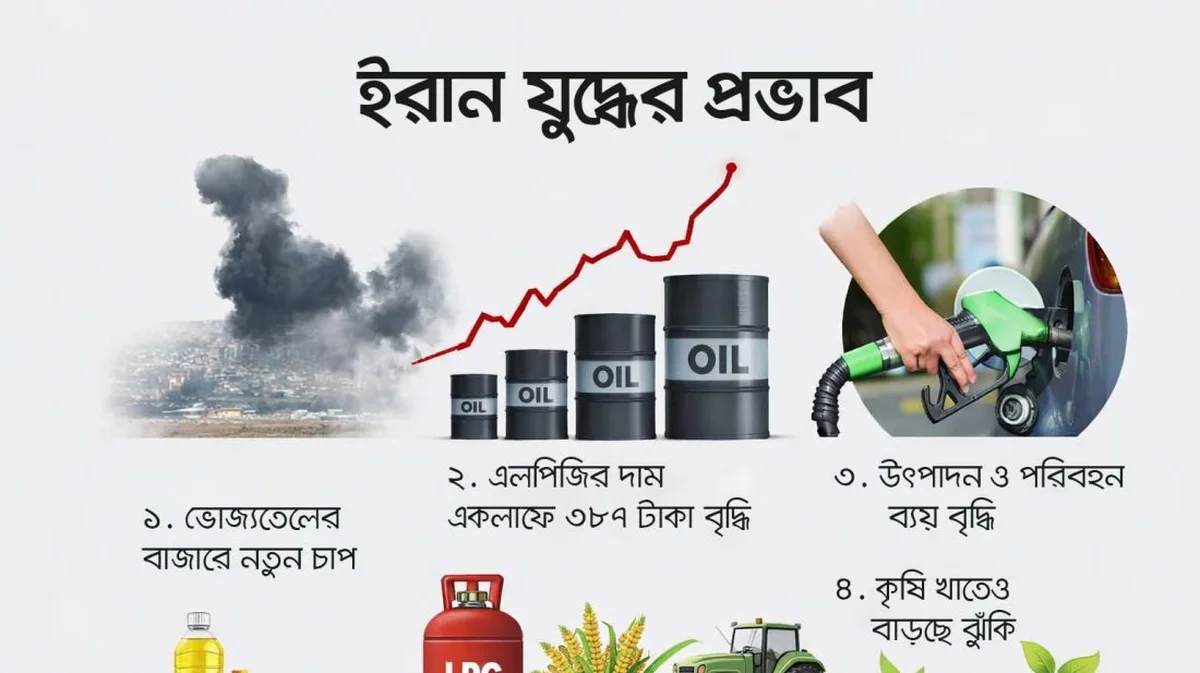
Recently, prices of loose edible oil have increased significantly. Retailers say that within just two days, the price of loose palm oil and soybean oil has increased by 7 to 10 taka per liter. According to traders, wholesale prices have suddenly risen by nearly 1,000 taka per drum, directly impacting the retail market. As a result, consumers are forced to buy oil at higher prices.
Traders say that ongoing conflict in the Middle East has created instability in the global energy market. Disruptions in fuel supply have increased transportation costs, which in turn are raising prices of import-dependent goods. Even before Eid-ul-Fitr, edible oil prices were already showing an upward trend. However, rising military tensions centered around Iran have created new pressure in the market.
LPG price jumps by 387 taka
The biggest shock to household expenses has come from the cooking gas market. The Bangladesh Energy Regulatory Commission (BERC) has announced new LPG prices for April. According to the new rates, the price of a 12 kg LPG cylinder has increased by 387 taka, reaching 1,728 taka, up from 1,341 taka last month. This means the price per kg has increased by about 32.30 taka, marking the largest recent hike.
BERC Chairman Jalal Ahmed announced the new price on Thursday (April 2) afternoon, which became effective from the same evening.
According to the new calculation, the price per kg of LPG has been set at 144.04 taka, and prices of cylinders of different sizes will be determined accordingly. However, there have long been complaints that gas is not always sold at the official rate. Consumers allege that in many cases LPG is being sold at 300 to 400 taka above the fixed price.
Meanwhile, the price of autogas used in vehicles has also increased. Under the new rate, the price per liter of autogas has been set at 79.77 taka, which is about 18 taka higher than before.
Expenses rising faster than income
One of the biggest concerns in the current economic situation is that expenses are rising faster than income. Due to the energy crisis, many industries are operating partially. Production in the small and medium enterprise (SME) sector has particularly declined. As a result, many workers are losing jobs or being forced to work at lower wages. Overtime work has also stopped for many, reducing their monthly income. At the same time, rising costs of food, fuel, and transportation are making life even more difficult.
A similar situation is seen in the transport sector. Due to the fuel crisis, vehicle operations have decreased in many areas. As a result, drivers, helpers, and ride-sharing workers are experiencing reduced incomes.
At the same time, due to limited transport services, there are complaints of overcharging fares, increasing travel expenses for passengers.
Rising production and transportation costs
The energy crisis has also created pressure on production and supply systems. Due to electricity shortages, many industries are using generators as an alternative, increasing production costs. A similar situation exists in goods transportation. Traders say that diesel shortages have increased transport costs, which is raising market prices.
Kamruzzaman Kamal, Marketing Director of Pran-RFL Group, said, “Energy is connected to almost every sector of the economy. Currently, uncertainty in diesel supply is creating problems in both production and marketing.” He added that limited transport often delays product delivery, reducing supply and pushing prices upward.
Growing risks in the agricultural sector
The impact of the energy crisis is also being felt in agriculture. Since irrigation heavily depends on diesel, disruptions in supply could affect agricultural production. The agriculture sector contributes about 13% to the country’s GDP and is also one of the largest sources of employment. Any disruption in production could impact food supply and market prices.
Fuel also plays a vital role in fertilizer production and transportation. Therefore, if the energy crisis persists, agricultural production costs may rise further.
Impact of the global market
According to M Zakir Hossain Khan, Chief Researcher at Change Initiative, a $10 increase in global oil prices per barrel could raise Bangladesh’s annual expenses by about $1 billion. If oil prices remain above $120 for a prolonged period, additional annual costs could reach $4 to $5 billion, equivalent to over 60,000 crore taka.
He noted that Bangladesh depends on imports for about 95% of its fuel, so global price increases quickly affect the domestic economy.
Pressure on the macroeconomy
Economist Professor Abu Ahmed said, “Energy is a sector that is connected to almost every part of the economy. So, when there is an energy crisis, it affects production, transportation, inflation, and overall economic growth.” He emphasized the need to reduce government expenditure and adopt efficient energy policies.
He added that the country’s foreign debt currently stands at around $115 billion, and a large portion of the budget is spent on interest payments. In this situation, any further increase in energy costs could put additional pressure on the economy.
Price pressure may increase further
Economists believe that if energy and transport costs continue to rise, a second wave of inflation may occur. Initially, fuel and transport costs increase, followed by higher production and supply costs, and eventually rising prices of food and services. This could further increase the cost of living, especially for low- and middle-income families.
Need for coordinated measures
Economists suggest that the government must ensure fuel supply, strengthen market monitoring, and keep production sectors active to tackle the situation. At the same time, priority should be given to fuel supply in key sectors such as agriculture, transportation, and export-oriented industries.
They believe that unless the global situation stabilizes, price pressure in the market is unlikely to ease completely. As a result, the rising trend in living costs may continue for the time being.
Source: Bangla Tribune