Liberation War Sculptures Vandalized Nationwide, No Initiative for Restoration
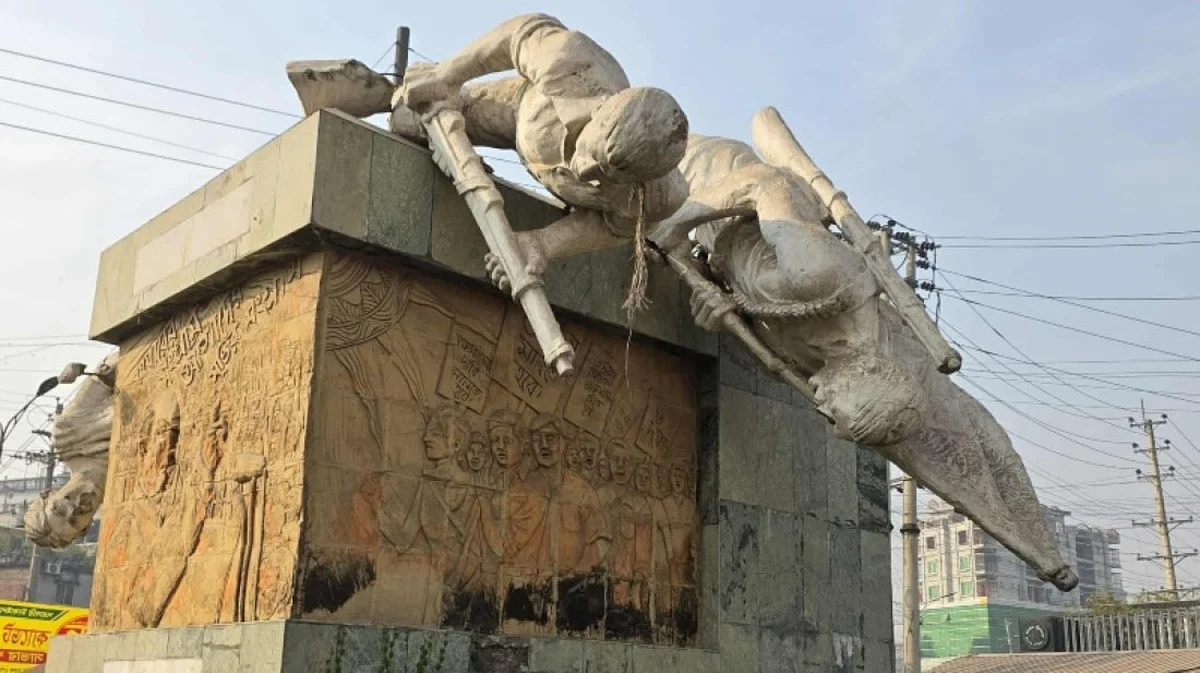
While traveling from Dhaka to Savar, just after crossing Hemayetpur Bazar, one’s eyes get stuck on a crumpled and broken sculpture. The sculpture titled “Bijoy Jatra (Victory March)”, created by Esanul Ahsar Khan Mithu, once depicted the upright torsos of two freedom fighters standing with chests held high. After being vandalized following August 5, 2024, the collapsed torso sculptures have still not been removed from the site. Every time someone passes by, it seems the very purpose is to repeatedly show these portraits of freedom fighters being dishonored.
In the face of a student–mass movement, the Awami League government fell on August 5 last year. Following this, numerous sculptures, relief sculptures, murals, and memorials were vandalized and set on fire in the capital and across the country. These include sculptures and murals of Bangabandhu Sheikh Mujibur Rahman, members of his family, the four national leaders, and other eminent personalities. There are also sculptures and murals symbolizing the Liberation War, various historical events, and contexts.
In the post–August 2024 period, the Faculty of Fine Arts of Dhaka University stated that they wanted to work on sculptures by preparing a list. Subsequently, Nasimul Khabir, Chairman of the Department of Sculpture at Dhaka University, confirmed to Bangla Tribune that a draft list of vandalized sculptures across the country has been prepared.
He said, “After August 5, 2024, taking advantage of political protests or student–mass protests, countless sculptures were vandalized across the country. For two to three months, we independently tried to compile a nationwide list of vandalized sculptures. At that time, we initially prepared a list of approximately four hundred and fifty vandalized sculptures.”
He further said, “Many of the vandalized sculptures actually had no political connection. Yet those sculptures were vandalized. Notably among them is the Venus sculpture at the house of Maharaja Shashikanta Acharya in Mymensingh. A group of religious extremists had long tried to demolish it. The sculpture has immense heritage value and significance.”
Nasimul Khabir added, “Additionally, more than fifty portrait sculptures of eminent personalities created by artist Shamim Sikder, a former student of Dhaka University, located on Fuller Road of Dhaka University, were vandalized. The sculpture Duranto created by Sultanul Islam in front of the Shishu Academy, the Tevaga Chattar based on the Santal rebellion created by artist Manabendra Ghosh in Kaharol upazila of Dinajpur—these were also vandalized, essentially by religious fundamentalists.”
He further said, “So far, we have no information about any restoration or reconstruction of any sculpture. There is not even any visible initiative from the ministry regarding how these sculptures can be repaired.”
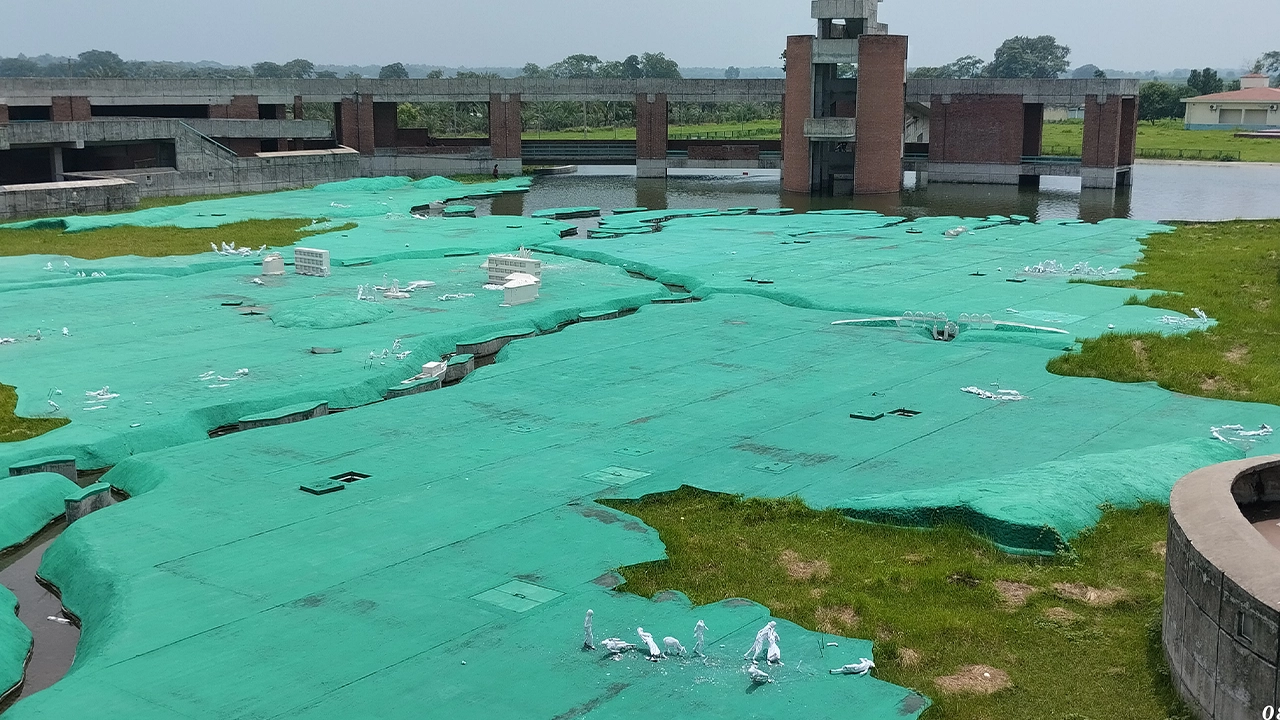
According to information received from the Department of Sculpture of Dhaka University, more than three hundred documentary sculptures of the Liberation War in Mujibnagar, Meherpur, have been vandalized. Along with these, numerous sculptures across the country depicting the Liberation War, freedom fighters, and Bangabandhu Sheikh Mujibur Rahman have been vandalized.

These include the bust sculpture of Bangabandhu by artist Shyamal Sarkar at Jagannath Hall of Dhaka University, the Bangabandhu sculpture at the Ansar Academy in Shafipur, the Bangabandhu sculpture at Chandpur bus stand, the Liberation War memorial sculpture in Shibchar, the Liberation War memorial sculpture in Rajshahi, and the Bangabandhu sculpture created by artist Shyamal Sarkar at Uzirpur Municipality in Barishal.
Additionally, notable vandalized sculptures include the Bangabandhu sculpture created by artist Ashiqur Rahman at BGB headquarters in Pilkhana, the Bangabandhu sculpture created by artist Shyamal Chowdhury at the Folk Art Museum in Sonargaon, the Bajrakontho/Bangabandhu sculpture created by artists Atikul Islam, Joyshish Acharya, Tapan Ghosh, Bilas Mondol, Parvez, and Nur at Boropul in Halishahar, Chattogram, the Bangabandhu sculpture at the five-road intersection of Kushtia Municipality (under construction), and the Bangabandhu sculpture at Comilla University.
The Liberation War sculpture at Babu Bazar in Keraniganj, the Liberation War sculpture in Tarail upazila of Kishoreganj, the freedom fighter sculpture created by artists Sanad Kumar Biswas and Rupam Roy at Ghatar Char, and the freedom fighter sculpture at Nur Islam Commander Square at Kadamtali intersection in Keraniganj were also vandalized.
The Mrittunjoy sculpture by artist Shyamal Sarkar at Bijoy Smarani in Dhaka, the bust of Shilpacharya Zainul Abedin at the Mymensingh Museum, the Tarjoni sculpture by artists Ali Mahmud, Alok Sarkar, Tapan Ghosh, and Imran Mahamud in Narsingdi, and Mrinal Haque’s rickshaw sculpture were also vandalized.
Furthermore, at Suhrawardy Udyan in the capital, the Independence and Liberation War commemorative relief sculpture (under construction) by artist Alok Roy, the documentary sculpture of the surrender on December 16, 1971 (under construction) by artists Rupam Roy and Syed Tarek Rahman, the terracotta relief sculptures based on the history of independence created by artists Mohammad Yunus, Shishir Bhattacharya, Shyamal Chowdhury, among others, and the documentary sculpture of the historic March 7 speech (under construction) by artists Roni Pal, Habibur Rahman, and Alok Roy were vandalized.
Regarding the vandalized sculptures on Fuller Road, Dhaka University student Tanzir Hossain told Bangla Tribune, “The entire sculpture on Fuller Road was created using the facial features of 18 martyrs who were killed from the 1952 Language Movement, the Liberation War of ’71, the Black Night of March 25, the Declaration of Independence on March 26, up to the final victory on December 16.”
He further said that sculptures of Rabindranath Tagore, Kazi Nazrul Islam, Lalon Fakir, Jagadish Chandra Bose, Bankim Chandra Chattopadhyay, Ishwar Chandra Vidyasagar, Michael Madhusudan Dutt, Sukanta Bhattacharya, artist S. M. Sultan, Subhas Bose, Mahatma Gandhi, Kemal Ataturk, Raja Ram Mohan Roy, Mao Zedong, Yasser Arafat, Sher-e-Bangla A. K. Fazlul Huq, Maulana Bhashani, Colonel M. A. G. Osmani, Tajuddin Ahmad, Siraj Sikder, and many other luminaries were also there.
Tanzir Hossain said, “The unfortunate thing is that after the mass uprising of ’24, these sculptures were vandalized. Even after so long, no initiative has been taken to restore them. The government should take steps to restore these as quickly as possible.”
When asked about when the vandalized sculptures across the country would be repaired, Mohammad Azmul Haque, Additional Divisional Commissioner serving as Administrator of the Dhaka District Council, told Bangla Tribune, “I am not aware of the matter. The department under whose supervision the sculptures were constructed would know the matter better.”
In response to whether the Ministry of Cultural Affairs has taken any initiative to restore vandalized sculptures, the Personal Secretary (Deputy Secretary) to the Secretary of the Ministry of Cultural Affairs, Md. Saiful Islam, told Bangla Tribune, “This matter related to sculptures is not under us. It falls under the Ministry of Local Government or the Department of Architecture. We work on language, literature, culture, and ethnic groups. We are not directly involved with sculptures. However, we do some work related to the National Museum. I am not aware whether any discussion regarding sculpture restoration has taken place in this ministry.”
In response to whether vandalized Liberation War–related sculptures would be restored, Liberation War Affairs Adviser Faruk-e-Azam said on December 14, after paying tribute at the Martyred Intellectuals’ Memorial in Mirpur, “The structures that were damaged during the uprising will be restored.”
Source: Bangla Tribune