

Railway Fares in the Eastern Zone to Increase from December 20

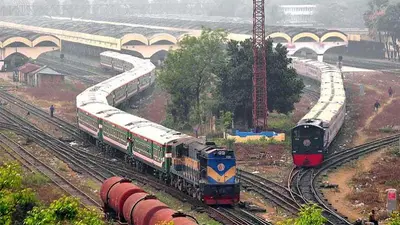
Bangladesh Railway is recovering its investment by imposing an Extra Distance or Pontage Charge (additional fee) on newly constructed bridges. This time, the organization has imposed pontage charges on old bridges and culverts as well. Due to the regular implementation of this charge on 11 bridges, the Eastern Railway authorities are increasing fares for all passenger trains from December 20. As a result, the highest fare is increasing by more than 200 taka. After approval from the Ministry of Railways, the Eastern Railway commercial division approved the new fare structure yesterday. From December 20, passengers will have to pay increased fares when purchasing tickets.
According to railway sources, a decision was taken to impose pontage charges on old bridges and culverts to increase railway revenue. For this, the railway authorities approved the distance chart for bridges and culverts that are 100 meters or longer. On November 25, Shah Alam, Deputy Director (Marketing) of the Railway, issued a letter instructing the Chief Commercial Officer of the Eastern Zone to take necessary measures to implement the new fare from December 20. Later, on December 8, Assistant Chief Commercial Officer Jasim Uddin Bhuiyan approved the letter for implementation and public dissemination. As per the new structure, the minimum fare in the Eastern Zone is increasing by 5 taka and the maximum by 226 taka.
Previously, one kilometer of a bridge was considered equivalent to 17 kilometers for fare calculation. Under the new rule, one kilometer of a bridge will be counted as 25 kilometers. An analysis of the data shows that for regular trains (intercity, mail, and commuter) on the Dhaka–Chattogram–Dhaka route, the current one-way fare distance is 346 kilometers. After imposing pontage, the distance increases by 35 kilometers, reaching 381 kilometers. Based on this, mail train fares on the longest distance (Dhaka–Chattogram and Chattogram–Dhaka) will increase by 15 taka, commuter trains by 20 taka, Shovan Chair by 45 taka, First Seat by 64 taka, Snigdha by 80 taka, First Berth and AC Seat by 98 taka, and AC Berth by 143 taka. On the same route, non-stop train fares will increase by 49 taka for Shovan Chair, 69 taka for First Seat, 88 taka for Snigdha, 108 taka for First Berth and AC Seat, and 159 taka for AC Berth. Apart from the maximum distance, fares for intermediate stations will also increase based on the pontage distance applied to each section.
Similarly, on the Dhaka–Cox’s Bazar–Dhaka route, the current one-way fare distance increases from 535 kilometers to 586 kilometers. For the additional 51 kilometers, fares will increase by 20 taka on mail trains, 25 taka on commuter trains, 60 taka on Shovan Chair, 92 taka on First Seat, 115 taka on Snigdha, 138 taka on First Berth and AC Berth, and 207 taka on AC Berth. On this route, non-stop train fares will increase by 64 taka for Shovan Chair, 101 taka for First Seat, 127 taka for Snigdha, 151 taka for First Berth, 150 taka for AC Seat, and 226 taka for AC Berth.
On the Dhaka–Sylhet–Dhaka route, the current one-way fare distance increases from 319 kilometers to 350 kilometers. Mail and commuter fares will increase by 15 taka, Shovan Chair by 35 taka, First Seat by 58 taka, Snigdha by 69 taka, First Berth and AC Seat by 80 taka, and AC Berth by 127 taka. On the Chattogram–Sylhet–Chattogram route, the one-way distance increases from 391 kilometers to 403 kilometers. On this route, fares will increase by 10 taka for mail and commuter trains, 25 taka for Shovan Chair, 40 taka for First Seat, 52 taka for Snigdha, 57 taka for First Berth and AC Seat, and 87 taka for AC Berth.