



Rohingyas in Deep Crisis
International Aid Below 50%, No Response to Interim Government
In March of this year, UN Secretary-General António Guterres visited Bangladesh. One of the main objectives of the visit was to highlight the Rohingya crisis strongly on the international stage. During this time, he also visited the Rohingya camps. He was accompanied by the Chief Adviser of Bangladesh’s interim government, Dr. Muhammad Yunus. In addition, in September, a high-level international conference on the Rohingya situation was held at the UN headquarters in the General Assembly Hall. The Chief Adviser of Bangladesh was in attendance. According to the Chief Adviser’s Press Wing, representatives from at least 75 countries and organizations participated in the conference. At various times, the Foreign Affairs Adviser and other senior officials of the interim government have been calling on different platforms for resolving the Rohingya crisis and increasing humanitarian assistance. But there has been no response to the call of the interim government. On the contrary, so far this year, the international assistance received for the Rohingyas living in Bangladesh has been less than half of what was required.
Due to the significant decline in international assistance, the Rohingya camps in Cox’s Bazar are now facing not only shortages in food or medical services but an existential crisis for the entire population. According to data from the Financial Tracking Service (FTS) of OCHA, a UN humanitarian coordination agency, a total of 934.5 million dollars was needed under the 2025 Joint Response Plan to address the Rohingya crisis. As of yesterday, only 464.4 million dollars had been received—just 49.7 percent of the requirement. This means more than half of the needed assistance (about 470 million dollars) is still lacking. Notably, under the 2024 Joint Response Plan, 852.4 million dollars had been required for the Rohingyas, but only 546.6 million dollars was received throughout the year, which was 64.1 percent of the total requirement. In other words, compared to last year, international assistance has declined significantly this year.
With the decline in international humanitarian aid, there has been a severe crisis across almost all humanitarian sectors—food, nutrition, healthcare, safe water and sanitation, shelter, and education. Analysts say that if assistance continues to fall in this manner, the Rohingya crisis may soon take a disastrous turn, posing major risks for Bangladesh as well.
Nearly 1.2 million forcibly displaced Rohingyas from Myanmar currently live in Bangladesh. They mostly live in refugee camps in Cox’s Bazar and Bhasan Char. Most of the funds required for their food, education, and training come from international assistance. Due to the decline in that assistance, the Rohingya camps have now fallen into a complex humanitarian crisis. According to a report by The Guardian, global humanitarian funding is currently decreasing. New wars, disasters, and shifting global attention have all contributed to the decline in humanitarian support for the Rohingya crisis. As a result, many donor organizations are pulling out. This has led to budget cuts in food, nutrition, healthcare, education, and shelter in the Rohingya camps. Basic necessities such as infant formula, cleaning supplies for toilets, and even medicines are not arriving regularly.
Analysts believe that if donor organizations cannot increase aid quickly, this population will face a long-term crisis in a completely helpless state. And if the assistance level continues to decline, the children growing up under thousands of tents in Cox’s Bazar will head toward a severely uncertain future—one where basic necessities of life such as food, healthcare, and education will not be guaranteed.
International assistance declining has created new and deep risks for Bangladesh regarding the Rohingya crisis, according to researcher and political analyst Altaf Parvez. He said, “Just as assistance has decreased now, it will decrease further in the future. The recent arrival of new Rohingyas is already complicating the situation. The first and most immediate risk is the economic pressure on Bangladesh. In addition, in the struggle to survive, Rohingyas may turn to irregular work and spread outside the camps. Attempts to migrate abroad illegally may increase. There is a risk of involvement in smuggling and drug trafficking. The even bigger concern is the risk of extremism. If assistance decreases and frustration grows, a section of Rohingya youth may become increasingly drawn to extremist or violent groups.”
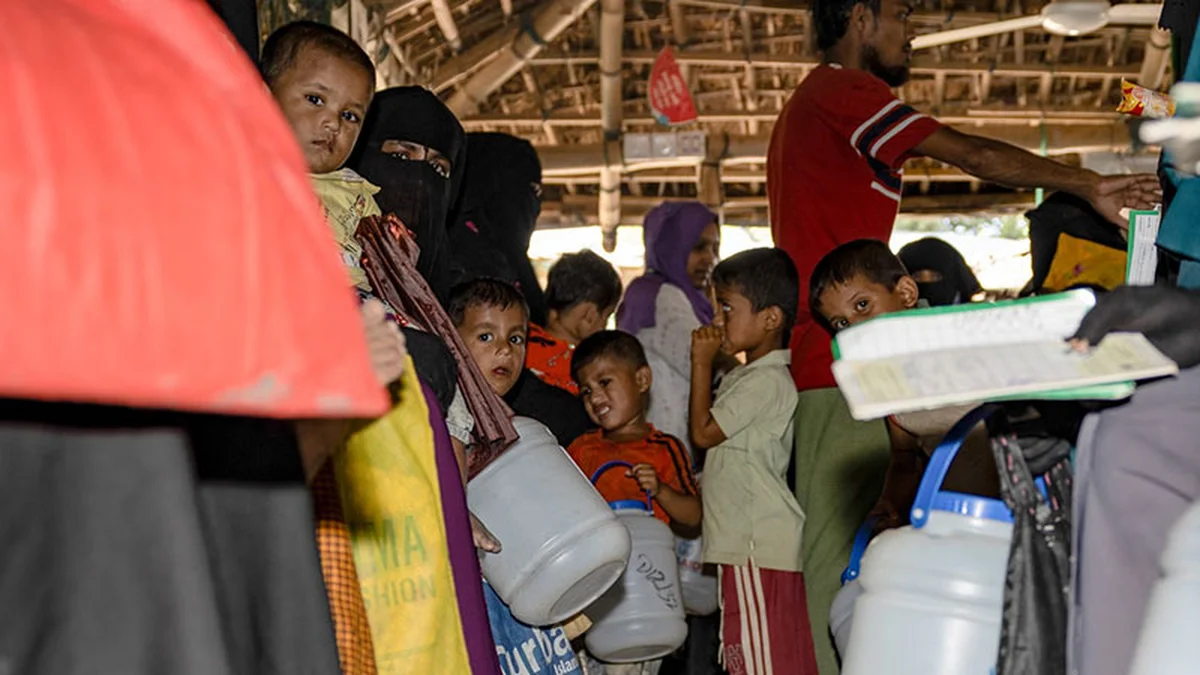
Due to a 50 percent decline in the required funding this year, many services have already been reduced by half. Many health centers have been forced to shut down or limit services. Maternity services, surgeries, and emergency care for children—all are under strain. UNICEF’s nutrition center in Camp 15 has to conduct severe malnutrition tests on 300 children every day, and the number of malnourished children has increased by 11 percent compared to last year. Newborns are being born into an environment where saline, vitamin A, and ready-to-use therapeutic food are all in shortage.
Not only children but pregnant women are also in poor condition. As rations have shrunk, regular meals in many families have dropped to half. Mothers are not getting protein-rich food and even safe delivery supplies are lacking. As a result, the number of low-birth-weight babies is increasing. Many children are at risk of severe malnutrition from the very first week of life.
Not only food or health—everyday life in the camps is in crisis. There is a shortage of safe water and sanitation. In many places, the supply of soap and basic hygiene items has stopped. The makeshift shelters made of tarpaulin and bamboo have become vulnerable due to lack of maintenance, with risks of collapsing during storms or rain. Budget cuts in education have reduced community-based learning opportunities. According to those involved, a dire situation may develop if funding does not increase. The impact will not only fall on the Rohingyas but also on the Cox’s Bazar region and the local economy.
Tanvirul Miraj Ripon, a journalist who has been working with refugees along the Myanmar–Bangladesh border for almost eight years, said, “In education, health, and nutrition, assistance is almost on the verge of stopping. Its immediate effects may not be visible, but later it will turn into a severe humanitarian disaster. If education stops, it will not only create learning gaps but also create major inequalities in overall skill development. This will increase the risk of conflict between camp youths and the local population.”
He also said, “The children who came in 2017 at the age of five or six are now teenagers or young adults. Without opportunities to acquire skills, they are becoming unemployed in large numbers. The extremist groups that are active will again look for opportunities to take advantage of the situation. The limited training programs that existed to make Rohingyas skilled human resources have almost stopped. As a result, they are unable to transform into a skilled workforce. On the contrary, drug traffickers will be able to target this population easily. Therefore, if assistance declines, the social impact will be devastating.”
Expressing concern over the downward trend in humanitarian assistance, relevant officials say that major donors such as the United States have already reduced support. If this trend continues, assistance will decline even further. Then a crisis similar to that before 2017 may emerge again. The biggest fear is that the world will gradually forget the Rohingya issue. This will not only increase the suffering of the Rohingyas in the camps but also raise the risk of their dispersal.