

Hundreds of Crores of Taka Collected Daily in Extortion from 3,000 Spots Across the Country
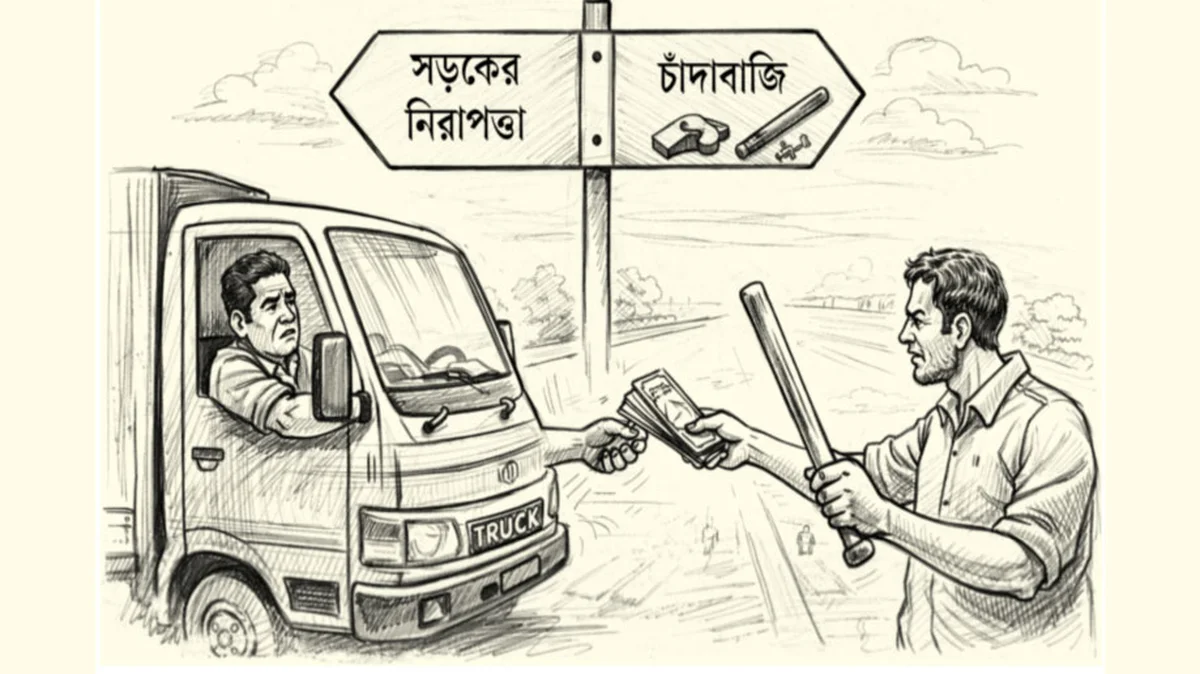
Across the capital and the entire country, nearly three thousand collection points are reportedly extracting hundreds of crores of taka in extortion every day. This extortion, centered around the transport sector, involves road transport owners’ associations, labor organizations, some members of law enforcement agencies, and political activists. In most cases, the money is collected against people’s will through intimidation.
According to information collected from across the country, it is seen that in some places money is collected in the name of terminal management, in some places in the name of parking, and in others extra money is taken along with municipal tolls. Transport drivers and owners have been helplessly paying this extortion for years. As a result, transport fares are increasing, the prices of vegetables and daily commodities are skyrocketing, and ultimately the general public has to bear the burden.
Road Transport, Bridges, Rail and Shipping Minister Sheikh Hasina said in this regard that donations and extortion are two different matters. Donations are given voluntarily, while extortion is forcibly collected. Sheikh Hasina stated that extortion is a criminal offense and that it is the responsibility of the police to take action in this matter. If necessary, an investigation committee can be formed. However, after Sheikh Hasina’s statement, a wave of criticism erupted on social media.
According to data from the Passenger Welfare Association, approximately 6.4 million taka is collected daily from city buses, about 30 million taka from long-distance buses, around 2.7 million taka from CNG auto-rickshaws in Dhaka, about 1.2 million taka from CNGs in Chattogram, nearly 150 million taka from battery-operated rickshaws in Dhaka, and around 400 million taka from battery-operated rickshaws in other parts of the country. In addition, approximately 400 million taka is collected daily from trucks and about 6.4 million taka from tempo and leguna vehicles. Altogether, nearly 1 billion taka is being collected daily from the transport sector.
There are allegations that although money is collected in the name of welfare of labor and owners’ association members, in reality it amounts to extortion. About 90 percent of the money is taken against the will of drivers and conductors. If money is not paid, incidents of vehicle vandalism or physical assault occur. Since independence, many leaders have become influential by relying on this money, and some have even become MPs and ministers. Even when governments change, influential leaders of different political parties compromise among themselves, and the extortion does not stop.
The General Secretary of the Passenger Welfare Association, Mozammel Haque Chowdhury, said that both donations and extortion exist on the roads. He believes that if a digital fare payment system is introduced, extortion will stop. However, in the past, governments did not view the matter positively. In his opinion, it is urgent to form a neutral investigation committee to uncover the real truth.
The President of the Bangladesh Road Transport Workers Federation, Abdur Rahim Box Dudu, said that direct collection of money in the name of the workers’ federation has stopped, but the owners’ association is still collecting money. In his view, there is little possibility that collections under various names will stop. On the other hand, the General Secretary of the owners’ association, Saiful Alam, said that they are voluntarily taking money to cover terminal management expenses, and this cannot be called extortion.
Additional Inspector General of Bangladesh Police (Highway Police) Md. Delwar Hossain Miah said that there is hardly any extortion on the highways. However, there are some problems centered around terminals.
Overall, it appears that extortion in the transport sector is harming not only drivers and owners but the entire society. Fares and commodity prices are rising, and ordinary people are paying the price every day. Without effective measures from the government and the concerned authorities, there is no sign that this syndicate will stop.