In the BCS question paper, the Liberation War is called a ‘Resistance War’
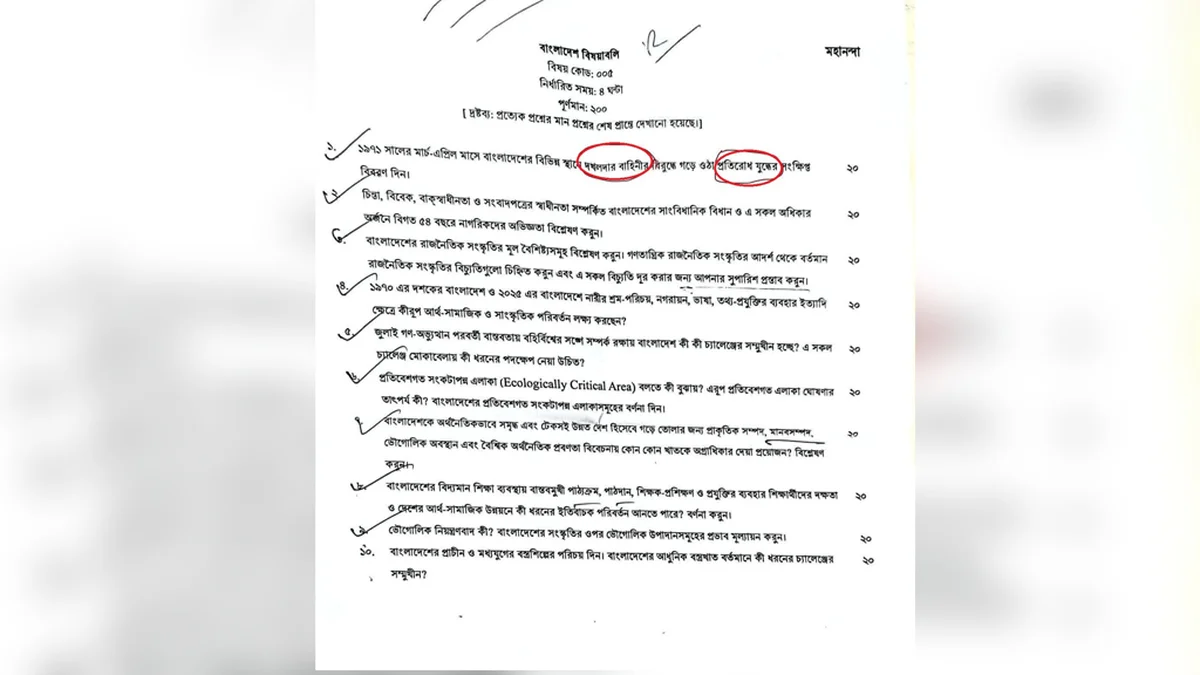
Widespread criticism continues over the use of the terms “resistance war” instead of “Liberation War” and “occupying forces” instead of “Pakistani forces” in the BCS written examination.
These terms appeared in Wednesday’s question paper for the subject “Bangladesh Affairs” in the 47th BCS examination.
In the “Mahananda” set of the 4-hour, 200-mark exam, question number 1 stated: “Give a brief description of the resistance war that developed in various parts of Bangladesh against the occupying forces during March-April 1971.”
On Thursday afternoon, several candidates confirmed to bdnews24.com that such a question appeared in the “Bangladesh Affairs” examination, though none agreed to reveal their names.
A candidate from Dhaka told bdnews24.com, “The terms ‘resistance war’ and ‘occupying forces’ felt somewhat odd. Many candidates discussed the matter.”
The written exam for the 47th BCS began on 27 November. Mandatory subjects will continue until 8 December, and subject-related written exams are scheduled from 10 to 18 December.
Criticism over word choice
Criticizing the choice of such terms, Asif Bin Ali, lecturer of Media and Journalism at North South University, wrote on his Facebook page on Thursday:
“In government job exam questions, they are avoiding the term Liberation War and writing ‘resistance war’; instead of Pakistan Army, they write ‘occupying forces.’
“A female DUCSU leader writes ‘thousands of martyrs.’ Jamaat’s Mufti Kazi Ibrahim says 16 December is not Victory Day but a ‘Black Day.’ He says section 32 is not part of the Liberation War. Your heart aches for the Bihari killings. Another far-right young intellectual now refers to freedom fighters as mobs. Sheikh Mujib cannot be called Bangabandhu. A few days from now they will say Zia was not a rebel. It’s only a matter of time.”
He further wrote, “Whenever we try to detach politics from these pro- and anti-Liberation War narratives and bring them to present-day rights, they drag it back into the same narrative. Those who are doing this are not doing it for history or out of sympathy for Biharis. The truth is, their masks have now come off. They have not forgotten the humiliation of defeat 54 years ago, which is why they are repeatedly attacking the Liberation War.”
Facebook user M Shahjalal Parvez posted a photo of the question and wrote, “In March 1971, people from all walks of life in Bangladesh began an armed Liberation War against the Pakistani invading forces. Why, in 2025, is the Pakistani invading force being called an occupying force and the armed Liberation War against them being called a resistance war? Never forget—if you question your own birth, people will call you illegitimate.”
Another candidate, Sabibul Islam, wrote on Facebook, “PSC is now under Jamaat’s control. That’s why in the 47th BCS question… the Pakistani army has become the occupying force… and the Liberation War has become the resistance war! Let’s keep watching.”
‘Such terminology clearly exposes our affection for Pakistan’
When asked, Liberation War researcher and author Salek Khokon told bdnews24.com, “By using the word ‘occupying forces,’ did they (PSC) consciously try to avoid the word Pakistan? That is what should be questioned. The independent country called Bangladesh was achieved through a bloody struggle, the blood of hundreds of thousands of martyrs, sacrifices, and the bravery of freedom fighters. The use of such terms in this country’s question paper clearly exposes an affection for Pakistan.
“It also raises suspicion whether this is an attempt to distort the history of independence. In the past, we saw exaggerations of history. Now we are seeing attempts to erase it. This is unfortunate.”
He said, “Since they mentioned March-April, resistance battles did take place in many places against the brutal massacres by the Pakistani army. In that sense, the term resistance war is correct. But if you say occupying forces, then what exactly is resistance? Resistance implies that you’re under attack.
“It seems the massacre carried out by Pakistan against Bengalis has been subtly downplayed here, which is unacceptable. The history of the Liberation War is as true as the sun; it is the root of our identity. Attempts to distort, manipulate, or change it happened before and perhaps are happening again.”
What the Commission Says
Attempts were made several times to contact Professor Mobassher Monem, Chairman of the Bangladesh Public Service Commission (PSC), for comment on Thursday, but his phone was found switched off.
When contacted Thursday afternoon, Masuma Afreen, Controller of Examinations (Cadre) of the Commission Secretariat, told bdnews24.com, “If you have any queries, please submit them in writing. I do not want to make any comments over the phone.”
PSC public relations officer SM Matiur Rahman said, “The Commission has not made any comment on this issue yet.”
A PSC official, speaking anonymously, explained the BCS question-setting process to bdnews24.com: “Moderators prepare the questions. Then subject experts finalize them.”
Claiming that the Commission is not directly involved in the question-setting process, the official added, “If the Commission is notified of any concerns about word choice, it typically warns the moderators for future question-setting.”
Source: bdnews24