

Experts Call for Constitutional Reforms to Strengthen Rights and Equality
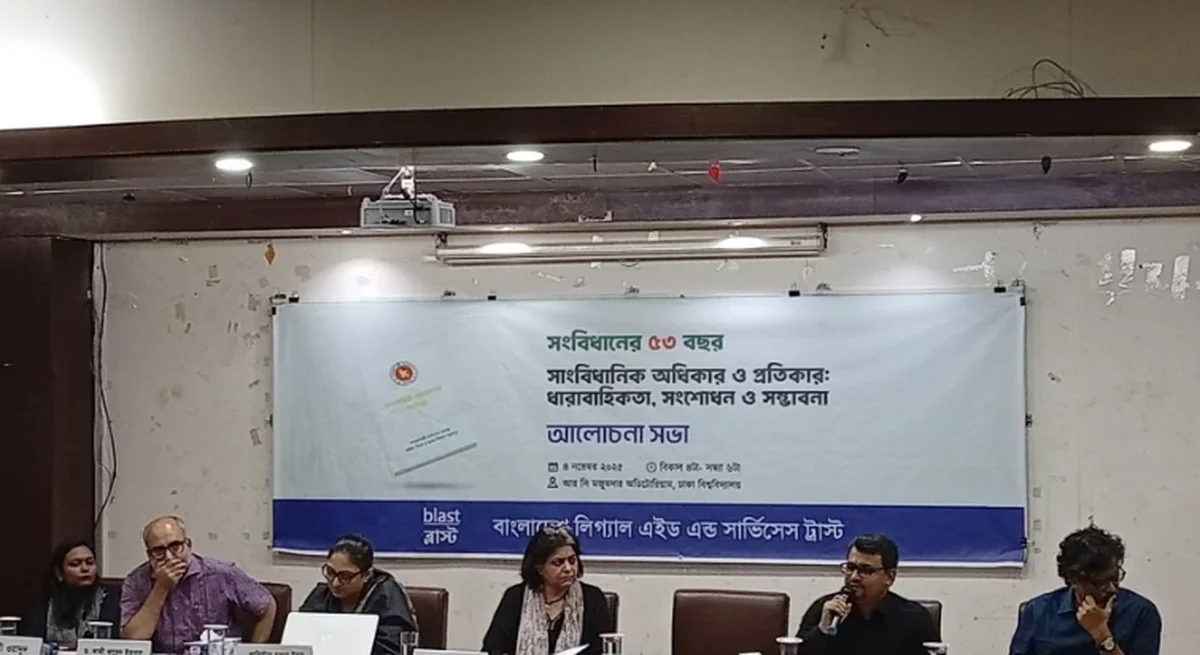
At a discussion marking the 53rd anniversary of the Constitution of Bangladesh, legal experts and rights advocates underscored the urgent need for constitutional reforms to make fundamental rights more effective through progressive interpretation and implementation.
Speakers emphasized that the Constitution’s core principles—equality and non-discrimination—must be reflected not only in judicial decisions but also in the broader spheres of politics, governance, and social life.
The discussion, titled “Constitutional Rights and Remedies: Continuity, Reform, and Possibilities,” was organized by the Bangladesh Legal Aid and Services Trust (BLAST) at the RC Majumdar Auditorium, University of Dhaka. Participants included senior lawyers, academics, and human rights defenders who reflected on the evolution of constitutional rights and the scope for reform.
Equality and Non-Discrimination
Psyme Wadud, Lecturer at the Department of Law, University of Dhaka, cited landmark Supreme Court judgments upholding the principle of equality. She noted that one of the central aspirations of the July Uprising was to build a state free from discrimination—an objective still awaiting full constitutional recognition.
She called for widening affirmative action programs to reach marginalized groups and stressed that genuine equality requires not only legal reform but also cultural and political transformation rooted in inclusion and empathy.
Personal Law and Constitutional Supremacy
Lawyer and writer Millat Hossain observed that although Article 7 declares the Constitution as the supreme law of Bangladesh, in practice, personal laws often override it, weakening the principle of equality before the law.
He argued that despite constitutional guarantees, systemic discrimination persists. References to a singular Bengali identity and the later inclusion of a state religion have, he said, marginalized indigenous peoples, Dalits, and religious minorities.
“We must imagine a state,” he added, “where every citizen can freely and proudly assert their own identity.”
Right to Health and Accountability
Supreme Court Advocate Barrister Rashna Imam noted that while the right to health has not yet been recognized as a fundamental right, it has been affirmed through judicial interpretation of the right to life and state policy principles.
Referring to the Dr Mohiuddin Farooque case, where the High Court recognized the right to a healthy environment, as well as cases on emergency medical care and organ donation, she emphasized the need for comprehensive legislation to ensure equitable, accountable, and accessible health services for all citizens.
Safeguards Against Arbitrary Arrest
Supreme Court Advocate Dr Qazi Zahed Iqbal stated that although the Constitution provides safeguards against arbitrary arrest and detention, these protections are often undermined by misuse of Sections 54 and 167 of the Code of Criminal Procedure and the Special Powers Act 1974.
He highlighted the BLAST and Saifuzzaman cases as key rulings on the issue, noting partial progress in incorporating the Supreme Court’s directives into recent legal amendments. Iqbal urged alignment of domestic laws with international human rights standards, particularly the Convention Against Torture, to ensure genuine accountability and remedy.
Freedom of Thought and Expression
Writer and Constitutional Reform Commission member Firoz Ahmed remarked that limitations on freedom of thought and expression have existed since the Constitution’s inception. While the 1972 Constitution reflected the ideals of the Liberation War, it also concentrated power within individuals, paving the way for one-party dominance.
He criticized Article 70 for curbing MPs’ freedom of conscience, thus weakening democratic representation. Ahmed shared the Commission’s key reform proposals, which include:
- Recognizing the right to critique judicial decisions;
- Protecting fundamental rights even during emergencies;
- Acknowledging collective property rights of indigenous peoples; and
- Constitutionally recognizing all ethnic and linguistic identities.
Broadening Constitutional Protections
Dr Sharif Bhuiyan, Senior Advocate of the Supreme Court and Commission member, noted that public debate on constitutional reform following the July Uprising was unprecedented in scope.
He said the Commission’s recommendations — including expanded social and economic rights and stronger equality protections — have yet to be fully incorporated into political discourse. He pointed to ongoing Supreme Court litigation regarding Articles 116, and the 13th and 15th Amendments, arguing that court-led reform can drive meaningful constitutional change.
Toward a People-Centered Constitution
In an open discussion, participants highlighted the need to recognize Bangladesh’s cultural and ethnic diversity, prevent forced evictions, address climate-related rights, ensure access to education and culture, and promote decentralization of power.
They also called for simplified versions of the Constitution to make it more accessible to the public.
In her closing remarks, Senior Advocate and BLAST Executive Director Sara Hossain noted that the post–July Uprising context had opened new space for public discourse on justice and rights. She cautioned against rising hate speech and conservative opposition to equality and non-discrimination.
Hossain emphasized that building strong, independent institutions and mobilizing citizens to speak out against injustice are essential steps toward realizing constitutional rights for all.