
Sheikh Hasina Warns of Anarchy and Democratic Collapse Under Yunus Administration
In her first speech at a public event since being forced into exile in India after losing power during the 2024 movement, Awami League leader Sheikh Hasina launched a sharp critique of Nobel laureate Muhammad Yunus, the Chief Adviser of Bangladesh’s interim government.
According to NDTV, accusing the current administration of running an “illegal and violent” regime, Sheikh Hasina said that under Yunus’s leadership the country has entered “an era of fear, anarchy, and the exile of democracy.”
Opponents of Sheikh Hasina—who has been sentenced to death by the International Crimes Tribunal on charges of ordering the killing of 1,400 people to suppress the movement in Bangladesh—often describe her as a “corrupt fascist autocrat.”
That same Sheikh Hasina, in her address, repeatedly labeled Yunus a “killer fascist,” “moneylender,” “money launderer,” and “power-hungry traitor,” launching an unusually fierce personal attack.
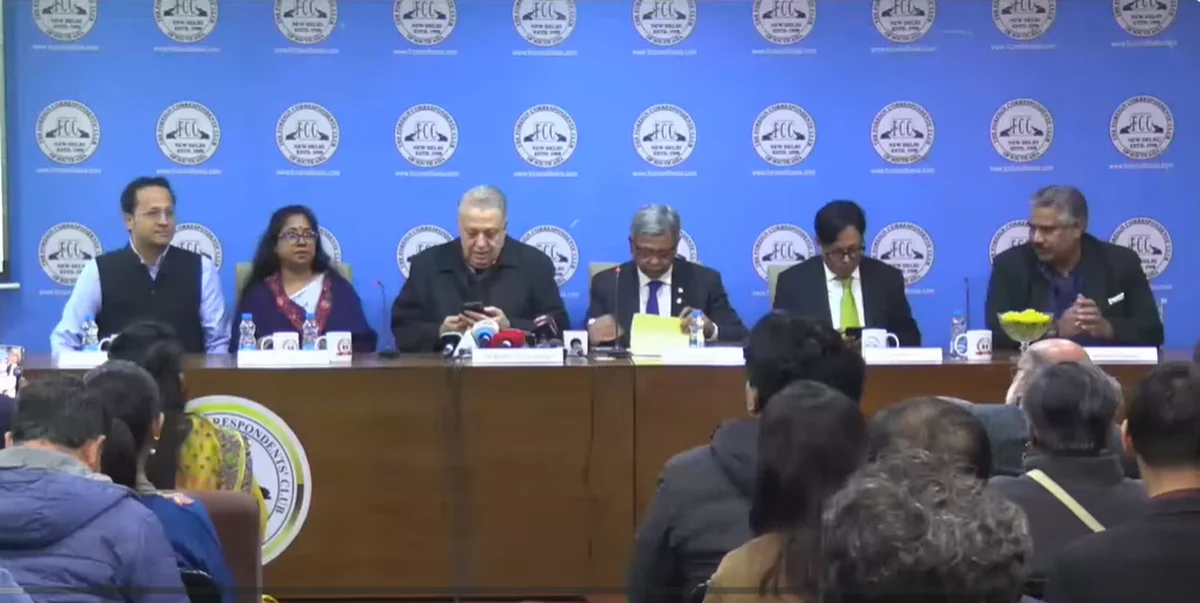
Sheikh Hasina delivered the speech via an audio message at a press conference held on Friday at the Foreign Correspondents’ Club in Delhi. In the eyes of Bangladesh’s courts, Sheikh Hasina is currently regarded as a fugitive death-row convict.
Describing the country’s ongoing political situation as a crisis threatening the very existence of “sovereignty and the constitution,” Sheikh Hasina called on her supporters to “overthrow a puppet government run in the interests of foreign powers.”
NDTV reported that several former Awami League ministers and party leaders were present at the press conference titled “Save Democracy in Bangladesh.”
Sheikh Hasina was not physically present at the event. Her audio message was played during the press conference, while Awami League leaders present responded to journalists’ questions.
At the very outset of her speech, the former Prime Minister said, “Bangladesh today stands at the edge of a deep abyss.”
Sheikh Hasina described the current situation in the country as “a massive prison, a death pit, a land of death”—phrases once similarly used by BNP leaders during her time in office.
The political leader who governed Bangladesh for the longest period alleged that “extremist forces and foreign powers are destroying the country.”
She claimed that on 5 August 2024 she was removed from power through a “carefully planned conspiracy.”
According to Sheikh Hasina, from that day onward “the country has entered an era of terrifying terror. Democracy is now in exile.” Human rights, she said, have been “trampled into the dust.”
She further alleged that media freedom has been “destroyed” and that violence against women and minorities is being “allowed to continue unchecked.”
Accusing that “mob lynching, looting, and extortion” are taking place across the country from the capital to rural areas, Sheikh Hasina said, “There is no security for life or property. Law and order has completely collapsed.”
Her most forceful attacks, however, were directed personally at Chief Adviser Muhammad Yunus.
Sheikh Hasina accused Yunus of “impoverishing” the country and “selling off territory and resources to foreign interests,” pushing Bangladesh “toward a firestorm of multinational conflict.”
She said, “By betraying the country, the killer fascist Yunus is pushing our beloved motherland toward catastrophe.”
Alongside her fierce criticism of Muhammad Yunus, Sheikh Hasina called on “all democratic, progressive, and secular forces aligned with the spirit of the Liberation War” to unite. She said, “The constitution written in the blood of martyrs must be restored.”
Sheikh Hasina described the Awami League as the “sole legitimate custodian of Bangladesh’s democratic and pluralist tradition,” despite opposition allegations that the party sought to establish one-party rule.
Calling the Awami League “the oldest and most significant political party of independent Bangladesh,” Sheikh Hasina said that her party, “with the people at its side,” would play a role in “rebuilding the prosperity that has been snatched away from the nation.”
In her audio message, Sheikh Hasina—who was removed from power during the 2024 movement—also outlined a five-point demand to “heal” the country.
First, she demanded the removal of the Yunus government and the “restoration of democracy,” as well as the creation of an environment for “free and fair elections,” despite allegations of widespread irregularities during the last three elections held under her administration.
Second, Sheikh Hasina called for an end to “violence and anarchy,” stating that stability is a prerequisite for economic recovery and effective citizen services.
Third, she demanded guaranteed security for religious minorities, women, and the most vulnerable communities, calling for an immediate halt to “attacks” against them.
Her fourth demand called for an end to the “harassment and arrests” of journalists, Awami League leaders and activists, and political opponents through the misuse of legal processes for “political purposes.”
In her fifth and final demand, Sheikh Hasina called for a “neutral investigation under the United Nations” into events over the past year, saying that without the “purification of truth,” national reconciliation is impossible.
Claiming that “the international community is standing by,” Sheikh Hasina told her supporters, “The interim government has failed to listen to the voice of the people. If we remain united, we are strong, and together we can establish our demands.”
NDTV wrote that Sheikh Hasina’s speech reflects the “deep divisions” within Bangladeshi politics. Sheikh Hasina sought to frame the current situation not as an ordinary political transition, but as a struggle between “the ideals of the Liberation War and extremism, chaos, and foreign influence.”
Through her deliberate choice of words such as “betrayal,” “occupation,” and “resistance,” she clearly attempted to energize her supporters and to present the Awami League’s current struggle not as a partisan cause, but as a “patriotic duty.”