




The Government Continues to Increase Its Debt Burden

The government had planned to borrow a certain amount from the banking system in the current fiscal year, but within nine months it has already borrowed more than that.
Now, to cover expenses for the remaining three months, the central bank is seeking an additional 5,000 crore taka from banks.
Expressing concern over the matter, two economists have urged caution.
Professor Osman Mahmud says that the increased burden of interest payments on loans will put the government’s fiscal discipline at risk.
Questions are also being raised about whether the ongoing contractionary monetary policy to control inflation can remain on track under the pressure of government borrowing.
Economist Zahid Hossain says that increasing expenditure without increasing revenue will only worsen the situation.
The financial advisor of the interim government, Salehuddin Ahmed, presented a budget of 7.90 lakh crore taka for the new fiscal year on June 2 last year. Against this, revenue was estimated at 5.64 lakh crore taka.
This created an overall deficit of 2.26 lakh crore taka, which is to be financed through borrowing. Of this, 1.35 lakh crore taka was planned to come from foreign sources and 1.25 lakh crore taka from domestic sources.
Within domestic sources, the interim government planned to borrow 1.04 lakh crore taka from the banking sector. However, by March, the government had already borrowed 1,12,711 crore taka.
Until last December, government borrowing from the banking system stood at 53,385 crore taka. The remaining 59,322 crore taka was borrowed in the last three months. Of these, the final month was under the BNP government, while the previous two months were under the interim government.
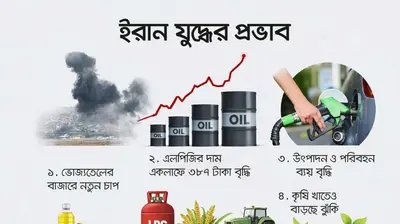
The country’s economy was already in a fragile state for various reasons. On top of that, the Iran war and the energy crisis have put additional pressure on the BNP government that assumed office in February.
To cope with this pressure, the government has requested another 5,000 crore taka on April 8. This borrowing will be raised from the banking sector through a special auction conducted by the central bank, using 91-day treasury bills.
According to the updated publication of “Major Economic Indicators” by the central bank, the government has had to increase borrowing to cover the revenue deficit, rising debt servicing costs, and higher import expenses.
According to data from the National Board of Revenue (NBR), in the first eight months of the current fiscal year, revenue collection fell short of the target by 71,472 crore taka. If this trend continues, the shortfall may exceed 1 lakh crore taka by the end of the fiscal year.
Professor Mahmud Osman Imam of the Economics Department at Dhaka University said that due to weak demand for private sector investment, banks are becoming more interested in lending to the government for assured returns. This will increase the government’s interest expenses.
“Through treasury bills and bonds, the government is borrowing. If it does not borrow from banks, it may have to print money. If demand rises in the future, the government might have to move in that direction.”
The lack of demand for private sector credit is evident from banks’ increased investment in treasury bills and bonds.
Banks are offering more than what the central bank is asking for. Recently, the central bank sought 3,500 crore taka through an auction, but banks offered 16,772 crore taka, five times the requirement.
The government borrowed against 91-day treasury bills at a cut-off yield of 9.78 percent.
Earlier, the central bank withdrew 11,500 crore taka through reverse repo, yet excess liquidity remains in the banking sector. This liquidity is being absorbed by government borrowing.
Mahmud Osman Imam said, “Due to the war, investment demand in the private sector is currently low. Without fuel, how will businesses expand? Another source of borrowing is the export sector, but it has shown negative growth over the past two months. That is why banks are willing to lend to the government.”
However, he warned that rising interest payments on debt will put additional pressure on fiscal discipline.
According to central bank data, private sector credit growth is currently around 6 percent. Banks may gradually increase interest rates on government borrowing.
He added, “If government interest expenses rise and people hold more cash, inflation may increase. Due to the fuel crisis, transportation of goods may decline. When goods cannot be transported, some traders may take advantage of the situation. Goods exist, but they are not accessible because they cannot reach the market.”
A large amount of cash also exists outside the banking system. According to the latest central bank data, the amount of money outside banks stood at 2,82,626 crore taka in January, up from 2,75,343 crore taka in December and 2,69,018 crore taka in November.
Zahid Hossain, former lead economist of the World Bank’s Dhaka office, warned about the government’s fiscal policy, saying the situation is reaching a point where traditional revenue calculations may no longer be effective.
He said, “On one hand, we are increasing expenditure through various projects. On the other hand, subsidies on fuel and fertilizer are rising. But revenue is not increasing. Yet the government says it wants to reduce dependence on borrowing. How will these three be balanced?”
Regarding whether increased government spending will burden the public, he said, “The answer depends on where the financing comes from and whether it will generate future income.
“Even if spending is financed through borrowing, the debt must be repaid. The key question is whether it will generate future income.”
He warned that increasing expenditure without increasing revenue will only lead to hardship.
Government borrowing demand usually rises in the last two months of the fiscal year, but the fact that it has increased a month earlier this time is concerning.
Zahid Hossain said, “If this continues, not only will the private sector face difficulties in making new investments, but it may also struggle to secure working capital.”