


The Nation Remembers Martyred Intellectuals with Deep Respect
Knowing that defeat was inevitable in 1971, the Pakistani forces, with the assistance of their collaborators, killed the nation’s brilliant sons—the martyred intellectuals—whom the nation is remembering today with deep respect.
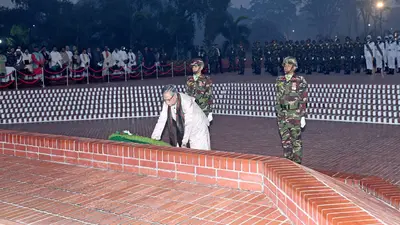
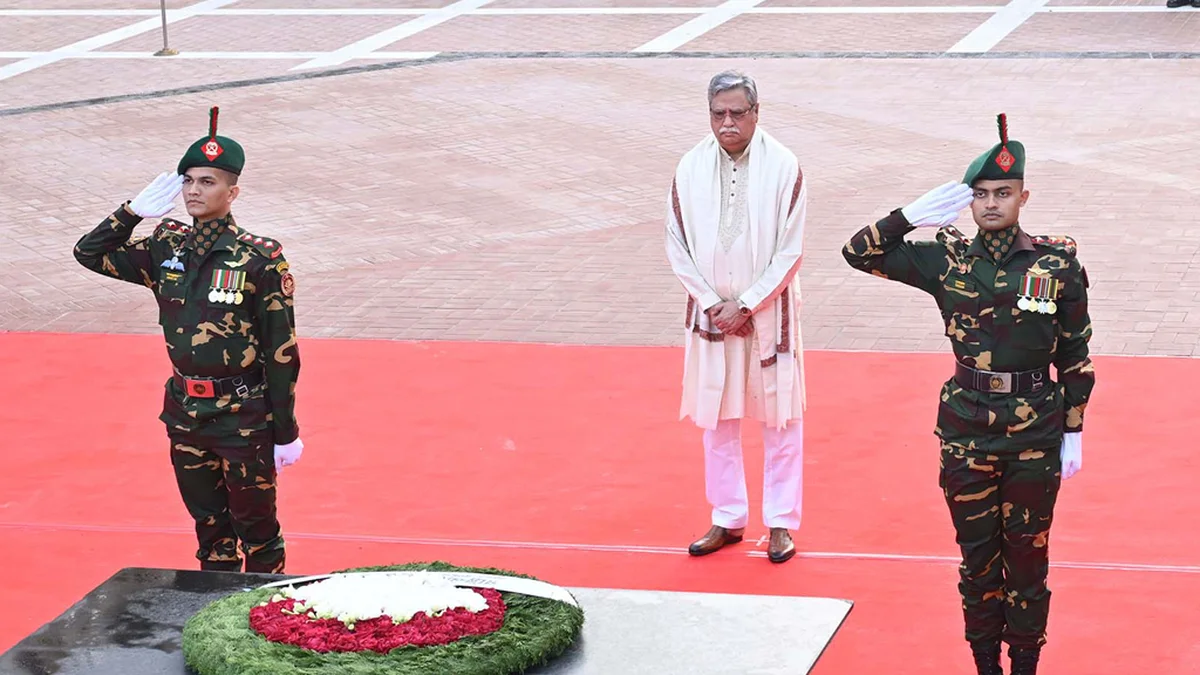
President Mohammed Shahabuddin and Chief Adviser Muhammad Yunus paid floral tributes at the Martyred Intellectuals Memorial in Mirpur on Sunday morning.
At 7:03 am, the President was the first to place a wreath at the memorial. Later, at 7:22 am, the Chief Adviser paid tribute by placing flowers.
After paying homage, the President and the Chief Adviser stood in silence for some time. During this period, a mournful tune was played on the bugle, and a smart contingent of the army rendered a guard of honour with arms.
Later, at the memorial premises, the Chief Adviser exchanged greetings with members of the families of the martyred intellectuals, war-wounded freedom fighters, the Chief Justice, and members of the Advisory Council.
From the night of March 25, 1971, throughout the entire period of the Liberation War, the Pakistani forces systematically killed intellectuals. However, the massacre took on a horrific form on the eve of victory. Local collaborators assisted them in these crimes.
In mid-December, when the victory of the Bengalis in the Liberation War became inevitable, the Pakistani forces, with the cooperation of the Razakars and the Al-Badr force, killed renowned intellectuals of Bangladesh, with the aim of crippling the country.
On December 14, 1971, the Pakistani occupying forces systematically murdered many eminent Bengalis, including university teachers, physicians, artists, writers, and journalists. Members of the Razakar, Al-Badr, and Al-Shams forces directly assisted in this massacre.
Later, the bodies of the nation’s finest sons, bearing marks of brutal torture, were found in the Mirpur and Rayerbazar areas, which later became known as killing fields.
In a message marking the day, President Mohammed Shahabuddin said, “Intellectuals are among the key architects of a nation’s development and progress. The intellectual builders of a nation contribute to the formation of a prosperous, knowledge-based society through the practice of free thought, creative activities, innovative capacity, and the development of democratic consciousness.
“For this reason, standing on the brink of defeat, the occupying forces carried out barbaric massacres across Dhaka and the entire country immediately before their surrender, with the vile objective of rendering the nation intellectually barren. They brutally abducted and killed many distinguished scholars, litterateurs, physicians, scientists, philosophers, engineers, lawyers, journalists, artists, political thinkers, and other eminent personalities of the country. Bangladesh continues to bear the wound of losing the nation’s finest sons at the dawn of independence.”