



Foreign Companies Granted Control of Laldia and Pangaon Ports Under Secret Contract Terms

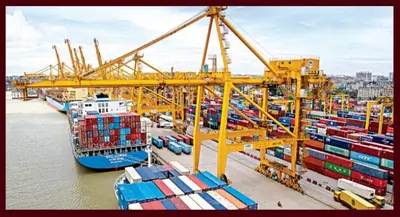
Nearly 60 percent of the future container-handling capacity of Chattogram Port has been handed over to foreign operators. Under the Public-Private Partnership (PPP) framework, two long-term agreements for operating two major terminals were signed yesterday, Monday, at the InterContinental Hotel in Dhaka—while keeping the terms of the agreements “confidential.”
A 33-year contract for the Laldia Terminal was signed with Denmark-owned APM Terminals, and a 22-year contract for the Pangaon Inland Container Terminal was signed with Switzerland’s Medlog SA. The Democratic Rights Committee, leftist alliances, and Islamist groups have raised questions about the process, especially because the procedure proposed by international consulting firm IFC for Laldia Terminal—meant to take 62 days—was completed in just two weeks.
It is known that APM Terminals submitted its proposal for constructing and operating the terminal at Laldia Char on 4 November. Technical evaluation was carried out on 5 November, and financial evaluation on 6 November. There are allegations that negotiations continued even on 7 and 8 November—both public holidays. After approval from the port board on 9 November, the Ministry of Shipping and the Ministry of Law approved the plan on 10–11 November.
Following this, the Advisory Committee on Economic Affairs made its recommendation on 12 November, and the final approval from the Chief Adviser was granted on 16 November, after which the Letter of Award was issued. Although two weeks are typically given after issuing the Letter of Award, the agreement was completed yesterday in less than a day.
Experts in port affairs say that if the terms of the contract fail to protect the country’s interests, Bangladesh may face major consequences later—citing the example of Djibouti in South Africa. If the plan proceeds as outlined, the four currently operational container terminals at Chattogram Port will also be run by foreign operators.
Of these, the Patenga Container Terminal has already been under the control of Saudi Arabia’s Red Sea Gateway Terminal since last year. New Mooring Container Terminal (NCT), currently operated by the Navy-controlled Dockyard, is set to be handed over to the UAE’s DP World by December. A portion of the Bay Terminal project is being allocated to DP World and another portion to Singapore’s PSA International. As a result, except for the General Cargo Berth (GCB) and Chittagong Container Terminal (CCT), most container-handling operations—about 60 percent—will fall under foreign control.
Political and religious organisations have strongly protested this process of handing over the port’s operations to foreign companies.
Amirul Haque, former director of FBCCI and chairman of the Seacom Group, has called for the publication of the full contract terms and expert review, citing the rights of the people. Former BGMEA first vice-president Nasir Uddin Chowdhury said that foreign operators are welcome if they improve efficiency and reduce costs, but not through a secretive deal.
Shaf Uddin Kabir Abid, coordinator of the Chattogram district unit of BASAD-Marxist, said that the chief adviser of the interim government has “rushed beyond his mandate” to lease out Chattogram Port to foreign companies. Through suspicious haste, irregularities, and secrecy, the Laldia Container Terminal has been leased to the Danish company APM for 48 years, he claimed. “Why must the deal be so secretive?” he asked. Professor Anu Muhammad, a member of the Democratic Rights Committee, called the haste “extreme betrayal” and said that prioritising port agreements over urgent issues like elections and law and order naturally creates suspicion.
Facing controversy, Bangladesh Investment Development Authority (BIDA) Executive Chairman Ashik Chowdhury defended the agreements. He clarified that the ownership of the port remains with Bangladesh; only construction and a fixed-term operation will be handled by foreign firms. He cited legal constraints and the risk of weakening the government’s negotiating position in future tenders as reasons for not disclosing the full contract.