

Extremist Influence, Foreign Pressure Threaten Bangladesh’s Democracy: Sajeeb Wazed Joy
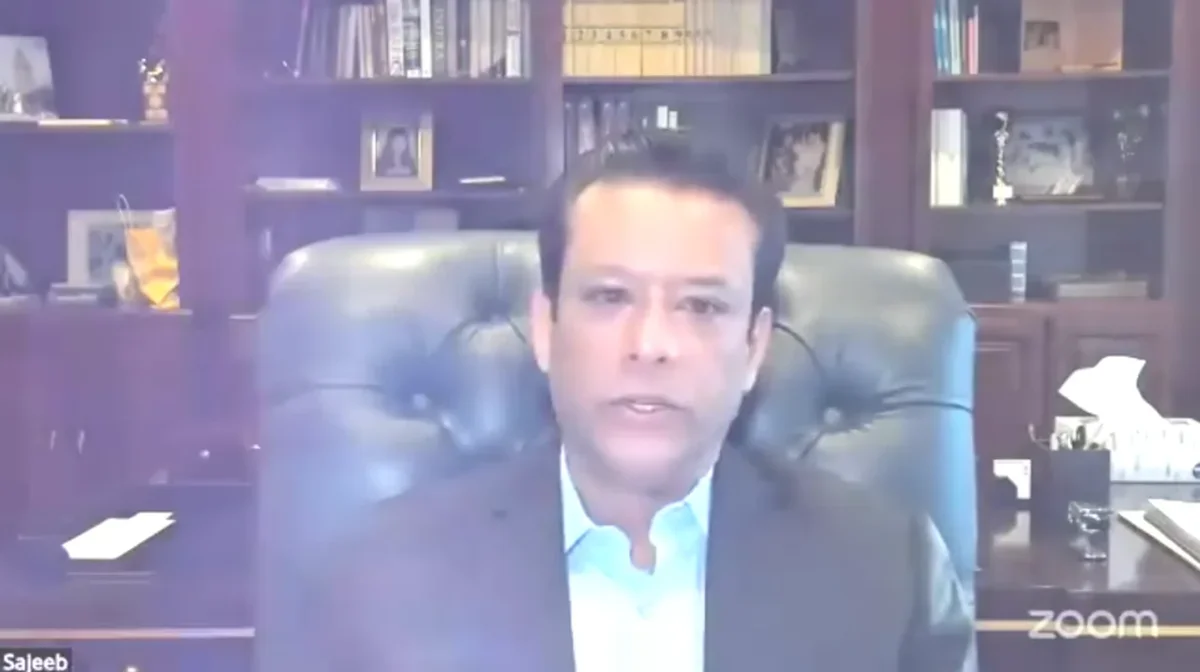
Expressing grave concern over Bangladesh’s current political reality, the election process, and the overall security situation, Sajeeb Wazed Joy son of Awami League President Sheikh Hasina and former ICT Adviser to the Prime Minister has stated that the country is now effectively under an “unelected and extremist Islamist-influenced regime” that is governing the state without any democratic mandate. He claimed that there is no environment for a free or fair election; rather, the upcoming election has turned into a “staged performance.”
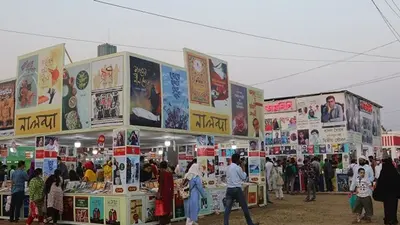
Joy made these remarks on Monday as the keynote speaker at the book launch event organized by the Kolkata-based cultural platform Khola Hawa, which focused on Bangladesh’s social and political situation. In his lengthy speech, he elaborated on the background of the movement, the role of the interim government, BNP–Jamaat politics, international influence, and various irregularities in the electoral process.
Quota Movement: ‘Communication Failure, Violence Fueled by Conspiracy’
Joy said that the demands of the students’ quota reform movement were not unreasonable. “The old quota system was dysfunctional. The Awami League government had abolished it long ago. However, following a case filed by a family of a freedom fighter, the court reinstated the quota,” he said.
According to him, the government’s biggest failure was its inability to clearly explain the matter to the public. “We failed to properly inform the people that this was a court decision. As a result, the movement grew based on misunderstandings,” Joy said.
However, he alleged that extremist groups, armed militants, and foreign intelligence agencies later infiltrated the movement and turned it violent. “Attacks on police stations and arson were initiated by armed groups. The government never wanted any deaths,” he said.
Death Toll and Accountability
While a United Nations report mentioned 1,400 deaths, Joy claimed that the figure also includes deaths that occurred when the Awami League was not in power.
“Many of those killed during the ten days after August 5 were police personnel and Awami League activists. Yet all responsibility has been placed on us,” he said.
He asserted that the Awami League government formed judicial inquiry commissions to investigate all killings and did not grant immunity to anyone. In contrast, he alleged that the current government has issued ordinances granting immunity to those involved in mob justice.
Harsh Criticism of the Interim Government
Labeling the interim government as “mandate-less,” Joy said that upon assuming power, it “released convicted militants.” He alleged the release of individuals convicted in cases such as the Holey Artisan attack, blogger killings, and attacks on diplomatic officials.
According to him, the government survives on the support of extremist Islamist groups. “They are directly using mobs. Judges, journalists, opposition voices—anyone who speaks out faces house encirclement, attacks, and vandalism,” he said.
He also mentioned attacks and arson incidents at television channels and newspaper offices, blaming government inaction.
Concerns Over the Election
Calling the upcoming election “one-sided,” Joy said that effectively all progressive parties, including the Awami League, have been cornered. “It has become a two-horse race—BNP and Jamaat. Other parties are being suppressed,” he said.
He claimed that a de facto ban has been imposed on the Awami League. “Party offices have been attacked, leaders and activists arrested, and campaigning halted. The Awami League has been banned. Progressive parties have been suppressed. The Jatiya Party’s offices have been burned, and its leaders jailed,” he said.
According to him, “This is not a competitive election; it is a display of a predetermined outcome.”
Postal Voting and Allegations of Manipulation
Questioning the decision to introduce postal voting for the first time, Joy said, “In Bangladesh, verifying this is nearly impossible. Videos have surfaced showing thousands of ballots being opened together and pre-stamped in favor of Jamaat.”
He added, “If rigging happens on election day, it can be detected. But with postal voting, there is no monitoring.”
BNP, the United States, and the Referendum Issue
Targeting BNP, Joy said the party is now under foreign influence. He alleged that despite the United States possessing evidence of corruption against Tarique Rahman, no legal action has been taken for political reasons.
“The United States can pressure him at any time. As a result, a future BNP government would be weak and controlled,” he said.
Regarding the referendum, he said, “There is no provision for a referendum in the constitution. The court has declared it unconstitutional. Yet the government is proceeding with it. BNP had previously opposed it but has suddenly expressed support.”
According to him, foreign powers aim to create a weak coalition government.
Warning on Jamaat
Joy described the rise of Jamaat-e-Islami as a major threat to Bangladesh’s future. He said that historically, Jamaat’s vote base has never exceeded 5–10 percent, but by banning the Awami League, they are being artificially strengthened.
“Jamaat’s objective is to establish a Sharia-based state. There is no such thing as a ‘moderate Islamist,’” he said.
Minority Rights and Regional Security
Joy claimed that minorities were safest during the Awami League’s 17 years in power and that militancy was firmly suppressed. He expressed concern that minorities and liberals would be at risk under the current situation.
He also warned about India’s security, stating, “The rise of Islamist forces in Bangladesh could pose a threat to India’s eastern border as well.”
Appeal to the International Community
In the concluding part of his speech, Joy urged the international community to declare in advance that the upcoming election would not be free or fair. “If people do not vote for the Awami League, that is not a problem. But holding an election without allowing participation is not democracy,” he said.
In his words, “This is the last moment to speak out. Otherwise, Bangladesh will fall into deep uncertainty for the next five to ten years.”