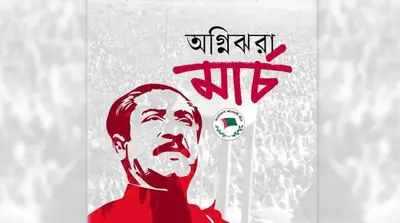

Historic March 7 Speech That Led Bangladesh Toward Independence
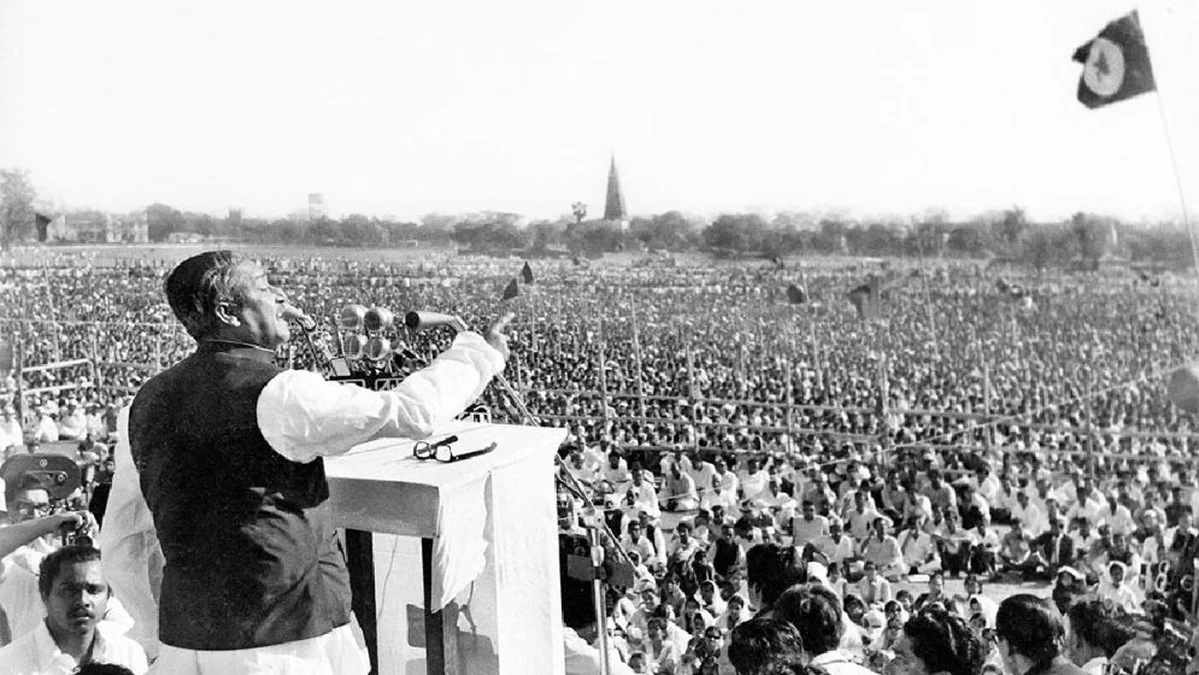
Historic March 7 is being observed today. On March 7, 1971, not only Pakistan but the whole world had its eyes on the Racecourse Ground in Dhaka. Embassies of major countries became busy. Reports about the situation in Dhaka were being sent to Washington, D.C. and Islamabad. The same question was on everyone’s lips: would Sheikh Mujibur Rahman declare independence today?
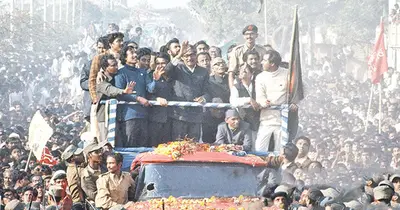
On that day, Dhaka was a city of processions. People from different parts of the country gathered at the Racecourse Ground in groups, arriving on foot, by bus, launch, and train. In the hands of Bengalis were placards of freedom, and slogans echoed everywhere “Brave Bengalis, take up arms, make Bangladesh independent.” The Racecourse Ground turned into a sea of people.
At 3:20 pm that afternoon, wearing a white pajama-panjabi and a sleeveless black coat, Sheikh Mujibur Rahman walked confidently onto the stage. Standing before the microphone, he waved to the waiting crowd amid thunderous slogans and continuous applause. Then he began his historic speech.
In every sentence and every word that day, he inspired the oppressed nation. Although there is no exact statistic of how many people gathered at the Racecourse Ground, eyewitnesses say it was the united uprising of the Bengali nation.
Many women also came carrying bamboo sticks, and some even brought bows and arrows. One placard read: “Mothers and sisters, take up arms.” It was a kind of preparation for war.
After this speech, the entire country changed.
All arrangements had been made by the authorities of Bangladesh Betar to broadcast Bangabandhu’s speech live from the Racecourse Ground. The broadcast had also started. However, when the military authorities stopped the transmission, all the Bengali employees of the radio station left the radio building. All broadcasting activities were suspended. Rumors spread outside Dhaka as well. Later at night, the military authorities were forced to allow the full speech of Bangabandhu to be broadcast.
Inspired by Bangabandhu’s speech that day, the Bengali nation plunged into the Liberation War. Later, after the brutal massacre carried out by Pakistani forces on the night of March 25, Bangabandhu declared the country’s independence in the early hours of March 26. The armed Liberation War officially began. After nine months of war, through the sacrifice of three million martyrs and the dishonor of two hundred and fifty thousand mothers and sisters, and through the extraordinary struggle of the nation, final victory was achieved on December 16. Thus emerged Bangladesh as an independent and sovereign state.
On October 30, 2017, the UNESCO recognized the speech as part of the “Memory of the World” documentary heritage. Through this recognition, its historic significance received international acknowledgment. Earlier, in a survey conducted by BBC, Bangabandhu’s March 7 speech was ranked among the greatest speeches of all time. The speech has also been translated into many languages of the world. It therefore remains an eternal flame of inspiration for the Bengali nation, continuing to provide endless strength and courage.