




Uncertainty Persists Over Implementation of July National Charter, Say Political Groups
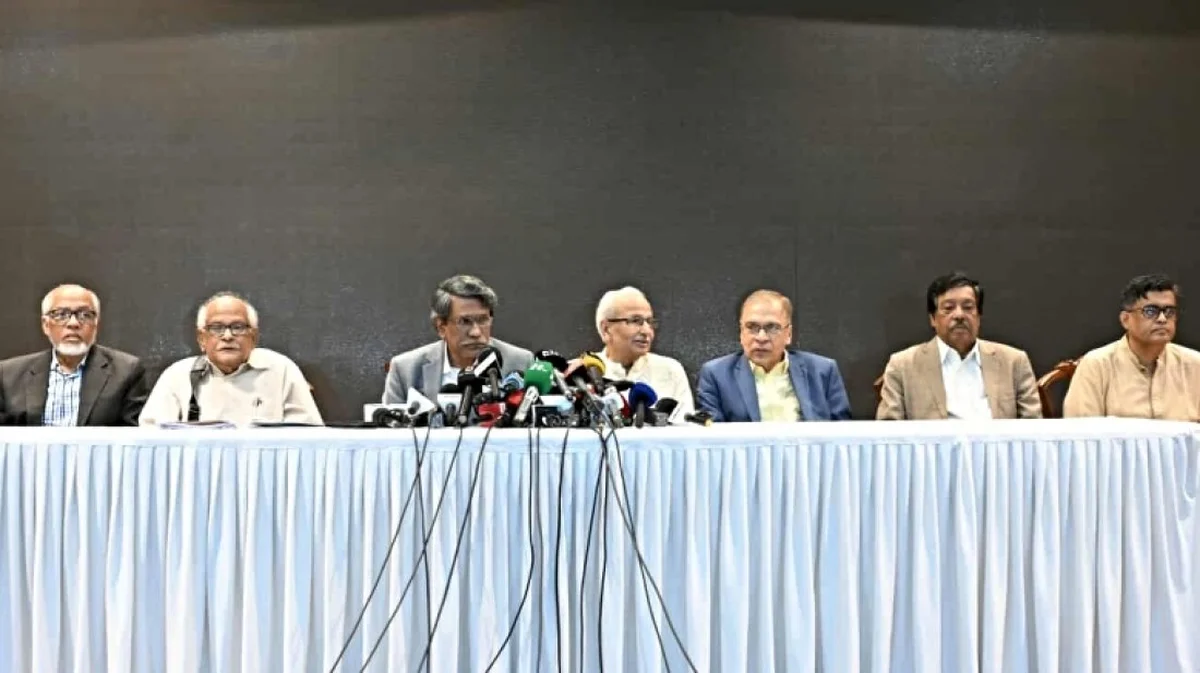
The National Consensus Commission has submitted its set of recommendations on implementing the July National Charter to the chief adviser, but questions remain about how the proposals will be put into effect.
In its report, the commission suggested the formation of a new body called the “Constitutional Reform Council.”
According to the proposal, the next parliament would function both as a regular legislature and as the Constitutional Reform Council for the first 270 days (nine months). If the council fails to implement the constitutional reform proposals within that period, the proposals would automatically become law. This provision was not part of the original July Charter before it was signed.
Meanwhile, the Bangladesh Nationalist Party (BNP) and its allies had earlier proposed holding a referendum on the day of the national election, but the commission recommended that it could be held earlier. The “note of dissent” clause has also been dropped.
On the other hand, Bangladesh Jamaat-e-Islami and the National Citizens Party (NCP) have maintained their stance that the referendum should not coincide with the election day. They argue that the referendum should be held in November to give the charter a proper legal foundation.
Leaders from both parties believe that if the election and referendum are held simultaneously, the referendum could lose its significance.
Four leftist parties, including the NCP, have still not signed the charter. This persistent division among political groups has raised doubts about whether the July Charter can be implemented at all.
Saiful Haque, general secretary of the Revolutionary Workers Party of Bangladesh, said:
“Some of us supported the idea of forming a Constitutional Reform Council with constitutional authority. However, the proposal that reforms would automatically become law if not implemented within 270 days is unprecedented anywhere in the world. It would have been better to leave this matter to the next parliament, and the timeframe should have been six months instead of nine.”
He added that while most parties supported holding a referendum on election day, the commission’s suggestion to hold it earlier was confusing. However, he welcomed the decision to drop the note of dissent.
BNP Standing Committee member Salahuddin Ahmed also reacted to the development on Tuesday (October 28).
Speaking to reporters after a meeting with the law adviser following the commission’s submission of recommendations to the chief adviser, he said:
“The commission’s proposal has created division instead of unity. The formation of a Constitutional Reform Council was not part of the original charter, and the note of dissent has been removed. The commission’s role has become questionable.”
What’s in the Implementation Proposal?
The National Consensus Commission made several proposals on how to implement the July National Charter, outlining three main processes.
The first proposal states that the interim government will present a comprehensive constitutional amendment bill based on the July Charter to a referendum. If approved by referendum, the bill will serve as a guide for the Constitutional Reform Council, and if the council fails to act within 270 days, the bill will automatically be incorporated into the constitution.
The second proposal suggests that the government issue the “July National Charter (Constitutional Reform) Implementation Order 2025” to operationalize the amendments.
The reforms mentioned in the order and its annex would be presented for referendum. After the order is issued, a Constitutional Reform Council comprising elected members of the next parliament would be formed with structural powers to carry out the amendments.
Another proposal says that, alongside forming the next parliament, a Constitutional Reform Council should also be established simultaneously.
The council would be responsible for completing the reforms within 270 days, after which its activities would end.
Mahmudur Rahman Manna, president of Nagorik Oikya, said:
“Politicians initially had little understanding of the July Charter, yet we all took part in the process. The commission’s recommendations are fine, but the proposed order has no constitutional basis. The matter should be left to the next parliament.”
Jamaat and NCP See No Uncertainty
A.H.M. Hamidur Rahman Azad, assistant secretary general of Bangladesh Jamaat-e-Islami, said the commission’s recommendations mark a positive step toward implementing the charter.
“The commission’s three-phase recommendation for implementation is a good direction,” he said.
He supported granting structural powers to the Constitutional Reform Council but reiterated that his party prefers the referendum to be held in November, not on election day.
“Holding a referendum alongside the national election would be unacceptable, as election campaigns would overshadow its importance,” he said, adding that the charter would eventually be implemented through any of the proposed processes.
Ariful Islam Adib, senior joint convener of the NCP, said:
“We generally welcome the commission’s recommendations, especially the removal of the note of dissent, the implementation order under the mandate of the mass uprising, and holding a yes/no referendum on the entire charter. However, the referendum should take place before the national election to make implementation smoother.”
Left Parties Call It a “Futile Exercise”
Four leftist parties — Communist Party of Bangladesh (CPB), Bangladesh Samajtantrik Dal (BSD), BSD (Marxist), and Jatiya Samajtantrik Dal (JASAD) — did not sign the July Charter during the October 17 signing ceremony over disagreements regarding the four fundamental principles of the constitution.
They have now termed the commission’s October 28 recommendations to the chief adviser as one-sided, accusing the body of breaking its promises.
Abdullah Kafi Ratan, general secretary of the CPB, said:
“The commission’s nine months of work have turned into a futile exercise. They have always prioritized their own agenda. The so-called constitutional order they proposed will not hold up in court because such an order cannot exist while a constitution is already in place.”
He added:
“If the council fails to complete its task within the timeframe, it should be dissolved. Also, excluding unresolved issues from the charter was a mistake. Signing or not signing the charter now makes little difference.”
Masud Rana, coordinator of the BSD (Marxist), said:
“We have always advocated for keeping the notes of dissent. The commission has now quietly dropped them. The proposal that reforms would automatically become law if not completed within 270 days is absurd. In this context, a referendum is meaningless.”