


Sheikh Hasina Slams Her War Crimes Trial, Says Bangladesh Election ‘Cannot Be Credible’ Without Awami League
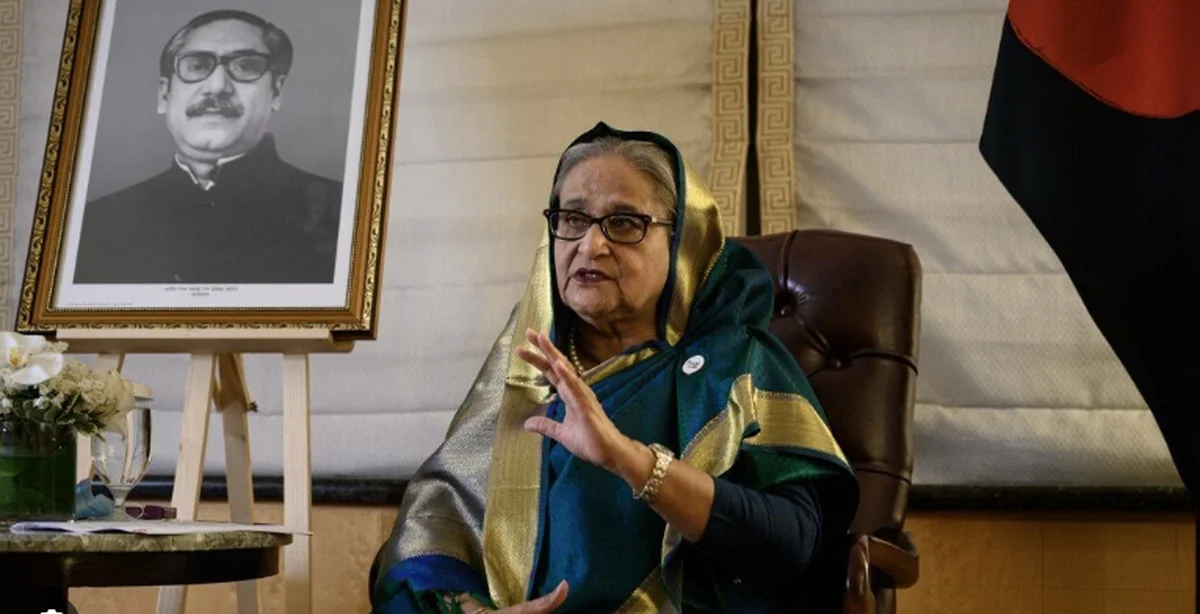
Ex-Prime Minister of Bangladesh, Sheikh Hasina, says that upcoming elections risk deepening the country’s political divide. In written responses to AFP—her first interview since being toppled—she condemned her trial for crimes against humanity as a “jurisprudential joke,” insisting a guilty verdict was “preordained.”
Following a student-led uprising in August 2024 that ended her 15-year rule, Sheikh Hasina fled by helicopter as crowds stormed her palace. The United Nations reports that up to 1,400 people were killed in crackdowns during her attempt to stay in power. The deaths are central to her trial. She remains in hiding, hosted by her longtime ally India, but remains defiant.
She said she “mourned all the lives lost during the terrible days” when students were gunned down in the streets. She warned that the ban imposed by the interim government of Muhammad Yunus on her party, the Awami League, is deepening a political crisis in a country of 170 million people ahead of elections slated for February 2026.
“Elections without the direct participation of all major parties, including the Awami League, cannot be credible,” she said. She added that by excluding her party, “he is sowing the seeds of future division in the country.” Her message: “Yunus must reinstate the Awami League to give Bangladeshis the choice they deserve.”
Rights groups have long accused her government of a string of abuses—including extrajudicial killings of rivals, suppression of opposition parties, manipulated courts and one-sided elections. The interim government banned her party in May under changes to the anti-terrorism act—a move condemned by Human Rights Watch as “draconian”.
Sheikh Hasina said: “Free and fair elections require genuine competition, the ability of all parties to campaign, and the electorate’s right to choose between alternatives. Elections are a competition of ideas. You cannot ostracise a party because you don’t like their policies.”
Her rivals, long repressed under her rule, are now making a comeback. The Bangladesh Nationalist Party (BNP) is seen as the front-runner, while Jamaat‑e‑Islami—the country’s largest Islamist party—is gaining in popularity. Sheikh Hasina, meanwhile, has ignored court orders to appear for her trial, in which she is accused of command responsibility for the deadly crackdown. The chief prosecutor, Tajul Islam, has described her as “the nucleus around whom all the crimes were committed” and is seeking the death penalty if she’s found guilty.
“The charges themselves are rejected in full and are not supported by any evidence,” Sheikh Hasina. “It has been appointed by an unelected administration consisting of my political opponents to try me in absentia for capital crimes.” A verdict is scheduled for November 13. “A guilty verdict is pre-ordained, sadly, and I will not be surprised when it comes,” she said.
On allegations she personally ordered security forces to open fire on crowds, she stated, “The charge that I personally directed security forces to open fire on crowds is bogus,” although she admitted “some mistakes were certainly made within the chain of command.” She argued that senior government officials’ decisions were “proportionate in nature, made in good faith and intended to minimise the loss of life.”
The prosecution, however, has played audio tapes verified by police suggesting she directly ordered her security forces to “use lethal weapons” against protesters. Hasina claimed the recordings were “taken out of context”.
She also pointed to a crackdown on her loyalists since her fall—citing, for example, February’s “Operation Devil Hunt”, during which security forces arrested thousands accused of “destabilising” the country. She gave no public information about hundreds or perhaps thousands of missing persons reportedly taken into secret detention centres under her rule. Earlier this month, lawyers for the Awami League asked the International Criminal Court to investigate alleged “retaliatory violence”—including beatings and lynchings—which senior British barrister Steven Powles KC said had “no realistic prospect” of being prosecuted in Bangladesh.
Asked whether she plans a return to politics, Sheikh Hasina replied: “My priority is the welfare and stability of Bangladesh.”
Source: AFP