
A Cry of a Female Worker from Saudi Arabia
They Are Taking Me Away, They Will Kill Me- Please Save Me
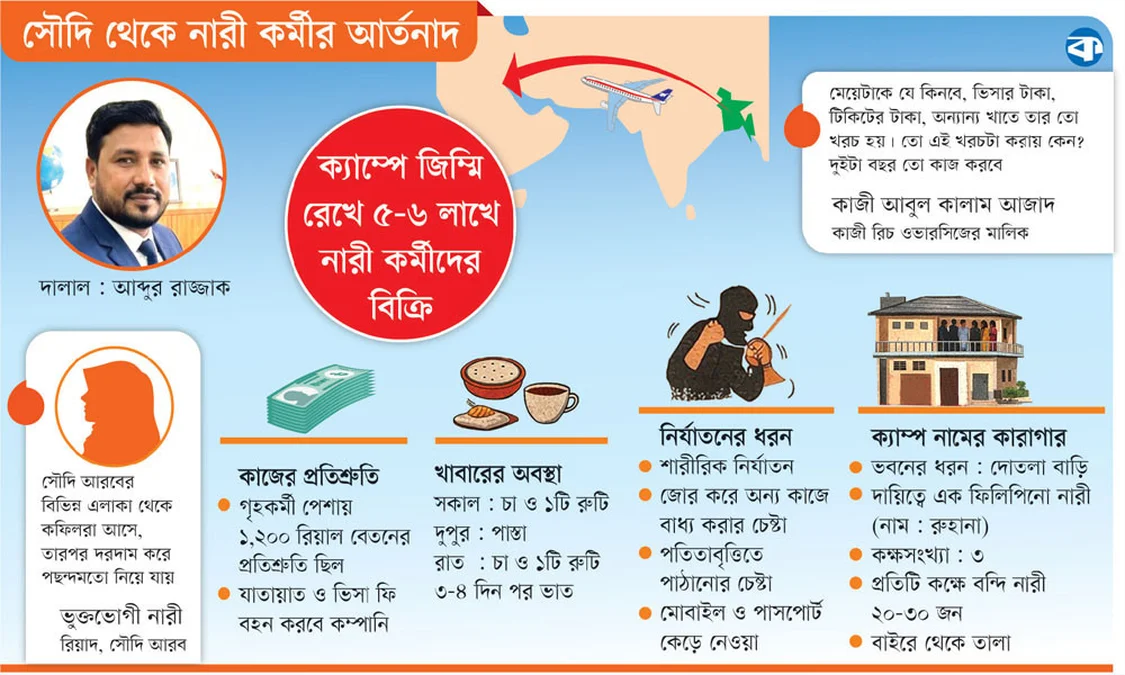
At least 20 women are packed inside a locked room on the second floor of a building in Riyadh, the capital of Saudi Arabia. None of them have passports or mobile phones. Those have been taken away. A lock hangs on the door outside. Days are passing in hunger and fear.
One of the “captives” is a 22-year-old young woman from Naogaon (her name is not disclosed for safety reasons). Two months ago, hoping to bring a little happiness to her poor family, she went to distant Saudi Arabia as a domestic worker under the G2G agreement. But after arriving there, she ended up in a dark prison-like place called a “camp”.
She was working as a housemaid in a house in Riyadh. After being subjected to cruelty, she pleaded with the broker to send her back home. As a result, she was placed in the local agency’s camp.
After receiving the news, we contacted the young woman through Imo on the evening of February 25.
At that time, she had been sent from the camp to work at another sponsor’s house. From there she spoke to us. One by one she told the painful stories of the women imprisoned in the camp. According to this expatriate woman, it is a two-storey house. On the ground floor lives a Filipino woman named Ruhana.
There are three rooms on the second floor. In each room 20 to 30 women are kept crowded together. Essential belongings are taken away and the door is locked from the outside by the broker’s people. There is also severe food shortage. The regular food in the morning and at night is one cup of tea with a piece of bread. Lunch is pasta. Rice is given only once every three to four days.
Clue from a note: We were basically investigating the conditions of Bangladeshi women working as domestic workers in various Middle Eastern countries. During this time, we received information about this tortured young woman from Naogaon. Hearing that another young woman from Habiganj who had been tortured in Saudi Arabia would return home at 6 pm on February 24, we took position at Hazrat Shahjalal International Airport in Dhaka about two hours earlier.
Time kept passing. Evening turned into night. But the plane carrying the expatriate woman did not arrive. We found no match between the broker’s words and actions. The night passed and dawn arrived. After various tricks and drama by the brokers, the flight of Jazeera Airways (No. J9-533) finally landed at 6 am. The flight came to Dhaka from Riyadh via Kuwait.
As soon as she came out through Exit Gate No. 2 of the airport, we met the young woman from Habiganj. While describing the inhuman torture she faced, she burst into tears. At one point she handed us a small note. The note had been sent by the young woman from Naogaon. It contained her mother’s mobile number and the number she uses on Imo in Saudi Arabia.
Using the number written on the note, we went to Naogaon. Their house is in Uttarpara village of Madhyodurgapur under Sadar Upazila. Seeing the journalists, the young woman’s mother burst into tears. She said that she sent her daughter abroad hoping for a better life in their poor household, but now she lives in tears.
She said they agreed to send their daughter abroad after being tempted by a local broker named Razzak. The mother told Kaler Kantho, “Razzak said no money would be needed, only a passport for my daughter. The company would bear all other expenses. So we agreed.”
She added, “Two days after arriving in Saudi Arabia, my daughter called on Imo crying. She said the people in the house where she worked were making various indecent proposals to her. When she refused, they beat her and did not give her proper food.”
Later, on February 25 at 9:30 pm, we contacted the victim through the Imo number written on the note. The young woman described what was happening to her: “In the first house where I worked as a maid, the sponsor started giving me indecent proposals from the beginning. When I refused, he beat me badly. When I informed the broker, the sponsor took me somewhere outside the house.”
A prison called camp: The young woman continued, “The car drove for about 15 minutes. Then they reached a two-storey house. I was handed over to a foreign woman. She took me to the second floor. When she opened the lock of a room, I saw many women already held hostage inside. I was kept there.”
She said, “Some people call the house an office, some call it a camp. From here we are sold to different people. The brokers in Bangladesh already know this. Only we did not know.”
Although it is called a camp or office, according to her description it is like a dark prison. On the upper floor of a two-storey house in Riyadh city there is a camp with three rooms where at least 20 to 30 women are kept hostage in each room. Their mobile phones and passports are taken away, so they cannot communicate with anyone outside.
About 20 women were kept in the same room with her. Most of them were Bangladeshi. She does not know clearly who were in the other rooms, but from hearing conversations she believes there were several Bangladeshi women there too.
According to her, the buying and selling of women takes place there. Saudi sponsors come from different parts of the country and choose women after bargaining. She said, “We were brought here saying we would work as housemaids, but we are sent to brothels. There are women who go there and never contact their families again.”
The expatriate woman told Kaler Kantho, “I came to Saudi Arabia on January 17. They brought me saying one type of work, but after coming here they give another type of work. Before this I was sent to two houses, but the male members there made indecent proposals, so I left. When I tried to contact the agency in Bangladesh through which I came, they did not answer my calls. Even when they answered, they abused me.”
After facing such horrific abuse, the woman kept pleading to return home. At that point the broker’s real face became clear. Broker Razzak told her clearly that she would have to pay two lakh taka to return home.
Broker’s office in Paltan: To investigate the incident, on March 1 we visited the office of broker Razzak at Daily Bangla intersection in Dhaka in disguise. As planned earlier, we went to the office of MashaAllah Overseas, where Razzak works. The young woman had been sent to Saudi Arabia through this agency in early January.
Pretending to be the victim’s brother, we waited there. After some dramatic moments we met broker Razzak Hossain. The young woman’s aunt was also present.
The family had complained earlier, but the agency ignored the complaints and threatened them. As usual, the father again asked to bring back his abused daughter. At that moment Razzak angrily said money would be needed to bring her back.
When we asked why they were reluctant to bring her back despite knowing she was being abused, Razzak said, “All these torture stories are acting. She just does not like staying there and wants to return. I have been in this business for 35 years. I have seen many like this.”
Later he changed his statement and said he had not been informed earlier that the girl was abused.
In front of us he demanded 125,000 taka to bring her back. When the father said he could not afford that much, Razzak said, “We spent a lot of money to send your daughter. If she leaves work, we will have to pay from our own pocket.”
He denied allegations of beating her in the Saudi office.
Several audio recordings of conversations between the victim and the broker are in possession of Kaler Kantho, and the newspaper verified their authenticity.
In those recordings, despite hearing about the torture, Razzak becomes angry at the victim and again demands money to bring her back.
While talking with the victim’s father, Razzak also said, “There is a contract between registered recruiting agencies in Saudi Arabia and them. Basically Saudi sponsors buy women from those agencies. Some buy for five lakh taka, some for four lakh. If someone we send works for three months, we get a share of that money.”
Under pressure he promised to take legal action to bring the woman back. But the next night he changed his stance again. He called the woman’s mother and pressured her to send money quickly, even threatening to send the girl elsewhere if the money was not sent. An audio recording of that call is also available.
The woman’s last message pleading for rescue: Last Monday at 9:30 pm the young woman sent us an urgent video message on Imo. In the 36-second video she spoke very quickly: “Assalamu Alaikum. They are taking me from here to the office. Maybe the Bangladesh office told them. I don’t know what they will do to me there. They might beat me. I have no idea. Maybe the Bangladesh office called them. Please do something as quickly as possible. Save me from here. Otherwise they will kill me. Please help me. Arrange for me to return to Bangladesh as soon as possible. This is my request.”
While recording the video she repeatedly looked around nervously, suggesting someone might have been nearby.
Assurance of rescue: When contacted yesterday, the Director General of the Wage Earners’ Welfare Board, Barrister Md. Golam Sarwar Bhuiyan, said the girl would be brought back to the country. He said, “We have instructed that she be taken quickly to our safe home in Riyadh. We will bring her back at our own expense.”
Earlier, on Monday night, we informed Reza-e-Rabbi, the head counsellor of the Labour Welfare Wing at the Bangladesh Embassy in Riyadh, via WhatsApp. We sent him the woman’s video message and documents. He promised quick action, but as of yesterday he had not confirmed any steps.
“Whoever buys the girl spends money”: When contacted last night, Kazi Abul Kalam Azad, owner of Kazi Rich Overseas, denied allegations of abuse. He said many girls simply want to return after going abroad.
He said, “There are costs for sending a girl abroad. The company that buys the girl spends money on visa, ticket and other expenses. Why would they spend that money? She should work for two years.”
He added, “Suppose you bring a maid to your house through a rental system for family help. Because of their culture they pay visa money and take them. Through licensed offices we complete the process, and we also receive some money.”
Minister promises action: Expatriates’ Welfare and Overseas Employment State Minister Nurul Haque Nur told Kaler Kantho last night, “I am not yet aware of this matter. If a written complaint is submitted, I will investigate and take necessary action.”
He added, “We have recently taken responsibility. There are several problems here. Many people are cheated by agencies and brokers. In the case of those registered with BMET we can help. For unregistered ones, sometimes legally there is little we can do.”
Source: Kaler Kantho