
Lowest Number of Female Candidates in a Decade and a Half
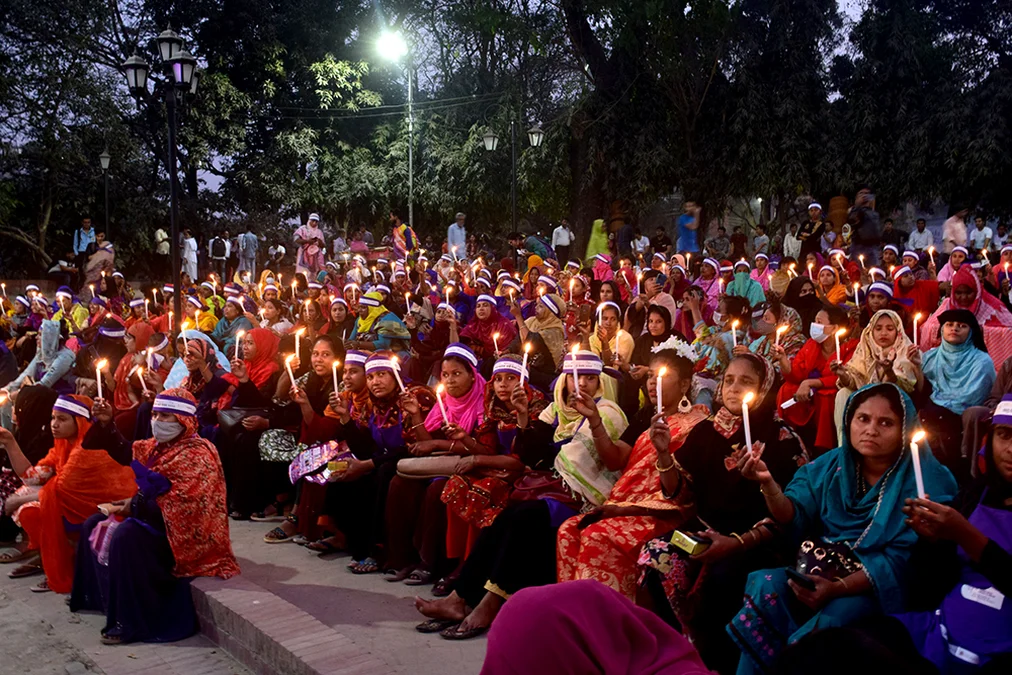
Among the 51 political parties contesting the 13th parliamentary election, 30 parties have not nominated a single female candidate. Even major parties such as Jamaat-e-Islami, which frequently chant slogans about women’s empowerment in meetings and seminars, have not nominated any female candidates. Overall, the proportion of female candidates in this election stands at just around three and a half percent. Although the 9th, 10th, 11th, and 12th parliamentary elections were not considered “participatory,” the proportional share of female candidates in those elections was higher than it is this time. This is despite the fact that the country has more than 62.8 million female voters.
Experts say that political parties are not prioritizing female nominations due to the recent rise in misogynistic rhetoric and the absence of any legal obligation. They warn that if this trend among political parties continues, it will harm the country’s democratic system in the long run.
According to the conditions for political party registration, parties are required to ensure a certain proportion of women in party positions, but there is no mention of women’s nominations for contesting elections. However, Clause 22(b)–(d) of the July National Charter 2025 states that every political party must ensure a minimum of 5 percent female candidates in this parliamentary election. It also sets a target to gradually increase this proportion to 33 percent in subsequent elections. Ironically, the parties that have been most vocal in demanding the implementation of the July Charter have the lowest number of female candidates.
After the scrutiny and withdrawal of nominations, a total of 1,991 candidates remain in the electoral race. Among them, only 65 are women.
According to data from the Election Commission, various non-governmental organizations, and the media, the highest number of female candidates 94 contested in the 2024 election, accounting for approximately 5.15 percent. In the 2018 election, there were 69 female candidates, comprising about 3.80 percent of the total. In the 10th parliamentary election in 2014, female candidates accounted for 5.55 percent.
Election Commission data show that the number of voters in the upcoming election is 127,711,793. Of them, 64,825,361 are male voters and 62,879,042 are female voters. There are also 1,234 third-gender voters. Despite nearly equal numbers of male and female voters, women face discrimination in candidacy.
Regarding political parties’ stance on nominating women, a member of the Election System Reform Commission, Dr. Mohammad Abdul Alim, said the number is truly disappointing. He stated that all the dialogue, advocacy, and participation in international forums regarding women’s empowerment in Bangladesh have become meaningless. In many countries around the world, political parties voluntarily create policies to empower women, but such practices do not exist in Bangladesh’s political parties.
He said that although there are legal provisions regarding women’s representation in party positions, there are none regarding candidacy. The July Charter includes a provision requiring 5 percent female nominations, but it has not yet been approved and may only be approved after a referendum.
He further said that political parties did not nominate women because they want to win at any cost. Parties consider which candidates have the highest chances of winning, and within Bangladesh’s socio-political culture, they assume women cannot win and also lack sufficient financial resources.
The July National Charter formulated by the National Consensus Commission states that each political party must nominate at least 5 percent women in this parliamentary election and gradually raise that proportion to 33 percent in future elections. However, since the July Charter has not yet been implemented, the provision is effectively inactive.
Political analyst and BASAD leader Rajekuzzaman Ratan said that considering gender at all in nominations is itself unjust. According to him, the most qualified individual should be nominated regardless of gender. He said that the five candidates nominated by his party are all important party members who have proven their competence by carrying out district-level responsibilities.
Analysts have expressed surprise at the very low number of female candidates nominated by the BNP, now the largest party following the banning of Awami League activities. After the death of Begum Khaleda Zia, the party has nominated only nine female candidates. The newly registered Bangladesh Socialist Party (BASAD–Marxist) also has nine female candidates, ranking second. This is the only party that has allocated one-third of its total nominations to women. Among other parties, the Jatiya Party (GM Quader) has nominated five women, Ganosamhati Andolon four, Amar Bangladesh (AB) Party three, and Gana Odhikar Parishad three women. However, since the AB Party is allied with Jamaat and Ganosamhati Andolon and Gana Odhikar Parishad are part of the BNP-led alliance, the likelihood of these women contesting the election until the end is low.
Women’s rights activist Dr. Fauzia Moslem said that the number of women nominated is extremely small possibly the lowest ever. She said this exposes the true mindset of political parties regardless of what they say publicly. Without women’s representation in parliament, she questioned who would raise women’s rights issues. She emphasized that the movement for women’s empowerment must continue.
Former head of the Women’s Affairs Reform Commission, Shirin Parveen Haque, described the low number of female candidates as disappointing but not surprising. She said the country’s political culture remains male-dominated, and even after the July uprising, there has been no significant change in political party mindsets.
She added that the lack of internal democracy within parties and the absence of women-friendly policies are the main reasons behind the low number of female candidates. Women were not involved in drafting the July Charter, and even reform commissions formed in the second phase including the Women’s Affairs Reform Commission were not invited for discussion. Although written requests were submitted, no response was received. A proposal to introduce directly elected reserved seats for women alongside general seats in every constituency was neither implemented nor discussed.
The first woman member of parliament in Bangladesh was elected in the third parliament in 1979. Five women were directly elected in 1986 and four in 1988. Data on the total number of female candidates in those elections are unavailable. According to records, 5 out of 39 candidates were elected in 1991, 8 out of 36 in June 1996, 6 out of 38 in 2001, 19 out of 59 in 2008, and 18 out of 29 in 2014. In the 10th parliament, five women were elected at different times through by-elections following their husbands’ deaths, seat resignations, and a seat vacated by the prime minister.
This year, among female candidates with valid nominations in 300 constituencies are BNP candidates Farzana Sharmeen (Natore-1), Israt Sultana Elen Bhutto (Jhalokathi-2), Sansila Zebrin (Sherpur-1), Afroza Khanam (Manikganj-3), Sanjida Islam (Dhaka-14), Shama Obaid Islam (Faridpur-2), Nayab Yusuf Ahmed (Faridpur-3), Nadira Akter (Madaripur-1), and Tahsina Rushdi (Sylhet-2).
From the National Citizen Party (NCP), candidates include Mahmuda Alam Mitu (Jhalokathi-1), Dilshana Parul (Dhaka-19), and Nabila Tasnid (Dhaka-20).