

‘Bangladesh on the Brink’ Unveiled at Queen Mary University of London
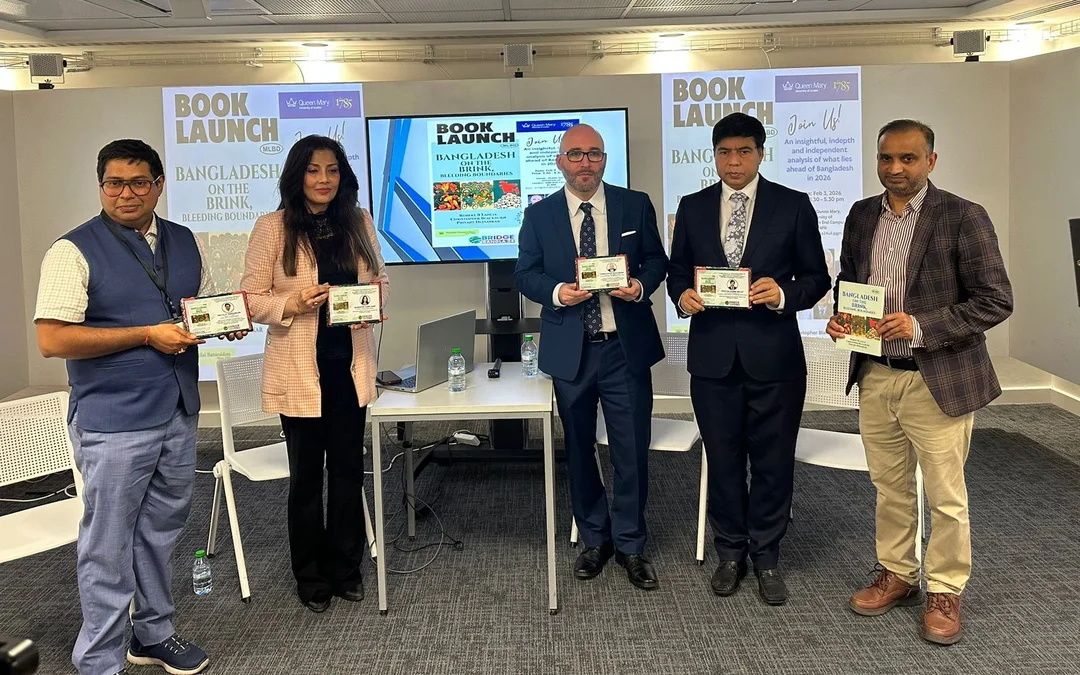
The book Bangladesh on the Brink was unveiled at a program held at the seminar hall of Queen Mary University of London in East London on Tuesday evening. The event took place at 7:00 pm (London time) and was organized by BridgeBangla24.
The program was moderated by BridgeBangla24 editor Shah Belal and was attended by a large number of expatriate Bangladeshis as well as representatives from various media outlets.
The book offers an independent, investigative, and critical analysis of Bangladesh’s political journey, covering developments from the Liberation War to the political changes and transfer of power following August 5, 2024. It examines the fall of an elected government and the emergence of a student–advisory governance structure led by Nobel laureate Dr. Muhammad Yunus.
The authors of Bangladesh on the Brink are Christopher Blackburn, Director of the Swiss–Bangladesh Strategic Forum; Robert Bob Lancia, a chaplain in the United States Navy and a representative from Washington State; and Priyojit Debsarkar, a London-based writer and geopolitical analyst.
According to the authors, Bangladesh is currently facing a fragile situation marked by the rise of fundamentalism, growing intolerance, and threats to democratic institutions—developments they say run counter to the country’s secular values.
Speaking at the discussion session following the book launch, former Member of the European Parliament and Director of the South Asia Development Forum, Paulo Casaca, said the book would serve as an important historical reference at a time when Bangladesh is passing through a critical phase.
Human rights activist and barrister Tania Amir expressed concern over violence against women, the rise of Jamaat-linked extremism, and the increasing spread of religious intolerance in Bangladesh.
Professor Dr. Habiul Millat of the Global Center for Democratic Governance–Canada warned that efforts were underway to turn Bangladesh into another Afghanistan, describing such attempts as a direct attack on Bengali identity, the Constitution, and the foundational principles of the state.
The event also featured the screening of a special documentary focusing on the current political situation in Bangladesh, the rise of extremist groups, and recent incidents of mob violence, which drew significant attention from the audience.